


E-auction 102-53631 - bpv_304904 - VESPASIANUS Tétradrachme syro-phénicien
Sie müssen angeschlossen sein und von cgb.fr genehmigt werden, um in einer E-Auktion teilzunehmen.Melden Sie sich an, um zu wetten..Die Kontobestätigungen sind innerhalb von 48 Stunden nach Ihrer Anmeldung gemacht.Warten Sie nicht bis die letzten zwei Tage vor dem Abschluss eines Verkaufs, um Ihre Registrierung abzuschließen. Klickend "BIETEN" verpflichten Sie sich vertraglich, diesen Artikel zu kaufen und Sie nehmen ohne Reserve die allgemeinen Verkaufsbedingungen für den e-auctions zu cgb.fr an.
Der Verkauf wird an der Zeit auf der Übersichtsseite angezeigt geschlossen werden. Angebote, die nach der Schließung Zeit empfangen sind, werden nicht gültig.
Bitte beachten Sie, dass die Fristen für die Einreichung Ihres Angebots auf unsere Server können variieren und es kann zur Ablehnung Ihres Angebots entstehen, wenn es in den letzten Sekunden des Verkaufs gesendet wird. Die Angebote sollen mit ganzer Zahl ausgeführt sein, Sie können Kommas oder des Punktes in Ihrem Angebot nicht erfassen. Bei Fragen klicken Sie hier, um einen Blick auf die FAQ E-Auktionen.
KEINE ANSCHAFFUNGSKOSTEN FÜR DIE KÄUFER.
KEINE ANSCHAFFUNGSKOSTEN FÜR DIE KÄUFER.
| Schätzung : | 175 € |
| Preis : | 64 € |
| Höchstgebot : | 64 € |
| Verkaufsende : | 30 März 2015 16:02:30 |
| Bieter : | 7 Bieter |
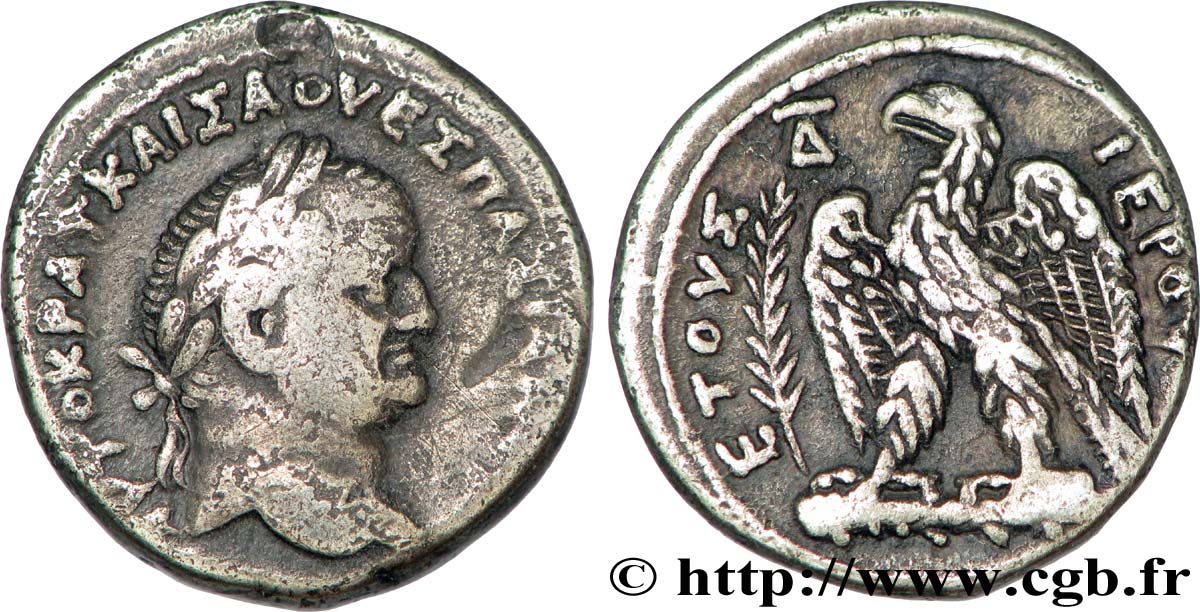
Type : Tétradrachme syro-phénicien
Datum: an 4
Name der Münzstätte / Stadt : Antioche, Syrie, Séleucie et Piérie
Metall : Silber
Durchmesser : 24 mm
Stempelstellung : 12 h.
Gewicht : 14,21 g.
Kommentare zum Erhaltungszustand:
Légère usure de circulation limitée à la mèche sous les lauriers au droit
N° im Nachschlagewerk :
Pedigree :
Cet exemplaire est le 0116_008 de la base TSP, c’est l’exemplaire qui illustre le type dans le Prieur
Vorderseite
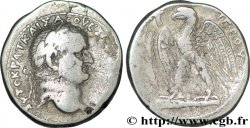
Beschreibung Vorderseite Tête laurée de Vespasien à droite (O*).
Legende des Averses AUTOKRAT KAISA OUESPASIANOU, (Autokratoros Kaisaros ouespasianou)
Übersetzung der Vorderseite (L'empereur césar Vespasien).
Rückseite
Beschreibung Rückseite Aigle debout à gauche sur une massue, les ailes déployées.
Legende des Reverses : ETOUS D IEROU (Etous d Ierou)
Übersetzung der Rückseite (quatrième année sainte).
Kommentare
Les monnaies du troisième groupe des frappes de Vespasien, caractérisées par un aigle à gauche sur une massue, sans couronne dans le bec, sont du style d’Alexandrie mais de la datation syrienne avec la lettre annuelle surmontée d’une barre. Les quantités frappées suivent les besoins : les frappes les plus massives sont celles de l’An 2, fin de la Guerre juive et elles se terminent en l’An 5 avec des quantités frappées décroissantes au fil des années.
Plusieurs graveurs participent à cette série où celui de notre exemplaire est très bien représenté. On doit remarquer que les pièces des groupes dits au style d’Alexandrie ont une caractéristique commune : l’aigle ne tient pas de couronne (groupes 1, 2 et 3) dans le bec. Ceci renforce l’idée que cette couronne était une distinction attribuée à la ville émettrice et que nous aurions affaire à un atelier militaire ou plus simplement à un atelier - quelque soit sa localisation - fourni en métal par le Trésor Militaire, sans lien organique avec une ville.
Dans la base TSP maintenue par Michel Prieur, soixante-cinq exemplaires sont maintenant répertoriés, dont en musées Paris (3), British, Hunterian, ANS, Fitzwilliam Museum Collection Mc Lean et Yale.
The coins of the third group of Vespasian's strikes, characterized by an eagle facing left on a club, without a crown in the beak, are of the Alexandrian style but of Syrian dating with the annual letter surmounted by a bar. The quantities minted follow the needs: the most massive mintings are those of Year 2, end of the Jewish War and they end in Year 5 with decreasing quantities minted over the years.
Several engravers participate in this series where that of our example is very well represented. It should be noted that the coins of the so-called Alexandrian style groups have a common characteristic: the eagle does not hold a crown (groups 1, 2 and 3) in its beak.. This reinforces the idea that this crown was a distinction awarded to the issuing city and that we would be dealing with a military workshop or more simply a workshop - whatever its location - supplied with metal by the Military Treasury, without an organic link with a city..
In the TSP database maintained by Michel Prieur, sixty-five examples are now listed, including in museums Paris (3), British, Hunterian, ANS, Fitzwilliam Museum Collection Mc Lean and Yale
Plusieurs graveurs participent à cette série où celui de notre exemplaire est très bien représenté. On doit remarquer que les pièces des groupes dits au style d’Alexandrie ont une caractéristique commune : l’aigle ne tient pas de couronne (groupes 1, 2 et 3) dans le bec. Ceci renforce l’idée que cette couronne était une distinction attribuée à la ville émettrice et que nous aurions affaire à un atelier militaire ou plus simplement à un atelier - quelque soit sa localisation - fourni en métal par le Trésor Militaire, sans lien organique avec une ville.
Dans la base TSP maintenue par Michel Prieur, soixante-cinq exemplaires sont maintenant répertoriés, dont en musées Paris (3), British, Hunterian, ANS, Fitzwilliam Museum Collection Mc Lean et Yale.
The coins of the third group of Vespasian's strikes, characterized by an eagle facing left on a club, without a crown in the beak, are of the Alexandrian style but of Syrian dating with the annual letter surmounted by a bar. The quantities minted follow the needs: the most massive mintings are those of Year 2, end of the Jewish War and they end in Year 5 with decreasing quantities minted over the years.
Several engravers participate in this series where that of our example is very well represented. It should be noted that the coins of the so-called Alexandrian style groups have a common characteristic: the eagle does not hold a crown (groups 1, 2 and 3) in its beak.. This reinforces the idea that this crown was a distinction awarded to the issuing city and that we would be dealing with a military workshop or more simply a workshop - whatever its location - supplied with metal by the Military Treasury, without an organic link with a city..
In the TSP database maintained by Michel Prieur, sixty-five examples are now listed, including in museums Paris (3), British, Hunterian, ANS, Fitzwilliam Museum Collection Mc Lean and Yale
Historischer Hintergrund
VESPASIANUS
(1.07.69-24.06.79)
Vespasien wurde am 17. November 9 in Flacrines, in der Nähe von Reate (im Sabinerland) geboren. Er gehört dem italienischen Stadtbürgertum an. Aedile im Jahr 38, Lender im Jahr 40, Konsul im Jahr 51, Prokonsul von Afrika im Jahr 63, er befehligte zusammen mit Claude die Expedition in die Bretagne. Nero vertraute ihm drei Legionen und ein prokonsularisches Imperium an, um den Aufstand in Judäa im Jahr 66 niederzuschlagen. Er wurde am 1. Juli 69 in Alexandria zum Augustus ernannt und seine Söhne Titus und Domitian wurden zum Cäsar befördert. Vitellius wurde am 20. Dezember 69 eliminiert. Titus war ab 71 durch seinen Vater direkt mit der Regierung verbunden. Seine Regierungszeit war der politischen und wirtschaftlichen Wiederherstellung Roms gewidmet. Im Jahr 73 übernahm er die Zensur. Er starb am 24. Juni 79 in Reate.
 Berichten über einen Fehler
 Die Seite drucken
 Teilen meiner Auswahl
 Stellen Sie eine Frage
 Einlieferung/Verkauf
In Verbindung stehende Artikel

 Details


Ihre zuletzt angesehenen Artikel
500 Francs type 1974 KAMERUN 1981 A.153d ST
18.00 €
VESPASIANUS Tétradrachme syro-phénicien fSS
115.00 €
PHILIPPUS II Tétradrachme syro-phénicien fSS
36.00 €
BOULANGERIE COOPERATIVE 5 Kg S
10.00 €
cgbfr.de numismatik


