


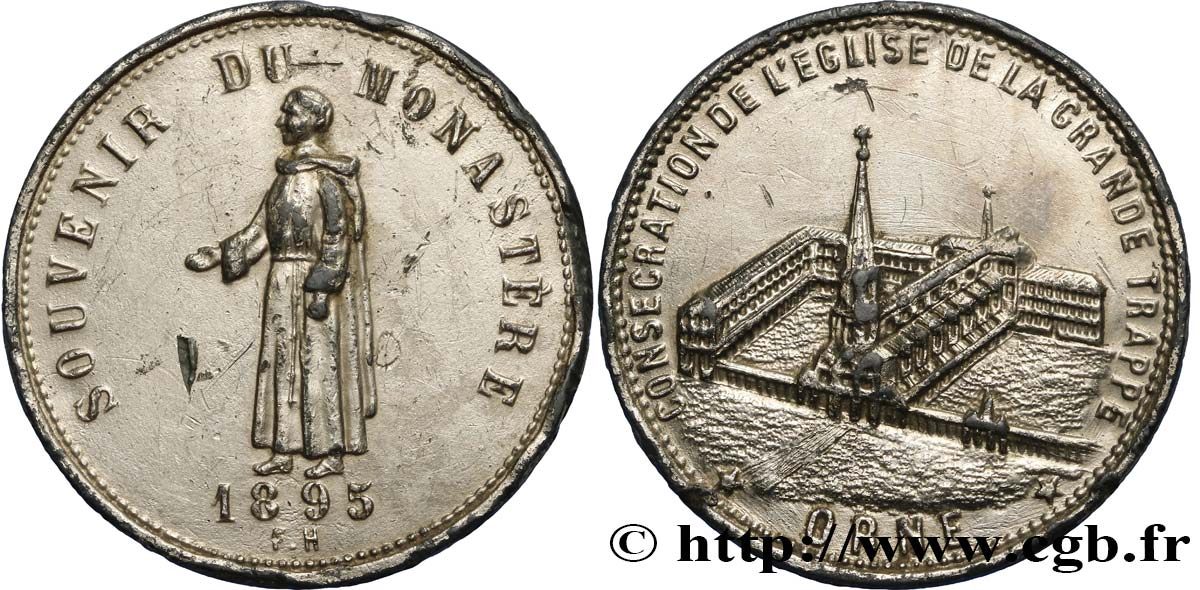
E-auction 327-243506 - fme_441823 - DRITTE FRANZOSISCHE REPUBLIK Médaille, Souvenir du monastère
Sie müssen angeschlossen sein und von cgb.fr genehmigt werden, um in einer E-Auktion teilzunehmen.Melden Sie sich an, um zu wetten..Die Kontobestätigungen sind innerhalb von 48 Stunden nach Ihrer Anmeldung gemacht.Warten Sie nicht bis die letzten zwei Tage vor dem Abschluss eines Verkaufs, um Ihre Registrierung abzuschließen. Klickend "BIETEN" verpflichten Sie sich vertraglich, diesen Artikel zu kaufen und Sie nehmen ohne Reserve die allgemeinen Verkaufsbedingungen für den e-auctions zu cgb.fr an.
Der Verkauf wird an der Zeit auf der Übersichtsseite angezeigt geschlossen werden. Angebote, die nach der Schließung Zeit empfangen sind, werden nicht gültig.
Bitte beachten Sie, dass die Fristen für die Einreichung Ihres Angebots auf unsere Server können variieren und es kann zur Ablehnung Ihres Angebots entstehen, wenn es in den letzten Sekunden des Verkaufs gesendet wird. Die Angebote sollen mit ganzer Zahl ausgeführt sein, Sie können Kommas oder des Punktes in Ihrem Angebot nicht erfassen. Bei Fragen klicken Sie hier, um einen Blick auf die FAQ E-Auktionen.
KEINE ANSCHAFFUNGSKOSTEN FÜR DIE KÄUFER.
KEINE ANSCHAFFUNGSKOSTEN FÜR DIE KÄUFER.
| Schätzung : | 60 € |
| Preis : | 13 € |
| Höchstgebot : | 13 € |
| Verkaufsende : | 22 Juli 2019 18:09:30 |
| Bieter : | 5 Bieter |
Type : Médaille, Souvenir du monastère
Datum: 1895
Name der Münzstätte / Stadt : 61 - Orne
Metall : Zinn
Durchmesser : 38 mm
Stempelstellung : 12 h.
Graveur F.H.
Gewicht : 18,58 g.
Rand lisse
Kommentare zum Erhaltungszustand:
Coups et rayures dans les champs. Traces de nettoyage
Vorderseite
Titulatur der Vorderseite SOUVENIR DU MONASTERE / 1895.
Beschreibung Vorderseite Moine debout à gauche faisant l’aumône.
Rückseite
Titulatur der Rückseite CONSÉCRATION DE L’ÉGLISE DE LA GRANDE TRAPPE.
Beschreibung Rückseite Vue du monastère de la Grande Trappe.
Kommentare
L'abbaye Notre-Dame de la Trappe (appelée jusqu'au début du XXe siècle la Grande-Trappe) est un monastère en activité, situé à Soligny-la-Trappe (Orne, France). Né au XIe siècle dans l'éphémère congrégation de Savigny, il rejoint comme son abbaye-mère l'ordre cistercien en 1147.
Alors que l'abbaye de la Trappe est confrontée, comme la plupart des établissements monastiques en général et cisterciens en particulier, à une baisse de la ferveur monastique aux XVIe et XVIIe siècles, elle est refondée suivant une lecture plus stricte de la règle en 1660. Cette réforme, initiée par l'abbé Armand Jean Le Bouthillier de Rancé, est dite originellement « de l'étroite observance », puis « de la stricte observance », mais plus communément appelée « trappiste » en hommage à l'abbaye qui lui a donné naissance.
Fermée comme tous les autres établissements monastiques à la Révolution française, la Trappe voit partir en exil l'abbé Augustin de Lestrange avec quelques moines ; ce sont eux qui, revenant en 1814, fondent à nouveau l'ordre cistercien de la stricte observance à la Trappe, d'où il rayonne dans le monde entier. En 1898, avec la restauration de Cîteaux, abbaye originelle de l'ordre cistercien, l'abbaye de la Trappe cesse d'être la tête de l'ordre auquel elle a donné son nom..
The Abbey of Notre-Dame de la Trappe (called until the beginning of the 20th century the Grande-Trappe) is a working monastery, located in Soligny-la-Trappe (Orne, France). Born in the 11th century in the short-lived congregation of Savigny, it joined the Cistercian order like its mother abbey in 1147..
While the Abbey of La Trappe was faced, like most monastic establishments in general and Cistercian ones in particular, with a decline in monastic fervor in the 16th and 17th centuries, it was refounded following a stricter reading of the rule in 1660.. This reform, initiated by Abbot Armand Jean Le Bouthillier de Rancé, was originally called \\\"of the narrow observance\\\", then \\\"of the strict observance\\\", but more commonly called \\\"Trappist\\\" in homage to the abbey which gave birth to it..
Closed like all other monastic establishments during the French Revolution, La Trappe saw Abbot Augustin de Lestrange leave for exile with a few monks; it was they who, returning in 1814, refounded the Cistercian order of strict observance at La Trappe, from where it spread throughout the world.. In 1898, with the restoration of Cîteaux, the original abbey of the Cistercian order, the Trappe Abbey ceased to be the head of the order to which it gave its name..
Alors que l'abbaye de la Trappe est confrontée, comme la plupart des établissements monastiques en général et cisterciens en particulier, à une baisse de la ferveur monastique aux XVIe et XVIIe siècles, elle est refondée suivant une lecture plus stricte de la règle en 1660. Cette réforme, initiée par l'abbé Armand Jean Le Bouthillier de Rancé, est dite originellement « de l'étroite observance », puis « de la stricte observance », mais plus communément appelée « trappiste » en hommage à l'abbaye qui lui a donné naissance.
Fermée comme tous les autres établissements monastiques à la Révolution française, la Trappe voit partir en exil l'abbé Augustin de Lestrange avec quelques moines ; ce sont eux qui, revenant en 1814, fondent à nouveau l'ordre cistercien de la stricte observance à la Trappe, d'où il rayonne dans le monde entier. En 1898, avec la restauration de Cîteaux, abbaye originelle de l'ordre cistercien, l'abbaye de la Trappe cesse d'être la tête de l'ordre auquel elle a donné son nom..
The Abbey of Notre-Dame de la Trappe (called until the beginning of the 20th century the Grande-Trappe) is a working monastery, located in Soligny-la-Trappe (Orne, France). Born in the 11th century in the short-lived congregation of Savigny, it joined the Cistercian order like its mother abbey in 1147..
While the Abbey of La Trappe was faced, like most monastic establishments in general and Cistercian ones in particular, with a decline in monastic fervor in the 16th and 17th centuries, it was refounded following a stricter reading of the rule in 1660.. This reform, initiated by Abbot Armand Jean Le Bouthillier de Rancé, was originally called \\\"of the narrow observance\\\", then \\\"of the strict observance\\\", but more commonly called \\\"Trappist\\\" in homage to the abbey which gave birth to it..
Closed like all other monastic establishments during the French Revolution, La Trappe saw Abbot Augustin de Lestrange leave for exile with a few monks; it was they who, returning in 1814, refounded the Cistercian order of strict observance at La Trappe, from where it spread throughout the world.. In 1898, with the restoration of Cîteaux, the original abbey of the Cistercian order, the Trappe Abbey ceased to be the head of the order to which it gave its name..
Historischer Hintergrund
DRITTE FRANZOSISCHE REPUBLIK
(04.09.1870-10.07.1940)
Die Nachricht von der Kapitulation Sedans löst am 4. September 1870 in Paris die Revolution aus. Die im Hôtel de Ville proklamierte Republik verfügt über eine provisorische Regierung namens Regierung der Nationalen Verteidigung. Auf der linken Seite durch den Aufstand der Kommune und auf der rechten Seite durch die Monarchisten bedroht, hatte das neue Regime einen schwierigen Start.. Als ursprünglicher Chef der Exekutive (Februar 1871) war Thiers für die Neuorganisation des Landes verantwortlich, bevor er sich für die Regierungsform entschied.. Er wurde im August 1871 Präsident der Republik und musste trotz seiner Bemühungen zur Befreiung des Territoriums im März 1873 sein Amt angesichts des Widerstands der Royalisten aufgeben.. Er wird dann durch Mac-Mahon ersetzt, der für die Wiederherstellung der Monarchie ist, aber dieser wird nach der Frage der Flagge nicht wiederhergestellt. Im November 1873 wurde dann das Gesetz des Septennats in Kraft gesetzt und 1875 wurden die Grundgesetze verabschiedet, die als Verfassung der Dritten Republik dienten.. Das parlamentarische System zeichnet sich insbesondere durch das klare Übergewicht der gesetzgebenden Gewalt gegenüber der exekutiven Gewalt aus. Antiklerikalistisch macht die Dritte Republik die Schule kostenlos, säkular und obligatorisch, führt aber die Kolonialpolitik für ihre wirtschaftlichen, strategischen und moralischen Ambitionen fort. Die Trennung von Kirche und Staat wurde 1905 beschlossen.. Die Idee der Rache an Deutschland und ein ausgeprägter Nationalismus stehen im Mittelpunkt der Boulang-Krise, des Panama-Skandals oder der Dreyfus-Affäre der Jahre 1886-1899, während die Außenpolitik insbesondere in Marokko sehr aktiv ist und sich das Wettrüsten entwickelt. Der Erste Weltkrieg war für Frankreich teuer, das sich erst ab 1920 oder gar 1928 von der Währung mit dem „Poincaré“-Franc erholte.. Die Krise von 1929 ist erst ab 1932 spürbar, dauert aber bis 1939, einer Zeit, in der die Instabilität der Minister sehr wichtig ist. Die Dritte Republik geriet 1934 ins Wanken und fand mit dem Antifaschismus einen neuen gemeinsamen Kitt, der es der Volksfront 1936 ermöglichte, an die Macht zu gelangen.. Doch das gegenüber Deutschland gelähmte Frankreich geriet anschließend in einen „Scheinkrieg“ und erlitt im Juni 1940 eine der größten Niederlagen seiner Geschichte.. Die am 10. Juli 1940 in der Nationalversammlung in Vichy versammelten Kammern stimmten, obwohl 1936 gewählt, Pétain in einer Art kollektivem Selbstmord mit 569 Ja-Stimmen, 80 Nein-Stimmen und 18 Enthaltungen die volle Macht zu..
 Berichten über einen Fehler
 Die Seite drucken
 Teilen meiner Auswahl
 Stellen Sie eine Frage
 Einlieferung/Verkauf
In Verbindung stehende Artikel

 Details




Ihre zuletzt angesehenen Artikel

1 Peso Oro RÉPUBLIQUE DOMINICAINE 1987 P.126b fS
3.00 €

FRANKREICH 5 Euro L'ÉGALITÉ 2013
7.00 €
cgbfr.de numismatik


