


v11_0911 - HENRY IV LE TRAITÉ DE VERVINS 1599

MONNAIES 11 (2002)
Startpreis : 381.12 €
Schätzung : 914.69 €
Erzielter Preis : 381.12 €
Startpreis : 381.12 €
Schätzung : 914.69 €
Erzielter Preis : 381.12 €
Type : LE TRAITÉ DE VERVINS
Datum: 1599
Metall : Silber
Durchmesser : 27 mm
Stempelstellung : 6 h.
Gewicht : 4,45 g.
Rand lisse
Seltenheitsgrad : R3
Kommentare zum Erhaltungszustand:
Belle patine à reflets bleus au droit et grise au revers. Ce jeton a reçu de petits chocs dans le champ du revers
N° im Nachschlagewerk :
Vorderseite
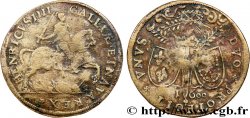
Titulatur der Vorderseite HENRICVS. IIII. FRANC-ORVM. ET. NAVARÆ. REX.
Beschreibung Vorderseite Écus accotés de France et de Navarre sous une large couronne, entourés des colliers de l’ordre de Saint-Michel et du Saint-Esprit.
Übersetzung der Vorderseite (Henri IV, roi des Francs et de Navarre).
Rückseite
Titulatur der Rückseite PAX. MARTIS. OPVS.
Beschreibung Rückseite Mars debout à gauche, arrosant un olivier, la main gauche sur sa haste ; à l'exergue .1599..
Übersetzung der Rückseite (La paix est l'œuvre de Mars).
Kommentare
Jacques De Bie dans son “Histoire métallique de la France”, Paris, 1636, donne l’explication du revers de ce jeton : “Le corps est d’une figure en pied armée à l’antique, représentant un Mars, qui avec un vase remply d’eau arrouse un olivier parroissant desia demy sec : Il tient en sa gauche, une demy-picque dressée au-long de sa hanche qui luy sert d’appuy au bras. Sous l’exergue : MDXCIX. marque assez precise, pour insinuer dans la mémoire de la postérité les utilitéz qu’apporta la paix entre deux monarques les premiers de la chrestienté”. De Bie fait allusion ici au traité de Vervins signé en 1598.
Jacques De Bie in his “Histoire métallique de la France”, Paris, 1636, gives the explanation of the reverse of this token: “The body is a full-length figure armed in the antique style, representing a Mars, who with a vase filled with water waters an olive tree appearing half-dry: He holds in his left, a half-spike raised along his hip which serves as a support for his arm. Under the exergue: MDXCIX. a fairly precise mark, to insinuate in the memory of posterity the usefulness that peace brought between two monarchs, the first of Christianity”. De Bie is alluding here to the Treaty of Vervins signed in 1598
Jacques De Bie in his “Histoire métallique de la France”, Paris, 1636, gives the explanation of the reverse of this token: “The body is a full-length figure armed in the antique style, representing a Mars, who with a vase filled with water waters an olive tree appearing half-dry: He holds in his left, a half-spike raised along his hip which serves as a support for his arm. Under the exergue: MDXCIX. a fairly precise mark, to insinuate in the memory of posterity the usefulness that peace brought between two monarchs, the first of Christianity”. De Bie is alluding here to the Treaty of Vervins signed in 1598
Historischer Hintergrund
HENRY IV
(02.08.1589-14.05.1610)
König nach dem tragischen Tod Heinrichs III., Henri de Bourbon, König von Navarra, stammte vom letzten Sohn des Heiligen Ludwig, Robert de Clermont, ab. Mit ihm beginnt die Dynastie der Bourbonen, die bis zur Revolution über Frankreich herrschte, in Frankreich in direkter Linie mit dem Grafen von Chambord ausstarb und noch immer in Frankreich in ihrem jüngeren Zweig Orleans und außerhalb Frankreichs in ihrem älteren Zweig existiert. mit den Häusern Spanien, Parma und Sizilien. Mit der Erklärung vom 4. August 1589 versprach Heinrich IV. die Aufrechterhaltung der katholischen Religion und die Einberufung eines Nationalrates. Es war Zeit für einen Bürgerkrieg. Der Herzog von Mayenne ließ Kardinal de Bourbon, damals ein Gefangener Heinrichs IV., unter dem Namen Karl X. zum König proklamieren.. Der König marschierte in die Normandie und besiegte Mayenne in der Nähe des Château d'Arques (21. September 1589), konnte Paris jedoch nicht einnehmen. In Tours wurde ein loyalistisches Parlament unter dem Vorsitz von Achille de Harlay eingesetzt. Nachdem Henri die gesamte Normandie mit Ausnahme von Rouen zurückerobert hatte, belagerte er Dreux (Februar 1590).. Mit der Verstärkung des Herzogs von Parma ging Mayenne gegen ihn vor und traf ihn in Ivry (März 1590).. Wieder einmal wurden die Leaguers besiegt. Die vom Herzog von Mercœur verteidigte Blockade von Paris begann im Mai 1590. Nachdem Mayenne und der Herzog von Parma am Ende des Sommers erschienen waren, umgab Henri die Stadt mit einem Netzwerk loyaler Städte und wartete ab. Mit dem Edikt von Mantes (Juli 1591) stellte er das Regime des Edikts von Poitiers wieder her. Beim Tod Karls X. (1590) machten die Spanier die Rechte der Infantin Claire-Isabelle-Eugénie geltend, der Tochter von Philipp II. und Elisabeth von Valois. Eine spanische Garnison ließ sich in Paris nieder. Der Herzog von Savoyen zog in die Provence ein, die Spanier ins Languedoc. Im Dezember 1592 berief Mayenne die Generalstaaten nach Paris. Sie wurden im Januar 1593 eröffnet und stellten mehrere Forderungen: einen katholischen König, die Periodizität der Stände, die Wiederherstellung der Freiheiten der Provinzen, die Aufnahme des Konzils von Trient in Frankreich, lehnten jedoch die Kandidatur der Infantin ab. Im Juli 1593 wurde ein allgemeiner Waffenstillstand unterzeichnet; Im selben Monat verzichtete Heinrich IV. in Saint-Denis auf den Protestantismus. Der Bund zerfiel bald und der König wurde im Februar 1594 in Chartres gekrönt. Im folgenden März reiste er nach Paris ein. Es gab keine Form der Repression. Die Picardie und der Herzog von Guise unterwarfen sich abwechselnd, und Clemens VIII. erteilte Heinrich im September 1596 seine Absolution. Der Krieg gegen Spanien begann offiziell im Januar 1595. Nach der Niederlage bei Fontaine-Française (Juni 1595) mussten die Spanier Burgund räumen und wurden bis zur Franche-Comté verfolgt. Mayenne reichte im Oktober ein, Joyeuse und Épernon folgten. In der Bretagne führte Mercœur bis 1598 einen Partisanenkrieg. Die Operationen gegen die Spanier waren für die Franzosen in den Jahren 1596 und 1597 kaum günstig. Der Friedensvertrag wurde im Mai 1598 von den beiden erschöpften Monarchien unterzeichnet: Dieser Vertrag von Vervins kehrte zu den Klauseln des Vertrags von Cateau-Cambrésis zurück. Durch das Edikt von Nantes (April 1598), das für immer und unwiderruflich erklärt wurde, wurde den Protestanten überall Gewissensfreiheit gewährt; Die Religionsfreiheit blieb dort, wo sie bestand, und wurde am Hof verankert. Zur Beilegung von Streitigkeiten zwischen Katholiken und Protestanten wurden halbparteiliche „Ediktkammern“ eingerichtet. Die Partei erhielt hundert Schutzorte, darunter Montpellier, Montauban und La Rochelle. Der Frieden kehrte zurück, die Lage des Königreichs war nicht weniger katastrophal. Heinrich IV. zeigte die größten Qualitäten eines Staatsmannes: Er vergaß die Vergangenheit und umgab sich mit glühenden Katholiken wie Villeroy und Präsident Jeannin, aber auch mit glühenden Hugenotten wie Sully, dem Finanzminister von 1601. Geschickt reduzierte er nach und nach die Macht der Gouverneure und Parlamente. Im Jahr 1600 heiratete er Marie von Medici, die ihm 1601 einen Dauphin schenkte. Im Jahr 1602 ließ er Marschall Biron, Gouverneur von Burgund, wegen einer Verschwörung zur Erhebung der Katholiken hinrichten. Im Jahr 1606 marschierte er gegen Sedan, die Hauptstadt des aus dem Königreich geflohenen Herzogs von Bouillon, und erwirkte dessen Unterwerfung. Zwischen Frankreich und den Habsburgern herrschte weiterhin Feindseligkeit. Im Jahr 1601 überließ der Herzog von Savoyen im Vertrag von Lyon Bresse, Bugey, Pays de Gex und Valromey dem König von Frankreich.. In Italien blieb der französische Einfluss jedoch gleich Null.. Frankreich unterstützte die Vereinigten Provinzen heimlich. Auf der Seite des Imperiums wollte Henri in die Nachfolge von Cleves und Juliers eingreifen, als er am 14. Mai 1610 von Ravaillac ermordet wurde.
 Berichten über einen Fehler
 Die Seite drucken
 Teilen meiner Auswahl
 Stellen Sie eine Frage
 Einlieferung/Verkauf
In Verbindung stehende Artikel

 Details


Ihre zuletzt angesehenen Artikel

CONSTANTIUS II Argenteus fVZ
373.00 €

VALERIANUS I Antoninien SS
80.00 €

AUGUSTE et AGRIPPA Dupondius fSS
13.00 €

HENRY IV LE TRAITÉ DE VERVINS SS
381.12 €
DOMITIANUS Sesterce, (GB, Æ 33) SS/fSS
200.00 €
cgbfr.de numismatik


