


E-auction 112-59640 - bpv_305256 - HADRIANUS Tétradrachme syro-phénicien
Sie müssen angeschlossen sein und von cgb.fr genehmigt werden, um in einer E-Auktion teilzunehmen.Melden Sie sich an, um zu wetten..Die Kontobestätigungen sind innerhalb von 48 Stunden nach Ihrer Anmeldung gemacht.Warten Sie nicht bis die letzten zwei Tage vor dem Abschluss eines Verkaufs, um Ihre Registrierung abzuschließen. Klickend "BIETEN" verpflichten Sie sich vertraglich, diesen Artikel zu kaufen und Sie nehmen ohne Reserve die allgemeinen Verkaufsbedingungen für den e-auctions zu cgb.fr an.
Der Verkauf wird an der Zeit auf der Übersichtsseite angezeigt geschlossen werden. Angebote, die nach der Schließung Zeit empfangen sind, werden nicht gültig.
Bitte beachten Sie, dass die Fristen für die Einreichung Ihres Angebots auf unsere Server können variieren und es kann zur Ablehnung Ihres Angebots entstehen, wenn es in den letzten Sekunden des Verkaufs gesendet wird. Die Angebote sollen mit ganzer Zahl ausgeführt sein, Sie können Kommas oder des Punktes in Ihrem Angebot nicht erfassen. Bei Fragen klicken Sie hier, um einen Blick auf die FAQ E-Auktionen.
KEINE ANSCHAFFUNGSKOSTEN FÜR DIE KÄUFER.
KEINE ANSCHAFFUNGSKOSTEN FÜR DIE KÄUFER.
| Schätzung : | 180 € |
| Preis : | 68 € |
| Höchstgebot : | 92 € |
| Verkaufsende : | 08 Juni 2015 16:08:30 |
| Bieter : | 10 Bieter |
Type : Tétradrachme syro-phénicien
Datum: 119
Name der Münzstätte / Stadt : Antioche, Syrie, Séleucie et Piérie
Metall : Silber
Durchmesser : 25 mm
Stempelstellung : 6 h.
Gewicht : 13,84 g.
N° im Nachschlagewerk :
Pedigree :
Cet exemplaire est le 0157_018, il provient de la trouvaille dite de Banias
Vorderseite
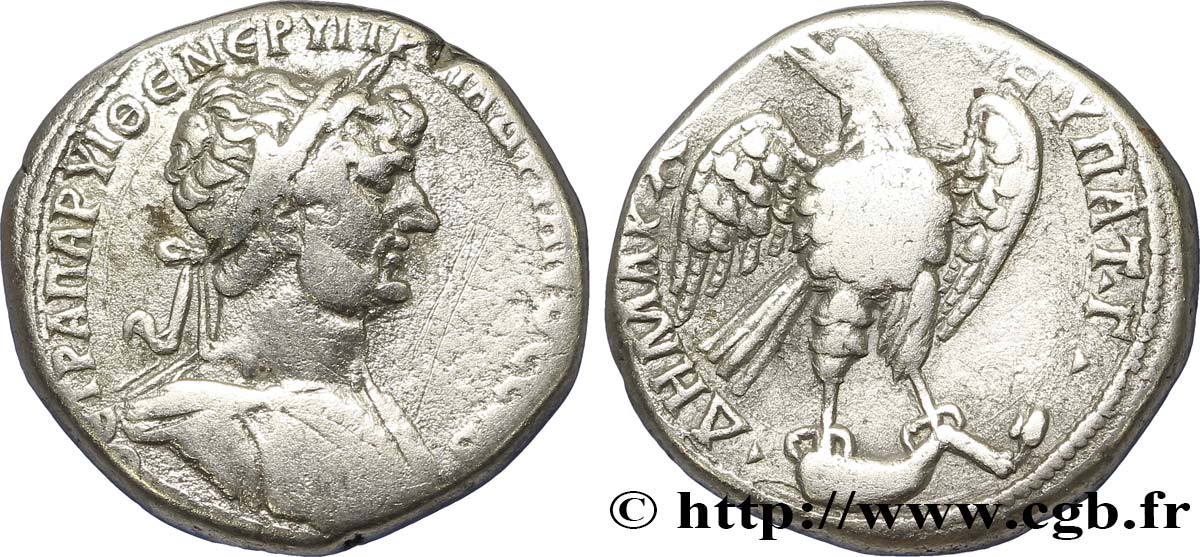
Beschreibung Vorderseite Buste fin, lauré et cuirassé, d’Hadrien à droite vu de trois-quarts de face, l’un des rubans sur l’épaule, l’autre derrière la tête.
Legende des Averses AUT KAI QE TRA PAR UI QE NER UI TRAI ADRIANOS SEB
Übersetzung der Vorderseite (L'empereur césar fils du divin Trajan le Parthique, fils du divin Nerva, Trajan Hadrien auguste).
Rückseite
Beschreibung Rückseite Aigle élancé debout à droite, tête et queue à gauche, sur un cuissot d’animal sacrificiel, les ailes déployées.
Legende des Reverses : DHMARC EX UPAT . G
Übersetzung der Rückseite (Tribun du Peuple, Consul pour la troisième fois).
Kommentare
Une observation plus fine de ce type a permis de détecter deux marqueurs variés, peut-être significatifs : la position des rubans et les détails du haut de la poitrine.
Durant l’an 2, les rubans sont systématiquement derrière la tête et le buste est cuirassé alors que pour l’an 3 on constate deux positions : le Prieur 157, suivant l’illustration du livre, a un ruban derrière la tête et l’autre sur l’épaule ; le 157A, en revanche, a les deux rubans derrière la tête. Cette variante se décompose en deux imagos, la première, 157A, montre un plastron de cuirasse renforcé sous le cou et parfaitement droit. La seconde montre un trait courbe : manifestement un drapé couvrant la cuirasse. Tous les exemplaires 157 donc avec un ruban sur l’épaule ont le cou nu. Logiquement, il y eut trois imagos différentes pendant cette troisième année.
Deuxième année de l’émission d’Antioche sur tous les nouveaux standards récemment établis : légendes à messages politiques, aigle “vivant” en attitude d’envol et non hiératique cuissot sacrificiel dans les serres, disparition de la palme dans le champ, axe à 6 heures.
Le graveur a changé par rapport à l’émission précédente et cette frappe, comme la précédente du deuxième consulat, est la dernière frappe à motivations économiques, donc en quantité importante, avant les frappes des Sévères. Il faut croire que l’afflux de tétradrachmes de Trajan aux types de l’aigle, de la Tyché et du Melqart fut suffisant pour alimenter le marché pendant trois quarts de siècle, aidés en cela par les très importantes frappes de Césarée de Cappadoce.
On note que les sigma sont gravés en C.
Dans la base TSP dix-huit exemplaires sont maintenant répertoriés pour le type 157 “pur”, dont en musées ANS et Berlin.
A closer observation of this type allowed the detection of two varied, perhaps significant, markers: the position of the ribbons and the details of the upper chest..
During year 2, the ribbons are systematically behind the head and the bust is armored, whereas for year 3 we see two positions: Prior 157, following the illustration in the book, has one ribbon behind the head and the other on the shoulder; 157A, on the other hand, has both ribbons behind the head.. This variant is divided into two images, the first, 157A, shows a breastplate reinforced under the neck and perfectly straight. The second shows a curved line: clearly a drape covering the breastplate. All examples 157 therefore with a ribbon on the shoulder have a bare neck. Logically, there were three different imagos during this third year.
Second year of the Antioch issue on all the new standards recently established: legends with political messages, “living” eagle in a flight attitude and not hieratic, sacrificial haunch in the talons, disappearance of the palm in the field, axis at 6 o’clock.
The engraver has changed compared to the previous issue and this strike, like the previous one from the second consulate, is the last strike with economic motives, therefore in significant quantity, before the strikes of the Severans. It must be believed that the influx of Trajan's tetradrachms with the eagle, Tyche and Melqart types was sufficient to supply the market for three-quarters of a century, helped in this by the very important strikes of Caesarea in Cappadocia..
Note that the sigmas are engraved in C.
In the TSP database eighteen examples are now listed for the “pure” type 157, including in ANS and Berlin museums
Durant l’an 2, les rubans sont systématiquement derrière la tête et le buste est cuirassé alors que pour l’an 3 on constate deux positions : le Prieur 157, suivant l’illustration du livre, a un ruban derrière la tête et l’autre sur l’épaule ; le 157A, en revanche, a les deux rubans derrière la tête. Cette variante se décompose en deux imagos, la première, 157A, montre un plastron de cuirasse renforcé sous le cou et parfaitement droit. La seconde montre un trait courbe : manifestement un drapé couvrant la cuirasse. Tous les exemplaires 157 donc avec un ruban sur l’épaule ont le cou nu. Logiquement, il y eut trois imagos différentes pendant cette troisième année.
Deuxième année de l’émission d’Antioche sur tous les nouveaux standards récemment établis : légendes à messages politiques, aigle “vivant” en attitude d’envol et non hiératique cuissot sacrificiel dans les serres, disparition de la palme dans le champ, axe à 6 heures.
Le graveur a changé par rapport à l’émission précédente et cette frappe, comme la précédente du deuxième consulat, est la dernière frappe à motivations économiques, donc en quantité importante, avant les frappes des Sévères. Il faut croire que l’afflux de tétradrachmes de Trajan aux types de l’aigle, de la Tyché et du Melqart fut suffisant pour alimenter le marché pendant trois quarts de siècle, aidés en cela par les très importantes frappes de Césarée de Cappadoce.
On note que les sigma sont gravés en C.
Dans la base TSP dix-huit exemplaires sont maintenant répertoriés pour le type 157 “pur”, dont en musées ANS et Berlin.
A closer observation of this type allowed the detection of two varied, perhaps significant, markers: the position of the ribbons and the details of the upper chest..
During year 2, the ribbons are systematically behind the head and the bust is armored, whereas for year 3 we see two positions: Prior 157, following the illustration in the book, has one ribbon behind the head and the other on the shoulder; 157A, on the other hand, has both ribbons behind the head.. This variant is divided into two images, the first, 157A, shows a breastplate reinforced under the neck and perfectly straight. The second shows a curved line: clearly a drape covering the breastplate. All examples 157 therefore with a ribbon on the shoulder have a bare neck. Logically, there were three different imagos during this third year.
Second year of the Antioch issue on all the new standards recently established: legends with political messages, “living” eagle in a flight attitude and not hieratic, sacrificial haunch in the talons, disappearance of the palm in the field, axis at 6 o’clock.
The engraver has changed compared to the previous issue and this strike, like the previous one from the second consulate, is the last strike with economic motives, therefore in significant quantity, before the strikes of the Severans. It must be believed that the influx of Trajan's tetradrachms with the eagle, Tyche and Melqart types was sufficient to supply the market for three-quarters of a century, helped in this by the very important strikes of Caesarea in Cappadocia..
Note that the sigmas are engraved in C.
In the TSP database eighteen examples are now listed for the “pure” type 157, including in ANS and Berlin museums
Historischer Hintergrund
HADRIANUS
(11.08.117-10.07.138)
Hadrian wurde 76 in Italica geboren. Als Schüler Trajans heiratete er im Jahr 100 Sabine, die Großnichte des Kaisers, und machte im Stab des Kaisers Karriere, insbesondere während des dakischen Feldzugs. Im Jahr 117 trat er die Nachfolge Trajans an und reiste zwanzig Jahre lang, wobei er das gesamte Reich besuchte – der einzige Kaiser, der sich dieser Übung anbot. Im Jahr 122 ging Hadrian nach Spanien. Ohne Kinder wählte er 136 zunächst Aélius als seinen Nachfolger, doch dieser starb am 1. Januar 138. Hadrian adoptierte dann am 25. Februar Antonin und wählte selbst Marcus Aurelius und Lucius Verus zu Antoninus‘ Erben. Er starb am 10. Juli 138.
 Berichten über einen Fehler
 Die Seite drucken
 Teilen meiner Auswahl
 Stellen Sie eine Frage
 Einlieferung/Verkauf
 Details



Ihre zuletzt angesehenen Artikel

500 Lei RUMÄNIEN 1934 P.036a SS
70.00 €
cgbfr.de numismatik


