


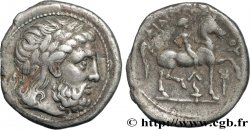
bgr_1091556 - DONAURAUM Tétradrachme au cavalier, imitation de Philippe II

Nicht verfügbar.
Artikel auf unserem Online-Shop verkauft.
Preis : 500.00 €
Artikel auf unserem Online-Shop verkauft.
Preis : 500.00 €
Type : Tétradrachme au cavalier, imitation de Philippe II
Datum: c. 320-280 AC.
Metall : Silber
Durchmesser : 25 mm
Stempelstellung : 3 h.
Gewicht : 14,16 g.
Seltenheitsgrad : R2
Kommentare zum Erhaltungszustand:
Belle drachme bien centrée. Patine grise
N° im Nachschlagewerk :
Pedigree :
Provient de la collection du Colonel Jean-Paul Beaulieu
Vorderseite
Titulatur der Vorderseite ANÉPIGRAPHE.
Beschreibung Vorderseite Tête laurée de Zeus à droite ; grènetis.
Rückseite
Beschreibung Rückseite Cavalier au pas à droite, tenant une palme de la main droite ; le cheval lève l'antérieur à droite, encadrée d’une lettre, d’une torche de course et d’un dauphin ; au-dessus du cavalier, la légende.
Legende des Reverses : FILIP-.-U/ L
Übersetzung der Rückseite (de Philippe).
Kommentare
Imitation de l’atelier d’Amphipolis avec le lambda et la torche de course sous le cheval au revers. Si le statère d'or de Philippe II de Macédoine a servi de prototype à de nombreuses imitations gauloises, le tétradrachme n'a pas été imité en Gaule, mais reste principal sujet d'inspiration des monnaies pour les Celtes du Danube (LT. 9697-9767, 9768-9832, 9618-9630, 9870-9886). Les premières imitations furent frappées dans le premier quart du IIIe siècle avant J.-C. La fabrication des copies serviles, puis des imitations, enfin des frappes celtiques continuèrent pendant plus de deux siècles.
Imitation of the Amphipolis mint with the lambda and the racing torch under the horse on the reverse. If the gold stater of Philip II of Macedon served as a prototype for many Gallic imitations, the tetradrachm was not imitated in Gaul, but remains the main source of inspiration for coins for the Danube Celts (LT. 9697-9767, 9768-9832, 9618-9630, 9870-9886). The first imitations were struck in the first quarter of the 3rd century BC. The manufacture of servile copies, then imitations, and finally Celtic strikes continued for more than two centuries
Imitation of the Amphipolis mint with the lambda and the racing torch under the horse on the reverse. If the gold stater of Philip II of Macedon served as a prototype for many Gallic imitations, the tetradrachm was not imitated in Gaul, but remains the main source of inspiration for coins for the Danube Celts (LT. 9697-9767, 9768-9832, 9618-9630, 9870-9886). The first imitations were struck in the first quarter of the 3rd century BC. The manufacture of servile copies, then imitations, and finally Celtic strikes continued for more than two centuries
Historischer Hintergrund
DONAURAUM
(3.-1. Jahrhundert v. Chr.)
Unter diesem Titel werden im Allgemeinen alle Münzen zusammengefasst, für die es keine genaue Zuschreibung gibt. Manchmal wird auch der Begriff „Ostkelten“ angeboten. Nachdem die Kelten Delphi geplündert und sich über Griechenland und Kleinasien ausgebreitet hatten, erbeuteten sie dank ihrer Plünderung eine beträchtliche Menge an Beute. Die hellenistischen Könige, Diadoken oder Epigonen, setzten sie als Söldner in ihren Armeen ein, deren durchschnittliches Gehalt normalerweise einem Stater Gold entsprach, was fünf Tetradrachmen attischer Währung oder zwanzig Drachmen entsprach. Die Prototypen, die den Kopf des Zeus mit einem Reiter darstellten, wurden auf dem Balkan, in Nordmazedonien und in Thrakien häufig kopiert und nachgeahmt. Die letzte Phase der Münzprägung findet am Ende des 2. oder Anfang des 1. Jahrhunderts v. Chr. statt, wo keine Spuren der Vorder- und Rückseite sowie Legenden mehr vorhanden sind als die gewölbte Vorderseite einer Münze. Auf beiden Seiten praktisch glatt Seiten.
 Berichten über einen Fehler
 Die Seite drucken
 Teilen meiner Auswahl
 Stellen Sie eine Frage
 Einlieferung/Verkauf
In Verbindung stehende Artikel
 Details


Ihre zuletzt angesehenen Artikel

FLANDRE - SIÈGE DE LILLE Cinq sols, monnaie obsidionale VZ/fVZ
350.00 €
cgbfr.de numismatik


