


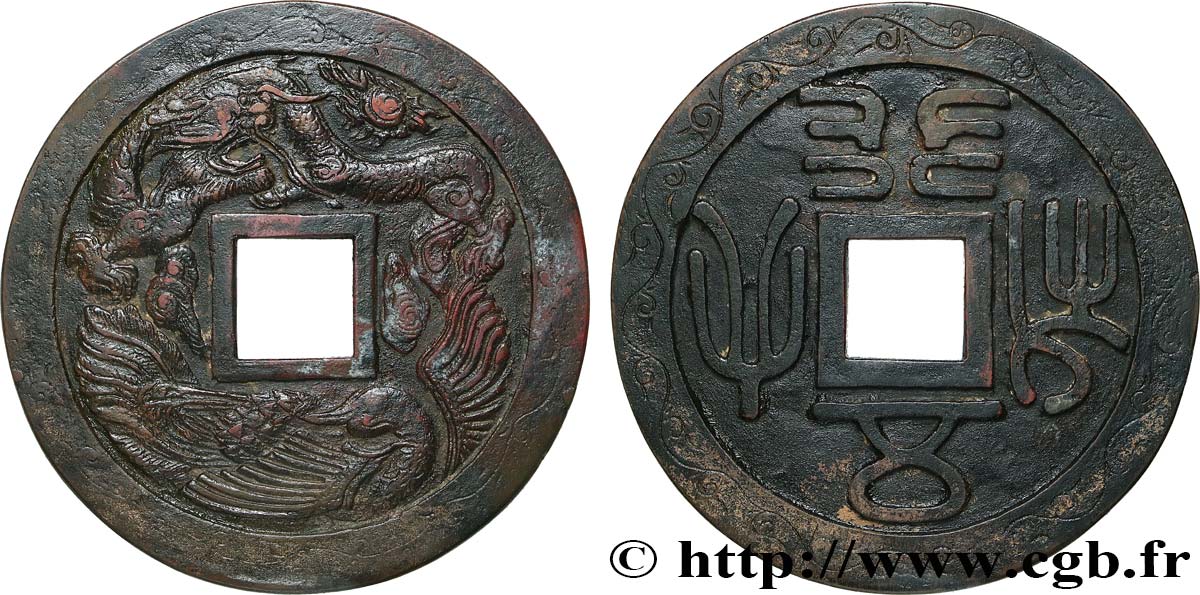
fme_644024 - CHINA Médaille de mariage, Grande amulette, reproduction
Menge
In den Warenkorb

Type : Médaille de mariage, Grande amulette, reproduction
Datum: (fin XXe siècle)
Metall : Bronze
Durchmesser : 148 mm
Stempelstellung : 12 h.
Gewicht : 470,44 g.
Rand lisse
Punze : sans poinçon
Kommentare zum Erhaltungszustand:
Patine hétérogène avec des taches noires et des traces de vernis un peu collant. Marques d’usure sur certains reliefs
N° im Nachschlagewerk :
Pedigree :
Cet exemplaire provient de la Collection Terisse
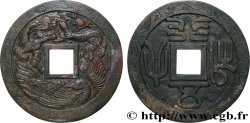
Vorderseite
Titulatur der Vorderseite (LÉGENDE EN SINOGRAMME CHINOIS) WU XING DA BU.
Übersetzung der Vorderseite Grande monnaie des cinq éléments.
Rückseite
Titulatur der Rückseite ANÉPIGRAPHE.
Beschreibung Rückseite Dragon, Phénix et Perle flamboyante (symbolisant l’harmonie du couple Homme et Femme et la richesse spirituelle).
Kommentare
Attention ! Cette médaille peut faire lieu à des frais de port supplémentaires.
Warning ! This medal may give rise to additional shipping costs.
Médaille de la fin du XXe siècle ! Il ne s’agit pas d’une production ancienne mais d’une médaille récente, probablement une reproduction ou copie.
Medal of the end of the XXth century, this medal is probably a replica as the time of production is recent.
D’après l’ouvrage, Amulette de Chine et du Viet-nam par François Thierry, “les pièces portant l’image de ces deux animaux fantastiques (dragon et phénix) étaient offertes lors des mariages en voeux de bonheur et d’harmonie et portent le nom générique “longfeng qian” soit pièces du dragon et du phénix”.
NB. «La théorie des cinq éléments est l’une des bases de la poésie chinoise ; très en vogue sous les Han, elle structure l’ensemble des phénomènes naturels, physiques, sociaux, intellectuels selon cinq catégories qui se succédent dans un cycle comprenant une montée, un apogée et une décadence. Ces catégories s’appuient sur cinq éléments, qui se succèdent en s’annihilant.».
Attention! This medal may incur additional shipping costs. Warning! This medal may give rise to additional shipping costs. Medal from the end of the 20th century! This is not an antique piece but a recent medal, probably a reproduction or copy. According to the book, Amulets of China and Vietnam by François Thierry, “coins bearing the image of these two fantastic animals (dragon and phoenix) were given at weddings as wishes for happiness and harmony and are known generically as “longfeng qian,” meaning dragon and phoenix coins.” Note: “The theory of the five elements is one of the foundations of Chinese poetry; very popular during the Han dynasty, it structures all natural, physical, social, and intellectual phenomena according to five categories that follow one another in a cycle comprising a rise, a peak, and a decline.” These categories are based on five elements, which follow one another and cancel each other out.
Warning ! This medal may give rise to additional shipping costs.
Médaille de la fin du XXe siècle ! Il ne s’agit pas d’une production ancienne mais d’une médaille récente, probablement une reproduction ou copie.
Medal of the end of the XXth century, this medal is probably a replica as the time of production is recent.
D’après l’ouvrage, Amulette de Chine et du Viet-nam par François Thierry, “les pièces portant l’image de ces deux animaux fantastiques (dragon et phénix) étaient offertes lors des mariages en voeux de bonheur et d’harmonie et portent le nom générique “longfeng qian” soit pièces du dragon et du phénix”.
NB. «La théorie des cinq éléments est l’une des bases de la poésie chinoise ; très en vogue sous les Han, elle structure l’ensemble des phénomènes naturels, physiques, sociaux, intellectuels selon cinq catégories qui se succédent dans un cycle comprenant une montée, un apogée et une décadence. Ces catégories s’appuient sur cinq éléments, qui se succèdent en s’annihilant.».
Attention! This medal may incur additional shipping costs. Warning! This medal may give rise to additional shipping costs. Medal from the end of the 20th century! This is not an antique piece but a recent medal, probably a reproduction or copy. According to the book, Amulets of China and Vietnam by François Thierry, “coins bearing the image of these two fantastic animals (dragon and phoenix) were given at weddings as wishes for happiness and harmony and are known generically as “longfeng qian,” meaning dragon and phoenix coins.” Note: “The theory of the five elements is one of the foundations of Chinese poetry; very popular during the Han dynasty, it structures all natural, physical, social, and intellectual phenomena according to five categories that follow one another in a cycle comprising a rise, a peak, and a decline.” These categories are based on five elements, which follow one another and cancel each other out.
Historischer Hintergrund
CHINA
 Berichten über einen Fehler
 Die Seite drucken
 Teilen meiner Auswahl
 Stellen Sie eine Frage
 Einlieferung/Verkauf
In Verbindung stehende Artikel
 Details


Ihre zuletzt angesehenen Artikel
CHINA Médaille de mariage, Grande amulette, reproduction SS
600.00 €
PHILIPPINEN 1 Peso - Administration Américaine 1907 San Francisco - S SS
60.00 €

GALLIEN - BELGICA - LEUCI (Region die Toul) Denier SOLIMA/COLIMA au gros œil SS
220.00 €
cgbfr.de numismatik


