


bpv_296883 - CALIGULA und AGRIPPINA MAIOR Tétradrachme syro-phénicien
Nicht verfügbar.
Artikel auf unserem Online-Shop verkauft (2018)
Preis : 2 000.00 €
Artikel auf unserem Online-Shop verkauft (2018)
Preis : 2 000.00 €
Type : Tétradrachme syro-phénicien
Datum: 39
Name der Münzstätte / Stadt : Antioche, Syrie, Séleucie et Piérie
Metall : Silber
Durchmesser : 25 mm
Stempelstellung : 12 h.
Gewicht : 14,65 g.
Seltenheitsgrad : R2
N° im Nachschlagewerk :
Pedigree :
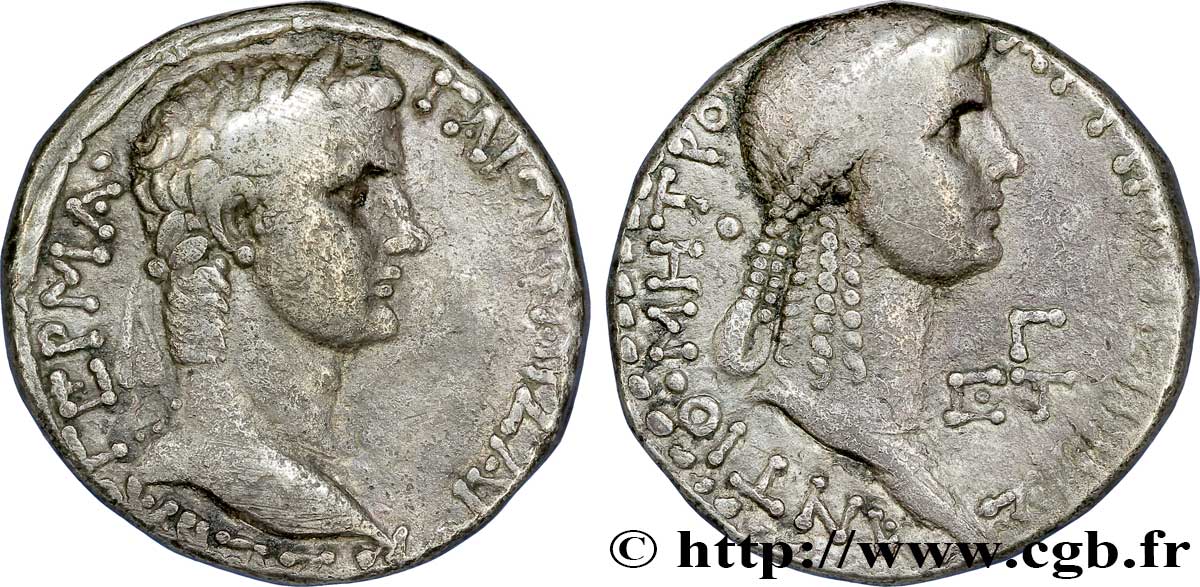
Cet exemplaire est référencé dans le RPC sous le numéro 4168/5. Il provient des ventes Numismatic Fine Arts 21, 1981, lot 12 puis Empire 3, 05 05 1985, lot 180 et enfin de la Collection Richard McAlee. C’est cet exemplaire qui illustre le type dans l’ouvrage de Richard McAlee The coins of Roman Antioch, page 127, n°226
Vorderseite
Beschreibung Vorderseite Tête laurée de Gaius Caligula à droite.
Legende des Averses GAIOU KAISAROS SEBA GERMA
Übersetzung der Vorderseite Gaius César Auguste Germanique.
Rückseite
Beschreibung Rückseite Buste drapé d’Agrippine mère à droite, dans le champ à droite un gamma majuscule sur ET (ETOYC gamma = an 3 du règne) point dans le champ gauche.
Legende des Reverses : AGRIPPEINHS ANTIO MHTRO
Übersetzung der Rückseite Agrippine Antioche Métropole.
Kommentare
C’est la présence du point dans le champ gauche du revers qui fait la différence avec le type Prieur 66.
On ignore la signification de ce point mais il est certain qu’il en a une puisque le cas d’un point pour distinguer certaines émissions va se poursuivre jusqu’à Néron.
On ignore pourquoi l’Empereur fit le choix d’un revers illustrant sa mère mais il n’est pas impossible que ce choix local soit fondé sur l’impact qu’elle aurait pu avoir en Orient comme épouse de Germanicus.
Caligula est le fils de Germanicus et d’Agrippine mère. Il connaît bien l’Orient, puisque c’est là que son père va mourir empoisonné à trente-trois ans et qu’il va assister, lui-même âgé de sept ans, à la crémation de la dépouille. Il rapportera les cendres à Rome avec sa mère ; le Peuple et le Sénat joindront leurs lamentations à celles de la famille lorsque les cendres seront déposées dans le mausolée d’Auguste.
Si Germanicus fut un modèle de romain, son fils ne partageait malheureusement pas ses qualités ; son assassinat par les prétoriens en janvier 41, après qu’il eut succédé à Tibère et régné dans les débordements les plus extrêmes, fut un soulagement.
Peu d’événements marquants pour l’histoire romaine à l’est de l’Empire sauf à propos des relations avec les Juifs.
Philon d’Alexandrie raconte que durant l’hiver 39, un groupe de juifs fanatiques détruisit un autel païen dans un temple grec.
En représailles, Caligula décida qu’une statue de lui-même incarnant Zeus serait dressée dans le Temple de Jérusalem.
Il déclencha alors une révolte qui fut sévèrement réprimée. On ignore ce qu’il advint de la statue.
En revanche, il fut indirectement la cause de l’un des pires massacres de Juifs de l’Antiquité lorsque, en 37, des bandes de Grecs d’Alexandrie, avec la complicité du préfet d’Égypte A. Avilius Flaccus, assassinèrent pour les voler de nombreux Juifs de la ville. Les Juifs vivaient à Alexandrie depuis sa fondation, arrivés avec l’armée grecque d’Alexandre et de Ptolémée et ils avaient construit le seul ghetto du monde romain, de part leur propre volonté et non pas parce que les Grecs souhaitaient les confiner. En 38, Flaccus, fut jugé, condamné et exilé.
Dans un registre moins politique, Caligula aida le peuple d’Antioche après le tragique tremblement de terre du 9 avril 37 durant lequel la ville et le faubourg de Daphné furent gravement endommagés.
Dans la base TSP maintenue par Michel Prieur, vingt-deux exemplaires, dont cinq en musées ou en collections publiques (Paris, ANS, Oxford, Berlin et Yale) sont maintenant répertoriés.
It is the presence of the point in the left field of the reverse which makes the difference with the Prieur 66 type.
The significance of this point is unknown, but it is certain that it has one, since the use of a point to distinguish certain emissions will continue until Nero..
It is not known why the Emperor chose a reverse depicting his mother, but it is not impossible that this local choice was based on the impact she could have had in the East as the wife of Germanicus..
Caligula is the son of Germanicus and Agrippina the mother. He knows the Orient well, since it is there that his father will die poisoned at the age of thirty-three and he will attend, himself aged seven, the cremation of the remains.. He will bring the ashes back to Rome with his mother; the People and the Senate will join their lamentations to those of the family when the ashes are placed in the mausoleum of Augustus.
If Germanicus was a model Roman, his son unfortunately did not share his qualities; his assassination by the Praetorians in January 41, after he had succeeded Tiberius and reigned in the most extreme excesses, was a relief.
Few significant events in Roman history in the east of the Empire except for relations with the Jews.
Philo of Alexandria relates that in the winter of 39, a group of fanatical Jews destroyed a pagan altar in a Greek temple..
In retaliation, Caligula decided that a statue of himself embodying Zeus would be erected in the Temple of Jerusalem.
He then started a revolt which was severely repressed. It is unknown what happened to the statue..
On the other hand, he was indirectly the cause of one of the worst massacres of Jews in Antiquity when, in 37, bands of Greeks from Alexandria, with the complicity of the prefect of Egypt A. Avilius Flaccus, murdered many of the city's Jews for the sake of stealing them. Jews had lived in Alexandria since its founding, having arrived with the Greek army of Alexander and Ptolemy, and they had built the only ghetto in the Roman world, of their own free will and not because the Greeks wished to confine them.. In 38, Flaccus was tried, condemned and exiled.
On a less political note, Caligula helped the people of Antioch after the tragic earthquake of April 9, 37, during which the city and the suburb of Daphne were seriously damaged..
In the TSP database maintained by Michel Prieur, twenty-two examples, including five in museums or public collections (Paris, ANS, Oxford, Berlin and Yale) are now listed.
On ignore la signification de ce point mais il est certain qu’il en a une puisque le cas d’un point pour distinguer certaines émissions va se poursuivre jusqu’à Néron.
On ignore pourquoi l’Empereur fit le choix d’un revers illustrant sa mère mais il n’est pas impossible que ce choix local soit fondé sur l’impact qu’elle aurait pu avoir en Orient comme épouse de Germanicus.
Caligula est le fils de Germanicus et d’Agrippine mère. Il connaît bien l’Orient, puisque c’est là que son père va mourir empoisonné à trente-trois ans et qu’il va assister, lui-même âgé de sept ans, à la crémation de la dépouille. Il rapportera les cendres à Rome avec sa mère ; le Peuple et le Sénat joindront leurs lamentations à celles de la famille lorsque les cendres seront déposées dans le mausolée d’Auguste.
Si Germanicus fut un modèle de romain, son fils ne partageait malheureusement pas ses qualités ; son assassinat par les prétoriens en janvier 41, après qu’il eut succédé à Tibère et régné dans les débordements les plus extrêmes, fut un soulagement.
Peu d’événements marquants pour l’histoire romaine à l’est de l’Empire sauf à propos des relations avec les Juifs.
Philon d’Alexandrie raconte que durant l’hiver 39, un groupe de juifs fanatiques détruisit un autel païen dans un temple grec.
En représailles, Caligula décida qu’une statue de lui-même incarnant Zeus serait dressée dans le Temple de Jérusalem.
Il déclencha alors une révolte qui fut sévèrement réprimée. On ignore ce qu’il advint de la statue.
En revanche, il fut indirectement la cause de l’un des pires massacres de Juifs de l’Antiquité lorsque, en 37, des bandes de Grecs d’Alexandrie, avec la complicité du préfet d’Égypte A. Avilius Flaccus, assassinèrent pour les voler de nombreux Juifs de la ville. Les Juifs vivaient à Alexandrie depuis sa fondation, arrivés avec l’armée grecque d’Alexandre et de Ptolémée et ils avaient construit le seul ghetto du monde romain, de part leur propre volonté et non pas parce que les Grecs souhaitaient les confiner. En 38, Flaccus, fut jugé, condamné et exilé.
Dans un registre moins politique, Caligula aida le peuple d’Antioche après le tragique tremblement de terre du 9 avril 37 durant lequel la ville et le faubourg de Daphné furent gravement endommagés.
Dans la base TSP maintenue par Michel Prieur, vingt-deux exemplaires, dont cinq en musées ou en collections publiques (Paris, ANS, Oxford, Berlin et Yale) sont maintenant répertoriés.
It is the presence of the point in the left field of the reverse which makes the difference with the Prieur 66 type.
The significance of this point is unknown, but it is certain that it has one, since the use of a point to distinguish certain emissions will continue until Nero..
It is not known why the Emperor chose a reverse depicting his mother, but it is not impossible that this local choice was based on the impact she could have had in the East as the wife of Germanicus..
Caligula is the son of Germanicus and Agrippina the mother. He knows the Orient well, since it is there that his father will die poisoned at the age of thirty-three and he will attend, himself aged seven, the cremation of the remains.. He will bring the ashes back to Rome with his mother; the People and the Senate will join their lamentations to those of the family when the ashes are placed in the mausoleum of Augustus.
If Germanicus was a model Roman, his son unfortunately did not share his qualities; his assassination by the Praetorians in January 41, after he had succeeded Tiberius and reigned in the most extreme excesses, was a relief.
Few significant events in Roman history in the east of the Empire except for relations with the Jews.
Philo of Alexandria relates that in the winter of 39, a group of fanatical Jews destroyed a pagan altar in a Greek temple..
In retaliation, Caligula decided that a statue of himself embodying Zeus would be erected in the Temple of Jerusalem.
He then started a revolt which was severely repressed. It is unknown what happened to the statue..
On the other hand, he was indirectly the cause of one of the worst massacres of Jews in Antiquity when, in 37, bands of Greeks from Alexandria, with the complicity of the prefect of Egypt A. Avilius Flaccus, murdered many of the city's Jews for the sake of stealing them. Jews had lived in Alexandria since its founding, having arrived with the Greek army of Alexander and Ptolemy, and they had built the only ghetto in the Roman world, of their own free will and not because the Greeks wished to confine them.. In 38, Flaccus was tried, condemned and exiled.
On a less political note, Caligula helped the people of Antioch after the tragic earthquake of April 9, 37, during which the city and the suburb of Daphne were seriously damaged..
In the TSP database maintained by Michel Prieur, twenty-two examples, including five in museums or public collections (Paris, ANS, Oxford, Berlin and Yale) are now listed.
Historischer Hintergrund
CALIGULA und AGRIPPINA MAIOR
Caligula ist seinen Eltern sehr verbunden. Er verlor seinen Vater Germanicus im Alter von sieben Jahren. Seine Mutter Agrippine, Tochter von Julie und Agrippa, zog ihn im Gedenken an diesen verstorbenen Vater auf. Mit der Zeit stellt sie ihre Kinder gegen Tibere, ihren Stiefvater, auf die Probe, weil dieser Julies dritter Ehemann war. Sie wirft ihm vor, ihren Mann durch Pison, den Gouverneur von Syrien, vergiftet zu haben. Tiberius entwickelt schließlich eine Abneigung gegen seine Schwiegertochter und lässt sie schließlich ins Exil verbannen. Dann exekutiert oder verbannt er die anderen Kinder der Nachkommen von Germanicus: Nero und Drusus werden nacheinander eliminiert, die jungen Agrippina und Drusilla werden verbannt, Agrippinas Mutter lässt sich sterben. Tiberius behält nur Caligula bei sich, der schließlich sein Nachfolger wird, nachdem er seinen Beschützer erstickt hat, wie aus der Aussage von Sueton hervorgeht.
 Berichten über einen Fehler
 Die Seite drucken
 Teilen meiner Auswahl
 Stellen Sie eine Frage
 Einlieferung/Verkauf
Ihre zuletzt angesehenen Artikel
REUNION - FRANZÖSISCHE UNION 1 Franc 1948 Monnaie de Paris fVZ
360.00 €
RÉPUBLIQUE LIGURE Médaille, Fête de la souveraineté du peuple fVZ
200.00 €

ANGLETERRE - ROYAUME D'ANGLETERRE - ÉDOUARD IV Noble d'or à la rose n.d. Londr
1700.00 €
CHARLES VII "THE WELL SERVED" Blanc dentillé 5/04/1431 Poitiers SS
182.94 €
cgbfr.de numismatik


