


fme_1083258 - ALLEMAGNE - ROYAUME DE PRUSSE - FRÉDÉRIC II LE GRAND Médaille, Bataille de Prague

100.00 €
Menge
In den Warenkorb

Type : Médaille, Bataille de Prague
Datum: 1757
Name der Münzstätte / Stadt : Allemagne
Metall : Bronze
Durchmesser : 48 mm
Stempelstellung : 12 h.
Graveur HOLTZHEY Johann Georg (1729-1808)
Gewicht : 40,20 g.
Rand Lisse
Punze : sans poinçon
Kommentare zum Erhaltungszustand:
Belle médaille en bronze malheureusement percée à 12 heures. Présence de quelques coups et rayures
Vorderseite
Titulatur der Vorderseite FRIDERICVS MAGN. D. G. REX BORVSS. FL. BRAND. DVX SILES ET.
Beschreibung Vorderseite Buste cuirassé de Frédéric II de Prusse à droite.
Rückseite
Titulatur der Rückseite FAMA. PRVDENTIA ET VIRTVTE, (LÉGENDE CIRCULAIRE) // AVSTIR. EXERC. PROPE. PRAG. EVNDIT / CÆSO ET PRAGA OBSESSA / VI MAJI MDCCLVII., (À L’EXERGUE).
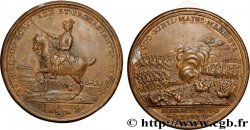
Beschreibung Rückseite Personnification de la Victoire ailée au centre, tenant la foudre, donnant un coup de pied dans la couronne de l’impératrice autrichienne Maria Theresia agenouillée ; bouclier iinscrit «VICTORIA FRIDERI / CI MAGN.” ; ALBISIL et MOLDA inscrit sur deux cruches, canon et armure en trophée.
Kommentare
Médaille attribuée au graveur hollandais Johann Georg Holtzhey (1729-1808).
Lors de la guerre de Sept Ans, la bataille de Prague voit, le 6 mai 1757, la victoire des Prussiens commandés par Frédéric II sur les Autrichiens de Charles-Alexandre de Lorraine. Le général autrichien Maximilian Ulysses Browne y est mortellement blessé, de même que le feld-maréchal prussien Curt Christophe de Schwerin. Cette victoire prussienne est suivie par le siège de Prague (mai-juin 1757) (en) mais Frédéric II, battu à la bataille de Kolin le 18 juin, doit se retirer et ne peut s'emparer de Prague.
Frédéric II de Prusse, dit Frédéric le Grand (en allemand, Friedrich der Große), né le 24 janvier 1712 à Berlin, mort le 17 août 1786 à Potsdam, de la maison de Hohenzollern, est roi de Prusse de 1740 à 1786, le premier à porter officiellement ce titre1. Il est simultanément le 14e prince-électeur de Brandebourg. Il est parfois surnommé affectueusement der alte Fritz (le vieux Fritz). Agrandissant notablement le territoire de ses États aux dépens de l'Autriche (Silésie, 1742) et de la Pologne (Prusse-Occidentale, 1772), il fait entrer son pays dans le cercle des grandes puissances européennes. Ami de Voltaire, il est l'un des principaux représentants du courant du «despotisme éclairé»..
Medal attributed to the Dutch engraver Johann Georg Holtzhey (1729-1808).
During the Seven Years' War, the Battle of Prague saw, on May 6, 1757, the victory of the Prussians commanded by Frederick II over the Austrians of Charles-Alexander of Lorraine.. Austrian General Maximilian Ulysses Browne was mortally wounded there, as was Prussian Field Marshal Curt Christophe of Schwerin.. This Prussian victory was followed by the siege of Prague (May-June 1757) but Frederick II, defeated at the Battle of Kolin on June 18, had to withdraw and could not capture Prague..
Frederick II of Prussia, known as Frederick the Great (in German, Friedrich der Große), born on January 24, 1712 in Berlin, died on August 17, 1786 in Potsdam, of the House of Hohenzollern, was King of Prussia from 1740 to 1786, the first to officially bear this title1. He was simultaneously the 14th Prince-Elector of Brandenburg.. He is sometimes affectionately known as der alte Fritz (old Fritz). Significantly expanding the territory of his states at the expense of Austria (Silesia, 1742) and Poland (West Prussia, 1772), he brought his country into the circle of the great European powers.. A friend of Voltaire, he is one of the main representatives of the \\\"enlightened despotism\\\" movement..
Lors de la guerre de Sept Ans, la bataille de Prague voit, le 6 mai 1757, la victoire des Prussiens commandés par Frédéric II sur les Autrichiens de Charles-Alexandre de Lorraine. Le général autrichien Maximilian Ulysses Browne y est mortellement blessé, de même que le feld-maréchal prussien Curt Christophe de Schwerin. Cette victoire prussienne est suivie par le siège de Prague (mai-juin 1757) (en) mais Frédéric II, battu à la bataille de Kolin le 18 juin, doit se retirer et ne peut s'emparer de Prague.
Frédéric II de Prusse, dit Frédéric le Grand (en allemand, Friedrich der Große), né le 24 janvier 1712 à Berlin, mort le 17 août 1786 à Potsdam, de la maison de Hohenzollern, est roi de Prusse de 1740 à 1786, le premier à porter officiellement ce titre1. Il est simultanément le 14e prince-électeur de Brandebourg. Il est parfois surnommé affectueusement der alte Fritz (le vieux Fritz). Agrandissant notablement le territoire de ses États aux dépens de l'Autriche (Silésie, 1742) et de la Pologne (Prusse-Occidentale, 1772), il fait entrer son pays dans le cercle des grandes puissances européennes. Ami de Voltaire, il est l'un des principaux représentants du courant du «despotisme éclairé»..
Medal attributed to the Dutch engraver Johann Georg Holtzhey (1729-1808).
During the Seven Years' War, the Battle of Prague saw, on May 6, 1757, the victory of the Prussians commanded by Frederick II over the Austrians of Charles-Alexander of Lorraine.. Austrian General Maximilian Ulysses Browne was mortally wounded there, as was Prussian Field Marshal Curt Christophe of Schwerin.. This Prussian victory was followed by the siege of Prague (May-June 1757) but Frederick II, defeated at the Battle of Kolin on June 18, had to withdraw and could not capture Prague..
Frederick II of Prussia, known as Frederick the Great (in German, Friedrich der Große), born on January 24, 1712 in Berlin, died on August 17, 1786 in Potsdam, of the House of Hohenzollern, was King of Prussia from 1740 to 1786, the first to officially bear this title1. He was simultaneously the 14th Prince-Elector of Brandenburg.. He is sometimes affectionately known as der alte Fritz (old Fritz). Significantly expanding the territory of his states at the expense of Austria (Silesia, 1742) and Poland (West Prussia, 1772), he brought his country into the circle of the great European powers.. A friend of Voltaire, he is one of the main representatives of the \\\"enlightened despotism\\\" movement..
Historischer Hintergrund
ALLEMAGNE - ROYAUME DE PRUSSE - FRÉDÉRIC II LE GRAND
(1740-17.08.1786)
Friedrich wurde am 24. Januar 1712 in Berlin geboren und ist der Sohn Friedrich Wilhelms I. Es war zunächst Frankreichs Verbündeter im Österreichischen Erbfolgekrieg (1740–1748), dann kam es während des Siebenjährigen Krieges (1756–1763) zu einer Kehrtwende. Er war einer der großen Gewinner des Pariser Friedens (1763) und beteiligte sich an der ersten Teilung Polens (1772). Friedrich II. (1712-1786) war der größte König Preußens. Als Freund Voltaires schrieb er auf Französisch und war das Vorbild des aufgeklärten Despoten der zweiten Hälfte des 18. Jahrhunderts. Er trat die Nachfolge seines Vaters Frédéric-Guillaume, König Sergent, an und machte Berlin zu einer echten Hauptstadt und das Schloss Sans Souci in Potsdam zu einem kleinen Versailles. Dank einer kriegerischen Politik machte er Preußen zum mächtigsten Staat Osteuropas und gleichte den Einfluss Österreichs und Russlands aus. Er starb am 17. August 1786 auf Schloss Sans-Souci (Potsdam)..
 Berichten über einen Fehler
 Die Seite drucken
 Teilen meiner Auswahl
 Stellen Sie eine Frage
 Einlieferung/Verkauf
In Verbindung stehende Artikel

 Details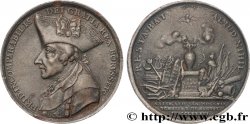


Ihre zuletzt angesehenen Artikel
BRETAGNE - DUCHÉ DE BRETAGNE - FRANÇOIS II Gros à l'écu fSS/fVZ
110.00 €

NAVARRE-BEARN - JEANNE OF ALBRET Teston fVZ
600.00 €

NAVARRE-BEARN - JEANNE OF ALBRET Teston SS/fVZ
370.00 €
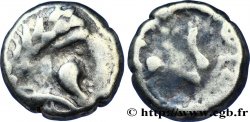
GALLIEN - CARNUTES (Region die Beauce) Quart de statère d’or pâle, dit “à
46.00 €

ALLEMAGNE - ROYAUME DE PRUSSE - FRÉDÉRIC II LE GRAND Médaille, Bataille de Pr
100.00 €

ÉTATS-UNIS D'AMÉRIQUE 1 Dollar Morgan 1889 Philadelphie ST67 autre
300.00 €
cgbfr.de numismatik


