


v29_0026 - ÄGINE - ÄGINE INSELN - ÄGINA Statère
MONNAIES 29 (2007)
Startpreis : 550.00 €
Schätzung : 850.00 €
Erzielter Preis : 1 000.00 €
Anzahl der Gebote : 8
Höchstgebot : 1 045.00 €
Startpreis : 550.00 €
Schätzung : 850.00 €
Erzielter Preis : 1 000.00 €
Anzahl der Gebote : 8
Höchstgebot : 1 045.00 €
Type : Statère
Datum: c. 400 AC.
Name der Münzstätte / Stadt : Égine
Metall : Silber
Durchmesser : 22 mm
Stempelstellung : 6 h.
Gewicht : 11,91 g.
Seltenheitsgrad : R1
Kommentare zum Erhaltungszustand:
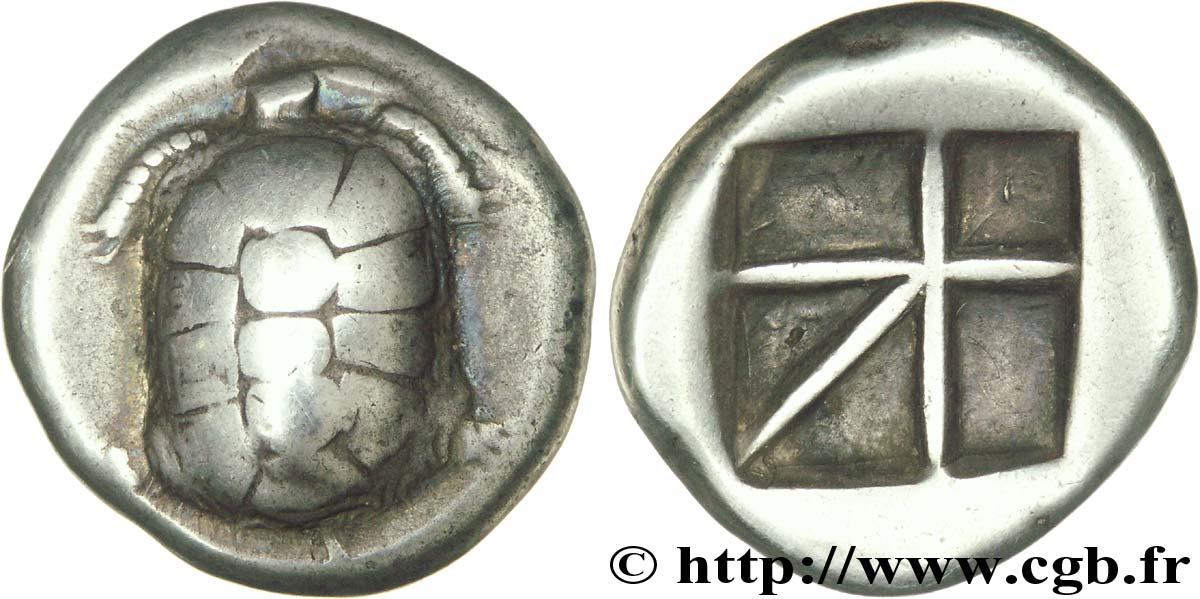
Flan large et complet. Petite faiblesse de fabrication au droit avec une usure superficielle sur la carapace de la tortue. Très beau carré creux. Une jolie patine avec des reflets mordorés recouvre cet exemplaire
N° im Nachschlagewerk :
Vorderseite
Titulatur der Vorderseite ANÉPIGRAPHE.
Beschreibung Vorderseite Tortue terrestre vue de dessus.
Rückseite
Titulatur der Rückseite ANÉPIGRAPHE.
Beschreibung Rückseite Carré creux divisé en cinq compartiments.
Kommentare
La fabrication des “tortues” s’interrompit quant Athènes occupa Égine à partir de 431 avant J.-C. Quand la cité fut libérée en 404 avant J.-C., elle recouvra sa liberté et reprit la fabrication monétaire. Notre statère pourrait avoir été fabriqué à ce moment. La tortue terrestre semble encore archaïque tandis que le carré creux est déjà fin et élégant. Ce statère serait alors une pièce de transition.
The production of \\\"turtles\\\" was interrupted when Athens occupied Aegina from 431 BC. When the city was liberated in 404 BC, it regained its freedom and resumed coin production. Our stater may have been produced at this time. The land turtle still appears archaic, while the hollow square is already fine and elegant. This stater would therefore be a transitional piece.
The production of \\\"turtles\\\" was interrupted when Athens occupied Aegina from 431 BC. When the city was liberated in 404 BC, it regained its freedom and resumed coin production. Our stater may have been produced at this time. The land turtle still appears archaic, while the hollow square is already fine and elegant. This stater would therefore be a transitional piece.
Historischer Hintergrund
ÄGINE - ÄGINE INSELN - ÄGINA
(6. – 5. Jahrhundert v. Chr.)
Die Stadt Ägina liegt auf der gleichnamigen Insel. Es liegt in gleichem Abstand zwischen Athen und der Küste von Argolis. In Ägina wurden im 6. Jahrhundert v. Chr. die ersten Münzen des Westens geprägt. Aufgrund seiner geografischen und wirtschaftlichen Lage war Ägina ein wichtiger Handelsort an der Schnittstelle zwischen Euböa, Athen, Korinth und dem Peloponnes. Der Äginetische Hengst (aus Ägina) verbreitete sich schnell im gesamten Ägäischen Meer, in Griechenland, Kreta und einem Teil Kleinasiens. Die Münzprägung scheint erst in der zweiten Hälfte des 6. Jahrhunderts v. Chr. begonnen zu haben. Unglücklicherweise wurde die Stadt nach den Perserkriegen von Athen in den Schatten gestellt, das sie 457 v. Chr. eroberte. Die Ägineter wurden von den Athenern vertrieben. Erst nach dem Fall Athens erlangte Ägina seine Freiheit zurück, hatte aber definitiv seine Wirtschaftskraft verloren..
 Berichten über einen Fehler
 Die Seite drucken
 Teilen meiner Auswahl
 Stellen Sie eine Frage
 Einlieferung/Verkauf
In Verbindung stehende Artikel
 Details
Ihre zuletzt angesehenen Artikel

1 Dollar VEREINIGTE STAATEN VON AMERIKA Chicago 1985 P.474 fS
3.00 €

20 Francs GUADELOUPE 1944 P.28a SGE
18.00 €

100 Francs MARTINIQUE 1943 P.19a fS
160.00 €

500 Francs BELGIEN 1963 P.135a S
30.00 €
PHILIPPUS I. ARABS Tétradrachme syro-phénicien VZ
200.00 €

ÄGINE - ÄGINE INSELN - ÄGINA Statère SS
1000.00 €
cgbfr.de numismatik


