


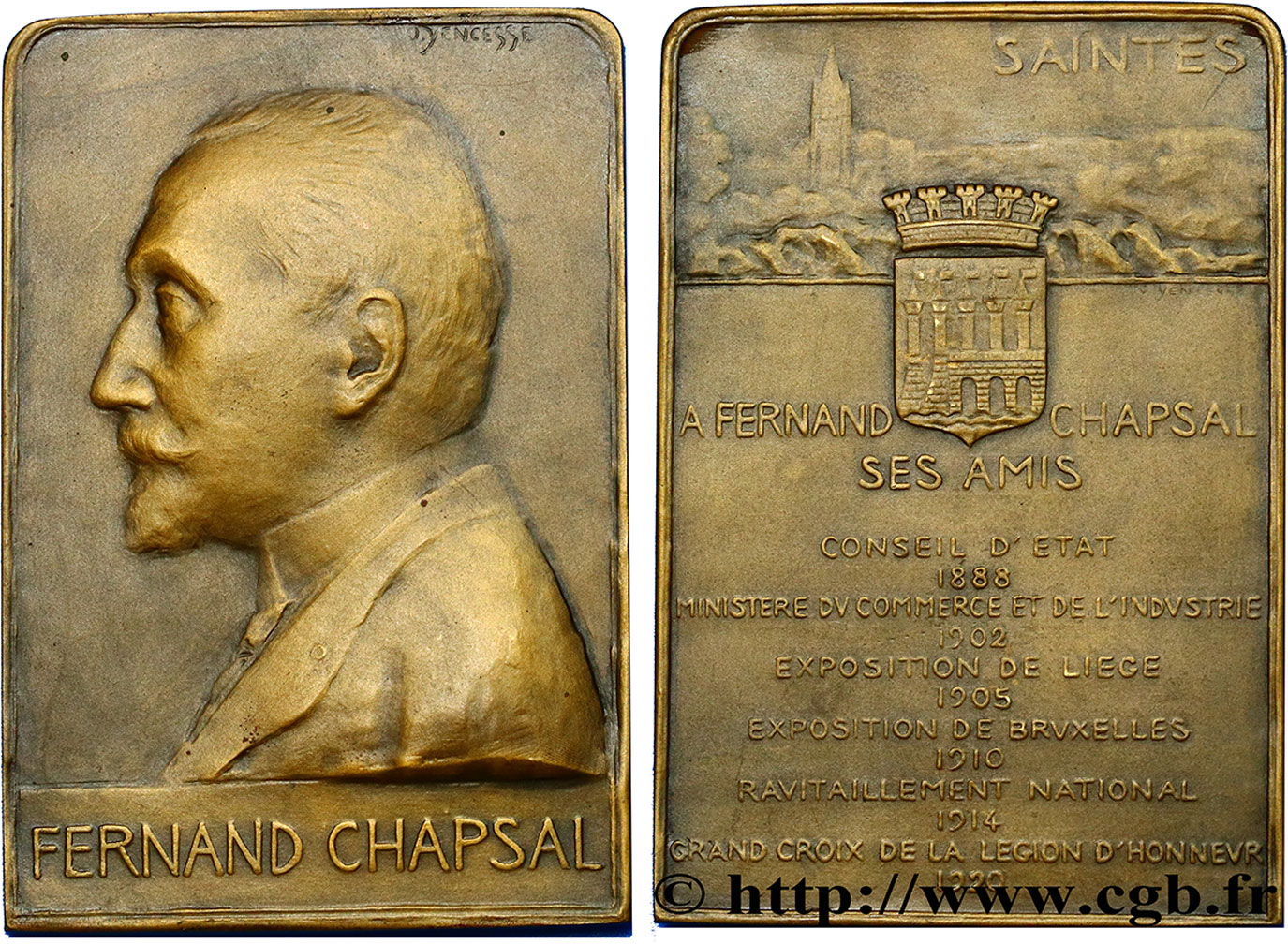
fme_400225 - DRITTE FRANZOSISCHE REPUBLIK Plaquette, Fernand Chapsal
Nicht verfügbar.
Artikel auf unserem Online-Shop verkauft (2018)
Preis : 150.00 €
Artikel auf unserem Online-Shop verkauft (2018)
Preis : 150.00 €
Type : Plaquette, Fernand Chapsal
Datum: 1920
Name der Münzstätte / Stadt : 17 - Saintes
Metall : Bronze
Durchmesser : 75 mm
Stempelstellung : 12 h.
Graveur YENCESSE Ovide (1869-1947)
Gewicht : 94 g.
Rand lisse + BRONZE
Kommentare zum Erhaltungszustand:
Belle et intéressante médaille avec une belle patine homogène
Vorderseite
Titulatur der Vorderseite FERNAND CHAPSAL.
Beschreibung Vorderseite Buste à gauche de Fernand Chapsal.
Rückseite
Titulatur der Rückseite SAINTES / A FERNAND CHAPSAL / SES AMIS / CONSEIL D’ÉTAT / 1888 / MINISTRE DU COMMERCE ET DE L’INDUSTRIE / 1902 / EXPOSITION DE LIÈGE / 1905 / EXPOSITION DE BRUXELLES / 1910 / RAVITAILLEMENT NATIONAL / 1914 / GRAND CROIX DE LA LÉGION D’HONNEUR / 1920.
Beschreibung Rückseite Légende en 15 lignes avec un écu couronné de la ville de Saintes et une vue de ville au-dessus.
Kommentare
Plaquette dans sa boîte en carton d’origine.
Fernand Chapsal, né à Limoges le 10 mars 1862, décédé à Neuilly-sur-Seine le 10 février 1939, est un homme politique français. Il était membre du Parti républicain, radical et radical-socialiste (PRS).
Ovide Yencesse (1869 - 1947), est un graveur-médailleur et sculpteur français. Il fut directeur de l'école des beaux-arts de Dijon de 1919 à 1934.
Son talent est remarqué par la critique ; le très influent Roger Marx trouvant qu'il apporte un « frisson nouveau » dans la médaille, en y introduisant l'impressionnisme. « C'est un art d'intimité, de compassion sociale, résolument moderne, écrit-il dans un article de 1902. Les qualités dictinctives du talent de M. Yencesse sont la pénétration, la tendresse. Dans ses compositions, ses portraits, il arrive à nous toucher au plus profond de l'âme, par la sobriété de la mise en scène, par l'élimination des détails ; il généralise l'accidentel et élève de la sorte au symbole tout spectacle pris autour de lui. La facture, très particulière, elle aussi, contribue à accroître le trouble où nous jettent ces images ; les reliefs émergent à peine du champ de la médaille, la pénombre enveloppe toutes les parties de l'ensemble, comme dans les peintures d'Eugène Carrière. Jamais on n'a mieux fait sentir quels rapports étroits unissent la glyptique et la peinture. » Cette facture très particulière, que son fondeur A. Liard savait parfaitement traduire, lui vaudra, par allusion à la peinture d'Eugène Carrière, le surnom de « Carrière de la médaille ». À l'Exposition universelle de 1900 à Paris, il obtient la médaille d'or et la Légion d'honneur.
.
Leaflet in its original cardboard box.
Fernand Chapsal, born in Limoges on March 10, 1862, died in Neuilly-sur-Seine on February 10, 1939, is a French politician. He was a member of the Republican, Radical and Radical-Socialist Party (PRS).
Ovide Yencesse (1869 - 1947), was a French engraver, medallist and sculptor. He was director of the Dijon School of Fine Arts from 1919 to 1934..
His talent was noted by critics; the very influential Roger Marx found that he brought a \\\"new thrill\\\" to the medal, by introducing impressionism.. \\\"It is an art of intimacy, of social compassion, resolutely modern,\\\" he wrote in a 1902 article.. The qualities that dictate M’s talent. Yencesse are penetration, tenderness. In his compositions, his portraits, he manages to touch us in the depths of our souls, through the sobriety of the staging, through the elimination of details; he generalizes the accidental and thus elevates to symbolism any spectacle taken around him.. The very particular workmanship also contributes to increasing the confusion into which these images cast us; the reliefs barely emerge from the field of the medal, the half-light envelops all parts of the whole, as in the paintings of Eugène Carrière. Never has the close relationship between glyptics and painting been better demonstrated.. \\\"This very particular invoice, which its founder A. Liard knew how to translate perfectly, earning him, through an allusion to the painting of Eugène Carrière, the nickname \\\"Carrière de la médaille\\\" (Medal Quarry).. At the 1900 World's Fair in Paris, he was awarded the Gold Medal and the Legion of Honor..
Fernand Chapsal, né à Limoges le 10 mars 1862, décédé à Neuilly-sur-Seine le 10 février 1939, est un homme politique français. Il était membre du Parti républicain, radical et radical-socialiste (PRS).
Ovide Yencesse (1869 - 1947), est un graveur-médailleur et sculpteur français. Il fut directeur de l'école des beaux-arts de Dijon de 1919 à 1934.
Son talent est remarqué par la critique ; le très influent Roger Marx trouvant qu'il apporte un « frisson nouveau » dans la médaille, en y introduisant l'impressionnisme. « C'est un art d'intimité, de compassion sociale, résolument moderne, écrit-il dans un article de 1902. Les qualités dictinctives du talent de M. Yencesse sont la pénétration, la tendresse. Dans ses compositions, ses portraits, il arrive à nous toucher au plus profond de l'âme, par la sobriété de la mise en scène, par l'élimination des détails ; il généralise l'accidentel et élève de la sorte au symbole tout spectacle pris autour de lui. La facture, très particulière, elle aussi, contribue à accroître le trouble où nous jettent ces images ; les reliefs émergent à peine du champ de la médaille, la pénombre enveloppe toutes les parties de l'ensemble, comme dans les peintures d'Eugène Carrière. Jamais on n'a mieux fait sentir quels rapports étroits unissent la glyptique et la peinture. » Cette facture très particulière, que son fondeur A. Liard savait parfaitement traduire, lui vaudra, par allusion à la peinture d'Eugène Carrière, le surnom de « Carrière de la médaille ». À l'Exposition universelle de 1900 à Paris, il obtient la médaille d'or et la Légion d'honneur.
.
Leaflet in its original cardboard box.
Fernand Chapsal, born in Limoges on March 10, 1862, died in Neuilly-sur-Seine on February 10, 1939, is a French politician. He was a member of the Republican, Radical and Radical-Socialist Party (PRS).
Ovide Yencesse (1869 - 1947), was a French engraver, medallist and sculptor. He was director of the Dijon School of Fine Arts from 1919 to 1934..
His talent was noted by critics; the very influential Roger Marx found that he brought a \\\"new thrill\\\" to the medal, by introducing impressionism.. \\\"It is an art of intimacy, of social compassion, resolutely modern,\\\" he wrote in a 1902 article.. The qualities that dictate M’s talent. Yencesse are penetration, tenderness. In his compositions, his portraits, he manages to touch us in the depths of our souls, through the sobriety of the staging, through the elimination of details; he generalizes the accidental and thus elevates to symbolism any spectacle taken around him.. The very particular workmanship also contributes to increasing the confusion into which these images cast us; the reliefs barely emerge from the field of the medal, the half-light envelops all parts of the whole, as in the paintings of Eugène Carrière. Never has the close relationship between glyptics and painting been better demonstrated.. \\\"This very particular invoice, which its founder A. Liard knew how to translate perfectly, earning him, through an allusion to the painting of Eugène Carrière, the nickname \\\"Carrière de la médaille\\\" (Medal Quarry).. At the 1900 World's Fair in Paris, he was awarded the Gold Medal and the Legion of Honor..
Historischer Hintergrund
DRITTE FRANZOSISCHE REPUBLIK
(04.09.1870-10.07.1940)
Die Nachricht von der Kapitulation Sedans löst am 4. September 1870 in Paris die Revolution aus. Die im Hôtel de Ville proklamierte Republik verfügt über eine provisorische Regierung namens Regierung der Nationalen Verteidigung. Auf der linken Seite durch den Aufstand der Kommune und auf der rechten Seite durch die Monarchisten bedroht, hatte das neue Regime einen schwierigen Start.. Als ursprünglicher Chef der Exekutive (Februar 1871) war Thiers für die Neuorganisation des Landes verantwortlich, bevor er sich für die Regierungsform entschied.. Er wurde im August 1871 Präsident der Republik und musste trotz seiner Bemühungen zur Befreiung des Territoriums im März 1873 sein Amt angesichts des Widerstands der Royalisten aufgeben.. Er wird dann durch Mac-Mahon ersetzt, der für die Wiederherstellung der Monarchie ist, aber dieser wird nach der Frage der Flagge nicht wiederhergestellt. Im November 1873 wurde dann das Gesetz des Septennats in Kraft gesetzt und 1875 wurden die Grundgesetze verabschiedet, die als Verfassung der Dritten Republik dienten.. Das parlamentarische System zeichnet sich insbesondere durch das klare Übergewicht der gesetzgebenden Gewalt gegenüber der exekutiven Gewalt aus. Antiklerikalistisch macht die Dritte Republik die Schule kostenlos, säkular und obligatorisch, führt aber die Kolonialpolitik für ihre wirtschaftlichen, strategischen und moralischen Ambitionen fort. Die Trennung von Kirche und Staat wurde 1905 beschlossen.. Die Idee der Rache an Deutschland und ein ausgeprägter Nationalismus stehen im Mittelpunkt der Boulang-Krise, des Panama-Skandals oder der Dreyfus-Affäre der Jahre 1886-1899, während die Außenpolitik insbesondere in Marokko sehr aktiv ist und sich das Wettrüsten entwickelt. Der Erste Weltkrieg war für Frankreich teuer, das sich erst ab 1920 oder gar 1928 von der Währung mit dem „Poincaré“-Franc erholte.. Die Krise von 1929 ist erst ab 1932 spürbar, dauert aber bis 1939, einer Zeit, in der die Instabilität der Minister sehr wichtig ist. Die Dritte Republik geriet 1934 ins Wanken und fand mit dem Antifaschismus einen neuen gemeinsamen Kitt, der es der Volksfront 1936 ermöglichte, an die Macht zu gelangen.. Doch das gegenüber Deutschland gelähmte Frankreich geriet anschließend in einen „Scheinkrieg“ und erlitt im Juni 1940 eine der größten Niederlagen seiner Geschichte.. Die am 10. Juli 1940 in der Nationalversammlung in Vichy versammelten Kammern stimmten, obwohl 1936 gewählt, Pétain in einer Art kollektivem Selbstmord mit 569 Ja-Stimmen, 80 Nein-Stimmen und 18 Enthaltungen die volle Macht zu..
 Berichten über einen Fehler
 Die Seite drucken
 Teilen meiner Auswahl
 Stellen Sie eine Frage
 Einlieferung/Verkauf
In Verbindung stehende Artikel
 Details


Ihre zuletzt angesehenen Artikel

5000 Dobras SAO TOMÉ UND PRINCIPE 2013 P.065d ST
12.00 €
10 Perpera MONTENEGRO Stari Bar 1914 P.M.134 S
90.00 €
5 Livres FRANKREICH 1793 Ass.46a S
3.00 €

25 centimes Lindauer, maillechort 1939 F.172/3 ST65
25.00 €

SINGAPUR Série FDC 6 monnaies 1986 ST
30.00 €

NEPAL Mohar SE 1829 Prithvi Bir Bikram 1907 SS
10.00 €
cgbfr.de numismatik


