


fme_1040182 - DRITTE FRANZOSISCHE REPUBLIK Médaille, Visite de la Monnaie

150.00 €
Menge
In den Warenkorb

Type : Médaille, Visite de la Monnaie
Datum: 1889
Name der Münzstätte / Stadt : 75 - Paris
Metall : Bronze
Durchmesser : 41,5 mm
Stempelstellung : 12 h.
Graveur LEONARD Laurent (1758-1774)
Gewicht : 29,13 g.
Rand lisse + corne BRONZE
Punze : corne BRONZE
Kommentare zum Erhaltungszustand:
Patine hétérogène. Traces de manipulation
Vorderseite
Titulatur der Vorderseite AURO AGENTO AERI FLANDO FERIUNDO // AEDES AEDIFICATAE / MDCCLXX.
Beschreibung Vorderseite Vue de la Monnaie depuis la Seine.
Rückseite
Titulatur der Rückseite EXPOSITION UNIVERSELLE / 1889 / LES MEMBRES / DU / CONGRÈS MONÉTAIRE / INTERNATIONAL / VISITENT LA MONNAIE / DE PARIS / - / 14 SEPTEMBRE .
Beschreibung Rückseite Légende en 9 lignes.
Kommentare
En 1765, Jacques-Denis Antoine fut préféré aux architectes Étienne-Louis Boullée et François Dominique Barreau de Chefdeville pour la construction de ce nouveau bâtiment de style néoclassique. L'abbé Jean Delagrive propose de réaliser le projet sur les quais de la Seine, à l'emplacement de l'ancien hôtel de Conti, qui avait été racheté par la Ville de Paris pour construire un nouvel hôtel de ville. Un arrêt du Conseil retint définitivement ce site auquel Antoine adapta ses plans, un quadrilatère de 1 hectare composé de plusieurs cours. Le site n'était pas encore très bien desservi, mais l'emplacement était historique et les perspectives urbanistiques valorisantes.
La première pierre fut posée par l'abbé Terray le 30 avril 1771. La façade sur le quai, longue de 117 m, fut achevée en 1773 et le gros œuvre, ainsi que l'essentiel du décor, en 1775. Cet édifice, très admiré, valut à Antoine d'entrer en 1776 à l'Académie royale d'architecture. Certains critiquèrent toutefois la façade sur le quai, jugée d'une magnificence peu en accord avec le caractère d'une « manufacture »..
In 1765, Jacques-Denis Antoine was chosen over architects Étienne-Louis Boullée and François Dominique Barreau de Chefdeville for the construction of this new neoclassical-style building. Abbé Jean Delagrive proposed carrying out the project on the banks of the Seine, on the site of the former Hôtel de Conti, which had been purchased by the City of Paris to build a new town hall. A Council decree definitively selected this site, to which Antoine adapted his plans: a 1-hectare quadrilateral composed of several courtyards. The site was not yet very well served, but the location was historic and the urban perspectives were attractive. The first stone was laid by Abbot Terray on April 30, 1771. The 117-meter-long façade on the quayside was completed in 1773, and the main structure and most of the decoration were completed in 1775. This much-admired building earned Antoine admission to the Royal Academy of Architecture in 1776. However, some criticized the façade on the quayside, which was deemed to be of a magnificence that was hardly in keeping with the character of a \\\"manufactory.\\\"
La première pierre fut posée par l'abbé Terray le 30 avril 1771. La façade sur le quai, longue de 117 m, fut achevée en 1773 et le gros œuvre, ainsi que l'essentiel du décor, en 1775. Cet édifice, très admiré, valut à Antoine d'entrer en 1776 à l'Académie royale d'architecture. Certains critiquèrent toutefois la façade sur le quai, jugée d'une magnificence peu en accord avec le caractère d'une « manufacture »..
In 1765, Jacques-Denis Antoine was chosen over architects Étienne-Louis Boullée and François Dominique Barreau de Chefdeville for the construction of this new neoclassical-style building. Abbé Jean Delagrive proposed carrying out the project on the banks of the Seine, on the site of the former Hôtel de Conti, which had been purchased by the City of Paris to build a new town hall. A Council decree definitively selected this site, to which Antoine adapted his plans: a 1-hectare quadrilateral composed of several courtyards. The site was not yet very well served, but the location was historic and the urban perspectives were attractive. The first stone was laid by Abbot Terray on April 30, 1771. The 117-meter-long façade on the quayside was completed in 1773, and the main structure and most of the decoration were completed in 1775. This much-admired building earned Antoine admission to the Royal Academy of Architecture in 1776. However, some criticized the façade on the quayside, which was deemed to be of a magnificence that was hardly in keeping with the character of a \\\"manufactory.\\\"
Historischer Hintergrund
DRITTE FRANZOSISCHE REPUBLIK
(04.09.1870-10.07.1940)
Die Nachricht von der Kapitulation Sedans löst am 4. September 1870 in Paris die Revolution aus. Die im Hôtel de Ville proklamierte Republik verfügt über eine provisorische Regierung namens Regierung der Nationalen Verteidigung. Auf der linken Seite durch den Aufstand der Kommune und auf der rechten Seite durch die Monarchisten bedroht, hatte das neue Regime einen schwierigen Start.. Als ursprünglicher Chef der Exekutive (Februar 1871) war Thiers für die Neuorganisation des Landes verantwortlich, bevor er sich für die Regierungsform entschied.. Er wurde im August 1871 Präsident der Republik und musste trotz seiner Bemühungen zur Befreiung des Territoriums im März 1873 sein Amt angesichts des Widerstands der Royalisten aufgeben.. Er wird dann durch Mac-Mahon ersetzt, der für die Wiederherstellung der Monarchie ist, aber dieser wird nach der Frage der Flagge nicht wiederhergestellt. Im November 1873 wurde dann das Gesetz des Septennats in Kraft gesetzt und 1875 wurden die Grundgesetze verabschiedet, die als Verfassung der Dritten Republik dienten.. Das parlamentarische System zeichnet sich insbesondere durch das klare Übergewicht der gesetzgebenden Gewalt gegenüber der exekutiven Gewalt aus. Antiklerikalistisch macht die Dritte Republik die Schule kostenlos, säkular und obligatorisch, führt aber die Kolonialpolitik für ihre wirtschaftlichen, strategischen und moralischen Ambitionen fort. Die Trennung von Kirche und Staat wurde 1905 beschlossen.. Die Idee der Rache an Deutschland und ein ausgeprägter Nationalismus stehen im Mittelpunkt der Boulang-Krise, des Panama-Skandals oder der Dreyfus-Affäre der Jahre 1886-1899, während die Außenpolitik insbesondere in Marokko sehr aktiv ist und sich das Wettrüsten entwickelt. Der Erste Weltkrieg war für Frankreich teuer, das sich erst ab 1920 oder gar 1928 von der Währung mit dem „Poincaré“-Franc erholte.. Die Krise von 1929 ist erst ab 1932 spürbar, dauert aber bis 1939, einer Zeit, in der die Instabilität der Minister sehr wichtig ist. Die Dritte Republik geriet 1934 ins Wanken und fand mit dem Antifaschismus einen neuen gemeinsamen Kitt, der es der Volksfront 1936 ermöglichte, an die Macht zu gelangen.. Doch das gegenüber Deutschland gelähmte Frankreich geriet anschließend in einen „Scheinkrieg“ und erlitt im Juni 1940 eine der größten Niederlagen seiner Geschichte.. Die am 10. Juli 1940 in der Nationalversammlung in Vichy versammelten Kammern stimmten, obwohl 1936 gewählt, Pétain in einer Art kollektivem Selbstmord mit 569 Ja-Stimmen, 80 Nein-Stimmen und 18 Enthaltungen die volle Macht zu..
 Berichten über einen Fehler
 Die Seite drucken
 Teilen meiner Auswahl
 Stellen Sie eine Frage
 Einlieferung/Verkauf
In Verbindung stehende Artikel

 Details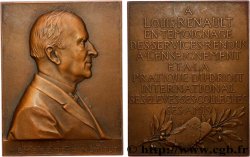


Ihre zuletzt angesehenen Artikel

FRANKREICH PIÈCE D'HISTOIRE - 10 EURO ARGENT DAGOBERT 2019
20.00 €
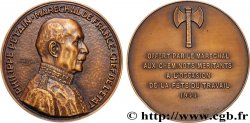
ETAT FRANÇAIS Médaille, Maréchal Pétain, offert aux cheminots VZ
200.00 €
cgbfr.de numismatik


