


E-auction 239-163051 - fme_412444 - DRITTE FRANZOSISCHE REPUBLIK Médaille Le baiser au Soleil
Sie müssen angeschlossen sein und von cgb.fr genehmigt werden, um in einer E-Auktion teilzunehmen.Melden Sie sich an, um zu wetten..Die Kontobestätigungen sind innerhalb von 48 Stunden nach Ihrer Anmeldung gemacht.Warten Sie nicht bis die letzten zwei Tage vor dem Abschluss eines Verkaufs, um Ihre Registrierung abzuschließen. Klickend "BIETEN" verpflichten Sie sich vertraglich, diesen Artikel zu kaufen und Sie nehmen ohne Reserve die allgemeinen Verkaufsbedingungen für den e-auctions zu cgb.fr an.
Der Verkauf wird an der Zeit auf der Übersichtsseite angezeigt geschlossen werden. Angebote, die nach der Schließung Zeit empfangen sind, werden nicht gültig.
Bitte beachten Sie, dass die Fristen für die Einreichung Ihres Angebots auf unsere Server können variieren und es kann zur Ablehnung Ihres Angebots entstehen, wenn es in den letzten Sekunden des Verkaufs gesendet wird. Die Angebote sollen mit ganzer Zahl ausgeführt sein, Sie können Kommas oder des Punktes in Ihrem Angebot nicht erfassen. Bei Fragen klicken Sie hier, um einen Blick auf die FAQ E-Auktionen.
KEINE ANSCHAFFUNGSKOSTEN FÜR DIE KÄUFER.
KEINE ANSCHAFFUNGSKOSTEN FÜR DIE KÄUFER.
| Schätzung : | 25 € |
| Preis : | 7 € |
| Höchstgebot : | 7 € |
| Verkaufsende : | 13 November 2017 19:06:00 |
| Bieter : | 5 Bieter |
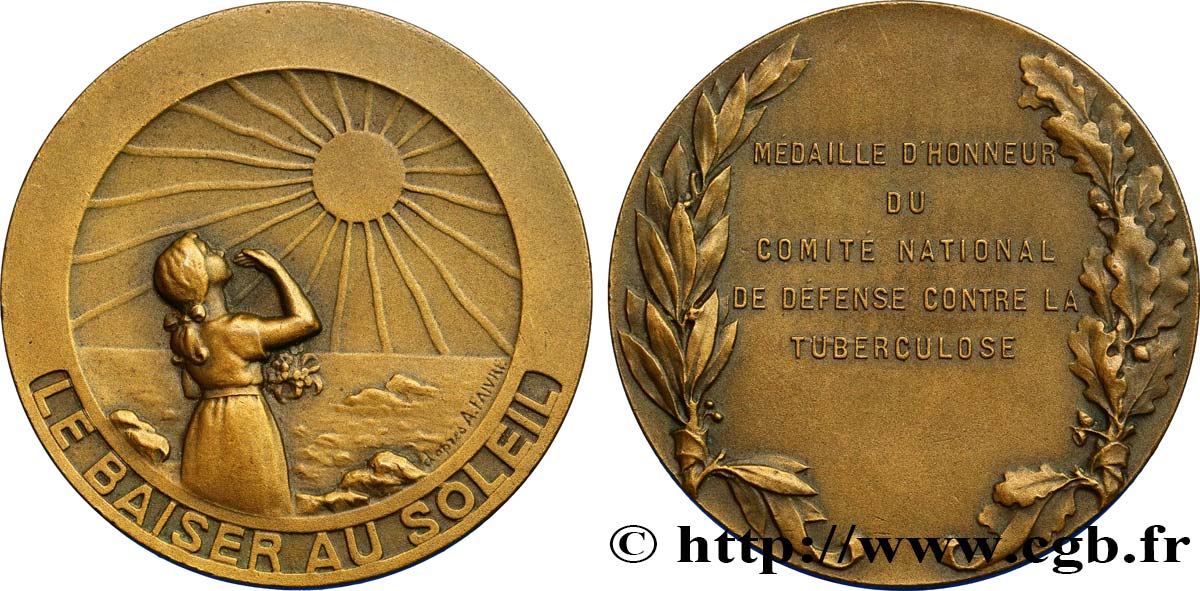
Type : Médaille Le baiser au Soleil
Datum: n.d.
Name der Münzstätte / Stadt : France
Metall : Bronze
Durchmesser : 49 mm
Stempelstellung : 12 h.
Graveur FAIVRE Abel (1867-1945)
Gewicht : 53 g.
Rand lisse + carré BRONZE
Kommentare zum Erhaltungszustand:
Intéressante médaille avec une belle patine ancienne homogène
Vorderseite
Titulatur der Vorderseite LE BAISER AU SOLEIL.
Beschreibung Vorderseite Jeune fille faisant un baiser au Soleil, la mer au second plan.
Rückseite
Titulatur der Rückseite MÉDAILLE D’HONNEUR / DU / COMITÉ NATIONAL / DE DÉFENSE CONTRE LA / TUBERCULOSE.
Beschreibung Rückseite Légende en cinq lignes entre deux branches de lauriers et de chêne.
Kommentare
Médaille signée au droite “D’aprés A. FAIVRE”.
Abel Faivre, né à Lyon, le 30 mars 1867 et mort à Nice le 13 août 1945, est un peintre, lithographe, illustrateur et caricaturiste français. Abel Faivre étudie pendant trois ans à l'École des beaux-arts de Lyon, puis à l'École des beaux-arts de Paris et à l'Académie Julian-de-Sartre auprès de Jules Lefebvre et Benjamin-Constant. Il a souvent exposé à la Société des artistes français et a été médaillé de 3e classe à l'Exposition universelle de 1894 puis médaillé d'honneur à l'Exposition de Lyon. Il a vécu et travaillé à La Croix-Valmer (Var), où un boulevard porte désormais son nom. Après avoir livré un grand nombre de dessins satiriques à L'Assiette au beurre, il est devenu célèbre par ses affiches de propagande pour soutenir l'effort de guerre français (1914-1918), dont celle de l'emprunt national de 1918 où il représente le Kaiser, tête baissée et tenant un glaive brisé, est chassé par les drapeaux des puissances alliées.
Il a également travaillé pour le journal humoristique Le Rire et pour Le Figaro.
Ses caricatures sont visibles au musée Jean-Jaurés à Castres.
.
Medal signed on the right “After A. FAIVRE”. Abel Faivre, born in Lyon on March 30, 1867 and died in Nice on August 13, 1945, was a French painter, lithographer, illustrator, and caricaturist. Abel Faivre studied for three years at the École des Beaux-Arts in Lyon, then at the École des Beaux-Arts in Paris and at the Académie Julian-de-Sartre with Jules Lefebvre and Benjamin-Constant. He often exhibited at the Société des Artistes Français and was awarded a 3rd class medal at the 1894 Universal Exhibition and then a medal of honor at the Lyon Exhibition. He lived and worked in La Croix-Valmer (Var), where a boulevard now bears his name. After producing a large number of satirical drawings for L'Assiette au beurre, he became famous for his propaganda posters supporting the French war effort (1914-1918), including the one for the 1918 national loan, in which he depicted the Kaiser, head bowed and holding a broken sword, being chased away by the flags of the Allied powers. He also worked for the humorous newspaper Le Rire and for Le Figaro. His caricatures can be seen at the Jean-Jaurés Museum in Castres.
Abel Faivre, né à Lyon, le 30 mars 1867 et mort à Nice le 13 août 1945, est un peintre, lithographe, illustrateur et caricaturiste français. Abel Faivre étudie pendant trois ans à l'École des beaux-arts de Lyon, puis à l'École des beaux-arts de Paris et à l'Académie Julian-de-Sartre auprès de Jules Lefebvre et Benjamin-Constant. Il a souvent exposé à la Société des artistes français et a été médaillé de 3e classe à l'Exposition universelle de 1894 puis médaillé d'honneur à l'Exposition de Lyon. Il a vécu et travaillé à La Croix-Valmer (Var), où un boulevard porte désormais son nom. Après avoir livré un grand nombre de dessins satiriques à L'Assiette au beurre, il est devenu célèbre par ses affiches de propagande pour soutenir l'effort de guerre français (1914-1918), dont celle de l'emprunt national de 1918 où il représente le Kaiser, tête baissée et tenant un glaive brisé, est chassé par les drapeaux des puissances alliées.
Il a également travaillé pour le journal humoristique Le Rire et pour Le Figaro.
Ses caricatures sont visibles au musée Jean-Jaurés à Castres.
.
Medal signed on the right “After A. FAIVRE”. Abel Faivre, born in Lyon on March 30, 1867 and died in Nice on August 13, 1945, was a French painter, lithographer, illustrator, and caricaturist. Abel Faivre studied for three years at the École des Beaux-Arts in Lyon, then at the École des Beaux-Arts in Paris and at the Académie Julian-de-Sartre with Jules Lefebvre and Benjamin-Constant. He often exhibited at the Société des Artistes Français and was awarded a 3rd class medal at the 1894 Universal Exhibition and then a medal of honor at the Lyon Exhibition. He lived and worked in La Croix-Valmer (Var), where a boulevard now bears his name. After producing a large number of satirical drawings for L'Assiette au beurre, he became famous for his propaganda posters supporting the French war effort (1914-1918), including the one for the 1918 national loan, in which he depicted the Kaiser, head bowed and holding a broken sword, being chased away by the flags of the Allied powers. He also worked for the humorous newspaper Le Rire and for Le Figaro. His caricatures can be seen at the Jean-Jaurés Museum in Castres.
Historischer Hintergrund
DRITTE FRANZOSISCHE REPUBLIK
(04.09.1870-10.07.1940)
Die Nachricht von der Kapitulation Sedans löst am 4. September 1870 in Paris die Revolution aus. Die im Hôtel de Ville proklamierte Republik verfügt über eine provisorische Regierung namens Regierung der Nationalen Verteidigung. Auf der linken Seite durch den Aufstand der Kommune und auf der rechten Seite durch die Monarchisten bedroht, hatte das neue Regime einen schwierigen Start.. Als ursprünglicher Chef der Exekutive (Februar 1871) war Thiers für die Neuorganisation des Landes verantwortlich, bevor er sich für die Regierungsform entschied.. Er wurde im August 1871 Präsident der Republik und musste trotz seiner Bemühungen zur Befreiung des Territoriums im März 1873 sein Amt angesichts des Widerstands der Royalisten aufgeben.. Er wird dann durch Mac-Mahon ersetzt, der für die Wiederherstellung der Monarchie ist, aber dieser wird nach der Frage der Flagge nicht wiederhergestellt. Im November 1873 wurde dann das Gesetz des Septennats in Kraft gesetzt und 1875 wurden die Grundgesetze verabschiedet, die als Verfassung der Dritten Republik dienten.. Das parlamentarische System zeichnet sich insbesondere durch das klare Übergewicht der gesetzgebenden Gewalt gegenüber der exekutiven Gewalt aus. Antiklerikalistisch macht die Dritte Republik die Schule kostenlos, säkular und obligatorisch, führt aber die Kolonialpolitik für ihre wirtschaftlichen, strategischen und moralischen Ambitionen fort. Die Trennung von Kirche und Staat wurde 1905 beschlossen.. Die Idee der Rache an Deutschland und ein ausgeprägter Nationalismus stehen im Mittelpunkt der Boulang-Krise, des Panama-Skandals oder der Dreyfus-Affäre der Jahre 1886-1899, während die Außenpolitik insbesondere in Marokko sehr aktiv ist und sich das Wettrüsten entwickelt. Der Erste Weltkrieg war für Frankreich teuer, das sich erst ab 1920 oder gar 1928 von der Währung mit dem „Poincaré“-Franc erholte.. Die Krise von 1929 ist erst ab 1932 spürbar, dauert aber bis 1939, einer Zeit, in der die Instabilität der Minister sehr wichtig ist. Die Dritte Republik geriet 1934 ins Wanken und fand mit dem Antifaschismus einen neuen gemeinsamen Kitt, der es der Volksfront 1936 ermöglichte, an die Macht zu gelangen.. Doch das gegenüber Deutschland gelähmte Frankreich geriet anschließend in einen „Scheinkrieg“ und erlitt im Juni 1940 eine der größten Niederlagen seiner Geschichte.. Die am 10. Juli 1940 in der Nationalversammlung in Vichy versammelten Kammern stimmten, obwohl 1936 gewählt, Pétain in einer Art kollektivem Selbstmord mit 569 Ja-Stimmen, 80 Nein-Stimmen und 18 Enthaltungen die volle Macht zu..
 Berichten über einen Fehler
 Die Seite drucken
 Teilen meiner Auswahl
 Stellen Sie eine Frage
 Einlieferung/Verkauf
In Verbindung stehende Artikel

 Details


Ihre zuletzt angesehenen Artikel

TUNESIEN - Französische Protektorate 10 Centimes AH1338 1920 Paris SS
2.00 €

GESCHICHTE FRANKREICHS Médaille, Paix de Tulsit SS
75.00 €
cgbfr.de numismatik


