


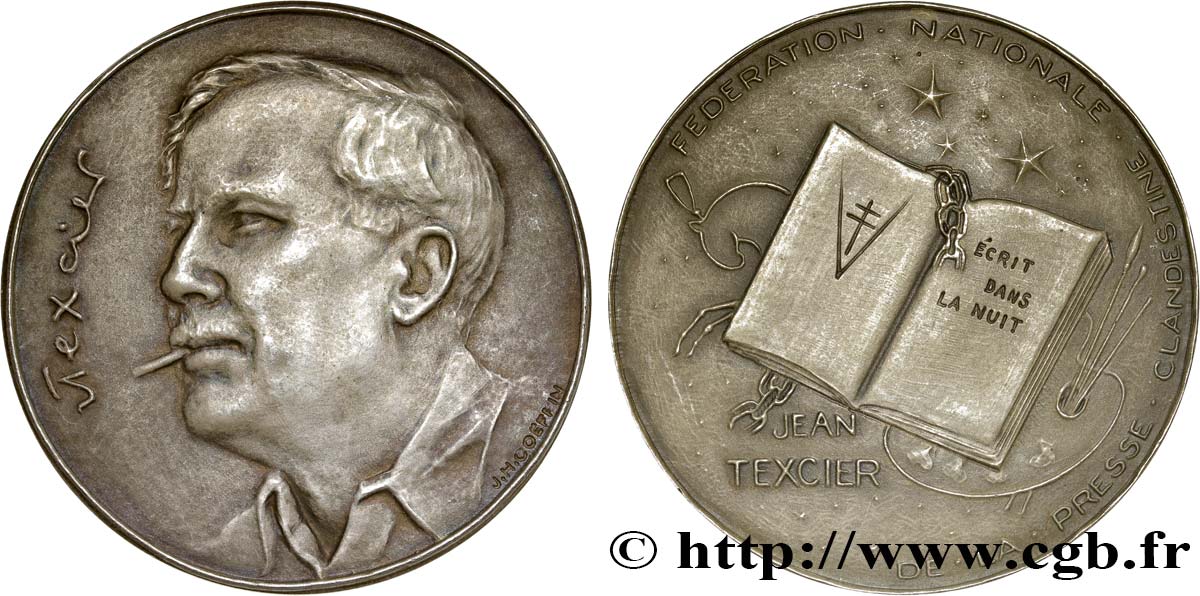
fme_367756 - DRITTE FRANZOSISCHE REPUBLIK Médaille de Jean Texcier - Presse clandestine
Nicht verfügbar.
Artikel auf unserem Online-Shop verkauft (2019)
Preis : 250.00 €
Artikel auf unserem Online-Shop verkauft (2019)
Preis : 250.00 €
Type : Médaille de Jean Texcier - Presse clandestine
Datum: n.d.
Name der Münzstätte / Stadt : 75 - Paris
Metall : Silber
Durchmesser : 68 mm
Stempelstellung : 12 h.
Graveur COËFFIN Josette Hébert (1906-1973)
Gewicht : 122 g.
Rand lisse + corne 1 ARGENT
Kommentare zum Erhaltungszustand:
Superbe médaille, avec une belle patine de vieil argent
Vorderseite
Titulatur der Vorderseite TEXCIER.
Beschreibung Vorderseite Buste de Jean Texcier à gauche, chemise ouverte, fumant une cigarette.
Rückseite
Titulatur der Rückseite FEDERATION . NATIONALE. DE. LA. PRESSE. CLANDESTINE.
Beschreibung Rückseite Livre ouvert déchaîné avec croix de Lorraine dans un V de Victoire, “Écrit dans la nuit”, sur fond de cheval, palette de peinture et pinceaux, astes.
Kommentare
Jean Texcier naît le 6 octobre 1888 à Rouen (Seine-Inférieure) dans un milieu d'enseignants républicains. Il adhère à la 5e section SFIO de la Seine à son arrivé à Paris en 1907. Secrétaire des Étudiants collectiviste de 1910 à 1913, il collabore à L'Humanité et à La Guerre sociale, milite aux côtés de Jaurès et de Pierre Renaudel, dont il reste toute sa vie l'ami. Licencié en droit, entré en 1909 au Ministère du Commerce, rédacteur en 1912, il est par ailleurs peintre et journaliste.
Réformé, Texcier s'engage en 1915 pour la durée des hostilités et sert comme téléphoniste. Gravement blessé en Champagne, volontaire pour les missions dangereuses, il est décoré à plusieurs reprises. Fidèle à la SFIO à Tours, partisan d'un socialisme de réformes et d'évolution, Texcier appartient au comité de rédaction de La Vie socialiste. En 1933, il participe à la fondation du Parti socialiste de France, mais revient à la SFIO, après la mort de Renaudel. Il collabore encore aux Nouvelles littéraires, illustrant les portraits d'hommes de lettres.
Texcier écrit en juillet 1940 et imprime en août chez Keller, rue Rochechouart, les Conseils à l'occupé, première brochure clandestine à l'ironie perçante. Il n'incite pas à la révolte mais au refus de toute compromission avec l'occupant. Il s'agit tout d'abord d'ignorer systématiquement l'occupation, d'oublier la langue allemande, etc. Des extraits sont lus à la BBC par Maurice Schuman. Suivent ensuite Notre combat, rappelant l'alliance avec l'Angleterre, Propos de l'occupé, qui comparent la collaboration à celle du cochon et du marchand de bestiaux pour le paysan, et de la paire de fesses et de la paire de bottes pour l'ouvrier, et Les Lettres à François en janvier 1941.
Mis à la retraite par le gouvernement de Vichy en 1941, Texcier est l'un des fondateurs du mouvement Libération-Nord avec Henri Ribière et Christian Pineau (ensemble, ils rédigent Nous les travailleurs). Membre du comité directeur, après l'arrestation de Pineau, il rédige le journal du mouvement (pseudo Serge Boze). Il participe aussi à la formation du CAS-Nord, puis à l'unification de celui-ci avec le CAS-Sud (avec Daniel Mayer ils rédigent le texte d'accord qui donne naissance au Parti socialiste clandestin en juin 1943). Membre du bureau permanent de la Fédération de la presse clandestine, il appartient à la commission de l'information du CNR.
En 1944, Libération Nord délègue Jean Texcier à l'Assemblée consultative provisoire. Il devient l'un des grands éditorialistes de l'après-guerre, À Combat au début du journal, puis comme directeur politique de Libé-Soir, de Gavroche et de Clarté. Il s'impose aussi comme critique littéraire au Populaire-Dimanche. À partir de 1947, il siège au Comité directeur de la SFIO. Désigné comme secrétaire général de Libération Nord, à la mort d'Henri Ribière, il décède à Paris, le 22 mars 1957.
Beaucoup de ses appels ou articles clandestins ont vu le jour dès la Libération sous le titre Écrit dans la nuit.
Après son décès, en 1957, un Comité des Amis de Jean Texcier publia Jean Texcier un homme libre, Albin Michel, 1960.
Jean Texcier était commandeur de la Légion d'Honneur. Il a aussi été décoré de la Médaille militaire, de la Croix de guerre 1914-1918 et 1939-1945.
http://museedelaresistanceenligne.org/media2229-Plaque-A.
Jean Texcier was born on October 6, 1888 in Rouen (Seine-Inférieure) into a family of republican teachers. He joined the 5th SFIO section of the Seine upon his arrival in Paris in 1907.. Secretary of the Collectivist Students from 1910 to 1913, he contributed to L'Humanité and La Guerre sociale, campaigned alongside Jaurès and Pierre Renaudel, with whom he remained a friend throughout his life.. A law graduate, he joined the Ministry of Commerce in 1909 and became an editor in 1912. He was also a painter and journalist..
Reformed, Texcier enlisted in 1915 for the duration of hostilities and served as a telephone operator.. Seriously injured in Champagne, volunteering for dangerous missions, he was decorated several times. Loyal to the SFIO in Tours, a supporter of a socialism of reforms and evolution, Texcier belongs to the editorial committee of La Vie socialiste. In 1933, he participated in the founding of the Socialist Party of France, but returned to the SFIO after the death of Renaudel.. He still collaborates with Nouvelles littéraires, illustrating portraits of men of letters..
In July 1940, Texcier wrote and printed in August at Keller's, rue Rochechouart, Conseils à l'occupié, the first clandestine brochure with piercing irony.. It does not incite revolt but rather the refusal of any compromise with the occupier.. First of all, it is a matter of systematically ignoring the occupation, forgetting the German language, etc.. Excerpts are read on the BBC by Maurice Schuman. Then follow Our Struggle, recalling the alliance with England, Words of the Occupied, which compares collaboration to that of the pig and the cattle dealer for the peasant, and of the pair of buttocks and the pair of boots for the worker, and Letters to François in January 1941..
Retired by the Vichy government in 1941, Texcier was one of the founders of the Libération-Nord movement with Henri Ribière and Christian Pineau (together, they wrote Nous les travailleurs). Member of the steering committee, after Pineau's arrest, he wrote the movement's newspaper (pseudo Serge Boze). He also participated in the formation of the CAS-Nord, then in its unification with the CAS-Sud (with Daniel Mayer they drafted the text of the agreement which gave birth to the clandestine Socialist Party in June 1943). A member of the permanent office of the Federation of the Underground Press, he is a member of the CNR's information commission..
In 1944, Libération Nord delegated Jean Texcier to the Provisional Consultative Assembly. He became one of the great editorialists of the post-war period, in Combat at the start of the newspaper, then as political director of Libé-Soir, Gavroche and Clarté. He also established himself as a literary critic at Populaire-Dimanche. From 1947, he sat on the SFIO Steering Committee. Appointed as secretary general of Libération Nord, upon the death of Henri Ribière, he died in Paris on March 22, 1957..
Many of his clandestine appeals or articles appeared after the Liberation under the title Written in the Night.
After his death in 1957, a Committee of Friends of Jean Texcier published Jean Texcier, a free man, Albin Michel, 1960.
Jean Texcier was a Commander of the Legion of Honor. He was also decorated with the Military Medal, the War Cross 1914-1918 and 1939-1945.
http://museedelaresistanceenligne. org/media2229-Plaque-A
Réformé, Texcier s'engage en 1915 pour la durée des hostilités et sert comme téléphoniste. Gravement blessé en Champagne, volontaire pour les missions dangereuses, il est décoré à plusieurs reprises. Fidèle à la SFIO à Tours, partisan d'un socialisme de réformes et d'évolution, Texcier appartient au comité de rédaction de La Vie socialiste. En 1933, il participe à la fondation du Parti socialiste de France, mais revient à la SFIO, après la mort de Renaudel. Il collabore encore aux Nouvelles littéraires, illustrant les portraits d'hommes de lettres.
Texcier écrit en juillet 1940 et imprime en août chez Keller, rue Rochechouart, les Conseils à l'occupé, première brochure clandestine à l'ironie perçante. Il n'incite pas à la révolte mais au refus de toute compromission avec l'occupant. Il s'agit tout d'abord d'ignorer systématiquement l'occupation, d'oublier la langue allemande, etc. Des extraits sont lus à la BBC par Maurice Schuman. Suivent ensuite Notre combat, rappelant l'alliance avec l'Angleterre, Propos de l'occupé, qui comparent la collaboration à celle du cochon et du marchand de bestiaux pour le paysan, et de la paire de fesses et de la paire de bottes pour l'ouvrier, et Les Lettres à François en janvier 1941.
Mis à la retraite par le gouvernement de Vichy en 1941, Texcier est l'un des fondateurs du mouvement Libération-Nord avec Henri Ribière et Christian Pineau (ensemble, ils rédigent Nous les travailleurs). Membre du comité directeur, après l'arrestation de Pineau, il rédige le journal du mouvement (pseudo Serge Boze). Il participe aussi à la formation du CAS-Nord, puis à l'unification de celui-ci avec le CAS-Sud (avec Daniel Mayer ils rédigent le texte d'accord qui donne naissance au Parti socialiste clandestin en juin 1943). Membre du bureau permanent de la Fédération de la presse clandestine, il appartient à la commission de l'information du CNR.
En 1944, Libération Nord délègue Jean Texcier à l'Assemblée consultative provisoire. Il devient l'un des grands éditorialistes de l'après-guerre, À Combat au début du journal, puis comme directeur politique de Libé-Soir, de Gavroche et de Clarté. Il s'impose aussi comme critique littéraire au Populaire-Dimanche. À partir de 1947, il siège au Comité directeur de la SFIO. Désigné comme secrétaire général de Libération Nord, à la mort d'Henri Ribière, il décède à Paris, le 22 mars 1957.
Beaucoup de ses appels ou articles clandestins ont vu le jour dès la Libération sous le titre Écrit dans la nuit.
Après son décès, en 1957, un Comité des Amis de Jean Texcier publia Jean Texcier un homme libre, Albin Michel, 1960.
Jean Texcier était commandeur de la Légion d'Honneur. Il a aussi été décoré de la Médaille militaire, de la Croix de guerre 1914-1918 et 1939-1945.
http://museedelaresistanceenligne.org/media2229-Plaque-A.
Jean Texcier was born on October 6, 1888 in Rouen (Seine-Inférieure) into a family of republican teachers. He joined the 5th SFIO section of the Seine upon his arrival in Paris in 1907.. Secretary of the Collectivist Students from 1910 to 1913, he contributed to L'Humanité and La Guerre sociale, campaigned alongside Jaurès and Pierre Renaudel, with whom he remained a friend throughout his life.. A law graduate, he joined the Ministry of Commerce in 1909 and became an editor in 1912. He was also a painter and journalist..
Reformed, Texcier enlisted in 1915 for the duration of hostilities and served as a telephone operator.. Seriously injured in Champagne, volunteering for dangerous missions, he was decorated several times. Loyal to the SFIO in Tours, a supporter of a socialism of reforms and evolution, Texcier belongs to the editorial committee of La Vie socialiste. In 1933, he participated in the founding of the Socialist Party of France, but returned to the SFIO after the death of Renaudel.. He still collaborates with Nouvelles littéraires, illustrating portraits of men of letters..
In July 1940, Texcier wrote and printed in August at Keller's, rue Rochechouart, Conseils à l'occupié, the first clandestine brochure with piercing irony.. It does not incite revolt but rather the refusal of any compromise with the occupier.. First of all, it is a matter of systematically ignoring the occupation, forgetting the German language, etc.. Excerpts are read on the BBC by Maurice Schuman. Then follow Our Struggle, recalling the alliance with England, Words of the Occupied, which compares collaboration to that of the pig and the cattle dealer for the peasant, and of the pair of buttocks and the pair of boots for the worker, and Letters to François in January 1941..
Retired by the Vichy government in 1941, Texcier was one of the founders of the Libération-Nord movement with Henri Ribière and Christian Pineau (together, they wrote Nous les travailleurs). Member of the steering committee, after Pineau's arrest, he wrote the movement's newspaper (pseudo Serge Boze). He also participated in the formation of the CAS-Nord, then in its unification with the CAS-Sud (with Daniel Mayer they drafted the text of the agreement which gave birth to the clandestine Socialist Party in June 1943). A member of the permanent office of the Federation of the Underground Press, he is a member of the CNR's information commission..
In 1944, Libération Nord delegated Jean Texcier to the Provisional Consultative Assembly. He became one of the great editorialists of the post-war period, in Combat at the start of the newspaper, then as political director of Libé-Soir, Gavroche and Clarté. He also established himself as a literary critic at Populaire-Dimanche. From 1947, he sat on the SFIO Steering Committee. Appointed as secretary general of Libération Nord, upon the death of Henri Ribière, he died in Paris on March 22, 1957..
Many of his clandestine appeals or articles appeared after the Liberation under the title Written in the Night.
After his death in 1957, a Committee of Friends of Jean Texcier published Jean Texcier, a free man, Albin Michel, 1960.
Jean Texcier was a Commander of the Legion of Honor. He was also decorated with the Military Medal, the War Cross 1914-1918 and 1939-1945.
http://museedelaresistanceenligne. org/media2229-Plaque-A
Historischer Hintergrund
DRITTE FRANZOSISCHE REPUBLIK
(04.09.1870-10.07.1940)
Die Nachricht von der Kapitulation Sedans löst am 4. September 1870 in Paris die Revolution aus. Die im Hôtel de Ville proklamierte Republik verfügt über eine provisorische Regierung namens Regierung der Nationalen Verteidigung. Auf der linken Seite durch den Aufstand der Kommune und auf der rechten Seite durch die Monarchisten bedroht, hatte das neue Regime einen schwierigen Start.. Als ursprünglicher Chef der Exekutive (Februar 1871) war Thiers für die Neuorganisation des Landes verantwortlich, bevor er sich für die Regierungsform entschied.. Er wurde im August 1871 Präsident der Republik und musste trotz seiner Bemühungen zur Befreiung des Territoriums im März 1873 sein Amt angesichts des Widerstands der Royalisten aufgeben.. Er wird dann durch Mac-Mahon ersetzt, der für die Wiederherstellung der Monarchie ist, aber dieser wird nach der Frage der Flagge nicht wiederhergestellt. Im November 1873 wurde dann das Gesetz des Septennats in Kraft gesetzt und 1875 wurden die Grundgesetze verabschiedet, die als Verfassung der Dritten Republik dienten.. Das parlamentarische System zeichnet sich insbesondere durch das klare Übergewicht der gesetzgebenden Gewalt gegenüber der exekutiven Gewalt aus. Antiklerikalistisch macht die Dritte Republik die Schule kostenlos, säkular und obligatorisch, führt aber die Kolonialpolitik für ihre wirtschaftlichen, strategischen und moralischen Ambitionen fort. Die Trennung von Kirche und Staat wurde 1905 beschlossen.. Die Idee der Rache an Deutschland und ein ausgeprägter Nationalismus stehen im Mittelpunkt der Boulang-Krise, des Panama-Skandals oder der Dreyfus-Affäre der Jahre 1886-1899, während die Außenpolitik insbesondere in Marokko sehr aktiv ist und sich das Wettrüsten entwickelt. Der Erste Weltkrieg war für Frankreich teuer, das sich erst ab 1920 oder gar 1928 von der Währung mit dem „Poincaré“-Franc erholte.. Die Krise von 1929 ist erst ab 1932 spürbar, dauert aber bis 1939, einer Zeit, in der die Instabilität der Minister sehr wichtig ist. Die Dritte Republik geriet 1934 ins Wanken und fand mit dem Antifaschismus einen neuen gemeinsamen Kitt, der es der Volksfront 1936 ermöglichte, an die Macht zu gelangen.. Doch das gegenüber Deutschland gelähmte Frankreich geriet anschließend in einen „Scheinkrieg“ und erlitt im Juni 1940 eine der größten Niederlagen seiner Geschichte.. Die am 10. Juli 1940 in der Nationalversammlung in Vichy versammelten Kammern stimmten, obwohl 1936 gewählt, Pétain in einer Art kollektivem Selbstmord mit 569 Ja-Stimmen, 80 Nein-Stimmen und 18 Enthaltungen die volle Macht zu..
 Berichten über einen Fehler
 Die Seite drucken
 Teilen meiner Auswahl
 Stellen Sie eine Frage
 Einlieferung/Verkauf
In Verbindung stehende Artikel
 Details


cgbfr.de numismatik


