


bpv_158416 - TREBONIANUS GALLUS Tétradrachme syro-phénicien
Nicht verfügbar.
Artikel auf unserem Online-Shop verkauft (2015)
Preis : 140.00 €
Artikel auf unserem Online-Shop verkauft (2015)
Preis : 140.00 €
Type : Tétradrachme syro-phénicien
Datum: 251
Name der Münzstätte / Stadt : Antioche, Syrie, Séleucie et Piérie
Metall : Scheidemünze
Durchmesser : 25,5 mm
Stempelstellung : 6 h.
Gewicht : 11,71 g.
Seltenheitsgrad : R2
Kommentare zum Erhaltungszustand:
Très faible usure, bonne frappe, mais très légère traces de corrosion sur toute la surface du droit
N° im Nachschlagewerk :
Pedigree :
Cet exemplaire, qui provient de la trouvaille dite Turquie 1930, est le 0670_008 de la base TSP
Vorderseite
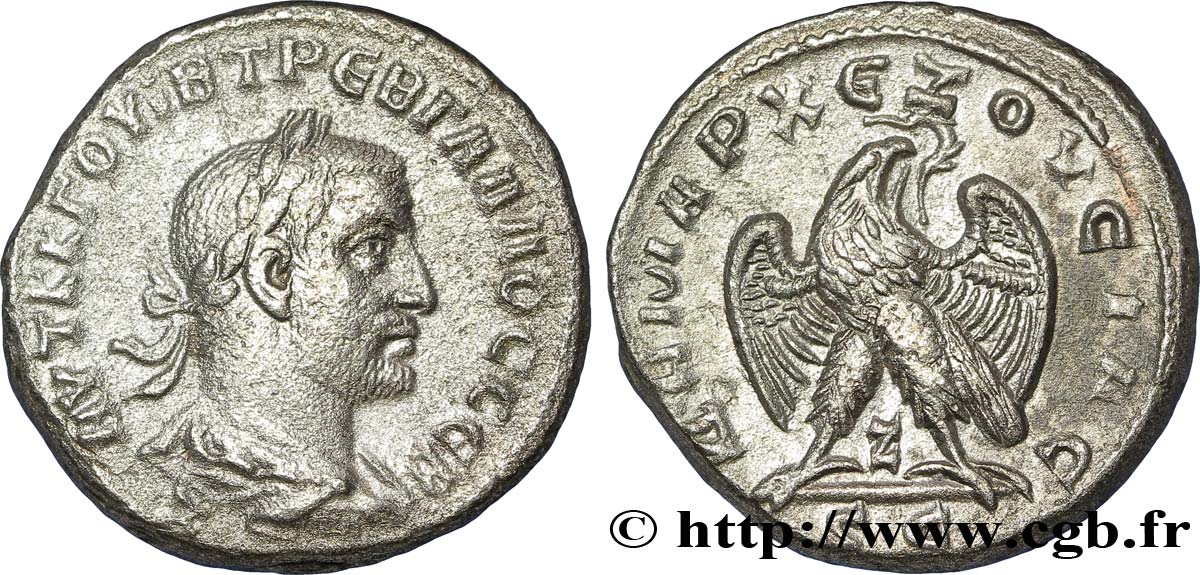
Beschreibung Vorderseite Buste lauré, drapé et cuirassé de Trébonien Galle à droite, vu de trois quarts en arrière (A*2), Z sous le buste.
Legende des Averses AUTK K G OUIB TREB GALLOS SEB
Übersetzung der Vorderseite (L’empereur césar Caius Vibius Trebonien Galle auguste).
Rückseite
Titulatur der Rückseite S C À L’EXERGUE.
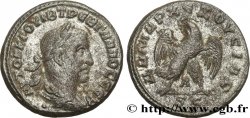
Beschreibung Rückseite Aigle debout à gauche sur une ligne de terre, les ailes déployées, tête et queue à droite, tenant une couronne feuillée dans son bec, lettre d’officine Z entre les pattes.
Legende des Reverses : DHMARC EX OUSIAS / Z
Übersetzung der Rückseite (Revêtu de la puissance tribunitienne / avec l’accord du Sénat d’Antioche).
Kommentare
La lettre Z correspond au 7, le Z étant la septième lettre de l’alphabet grec. La pièce est de la septième officine.
Il a fallu créer une variante dans l’officine 7 afin de distinguer les légendes longues commençant par AYTOKK et les courtes en AYTKK. Il est peu probable que cette formule raccourcie provienne d’un choix du graveur manquant de place. En effet, même si l’on peut supposer que, la gravure se faisant à l’envers, le monnayeur ait terminé sa légende par le début de celle-ci, donc découvert alors le manque de place, donc retiré une lettre, il y a trop d’exemples où une lettre manquante faute de place est placée à la fin grammaticale de la légende avec abréviation du CEB pour penser que c’est la raison réelle de cette légende courte. Malheureusement, tant qu’une série de liaisons de coins n’aura pas été faite, aucun motif numismatique n’apparaît pour placer ces légendes courtes à un emplacement particulier de la frappe.
Richard McAlee ne tient pas compte de cette variante de légende dans son classement.
On constate que la légende courte existe aussi bien avec l’aigle à gauche, comme nous la trouvons avec l’aigle à droite. Il n’y a donc pas de lien entre ces deux caractéristiques.
Sans que l’on comprenne pourquoi, l’officine Z, donc la septième, se caractérise par une production relativement importante. Peut-être faut-il en déduire qu’elle ne frappait que des tétradrachmes alors que les autres frappaient également des antoniniens ou des tétradrachmes pour Volusien ?
Les frappes de Trébonien Galle et de Volusien signent la fin de la série des tétradrachmes syro-phéniciens, si l’on ne tient pas compte du sursaut d’Uranius Antoninus. Cette courte frappe, 251/253, va concentrer tous les symptômes d’une fin, de l’effondrement de l’aloi à celui du style.
Notons tout d’abord les changements de fond : mis à part la complète disparition des bustes radiés qui sont réservés à Volusien, la palme disparaît et la position de l’aigle change.
Que pouvait représenter cette palme ?
Une autorité impliquée dans le financement du monnayage ? Dans ce cas, elle aurait passé les siècles et serait certainement d’essence religieuse puisque sa première apparition est dans la main de la Tyché de la ville. Le culte rendu à cette divinité était-il si important que les autorités auraient pu en mettre le clergé à contribution où requérir son aval ? Si tel est le cas, pourquoi Trébonien Galle aurait-il dérogé à l’habitude ? Pourquoi aurait-elle disparu sous les Sévères ?
On peut aussi penser à un raccourci symbolique de la Tyché mais pourquoi Trébonien aurait-il éliminé cette référence ? La question reste ouverte.
D’autant plus que le changement de position de l’aigle, où tête et queue sont maintenant systématiquement en position inverse du corps, rappelle immanquablement les rarissimes émissions finales de Trajan Dèce et de sa famille avec cette position et le point entre les pattes, remplacé chez Trébonien Galle par la lettre d’atelier. Il faut croire que les changements de type monétaire précèdent, dans l’Antioche du IIIe siècle, les chutes de régime : cela se vérifie de Philippe à Galle.
La première série de frappe est de 251 AD avec un revers sans marque de consulat. Tous les bustes sont laurés, drapés et cuirassés sauf un buste à gauche de la septième officine, le seul buste exceptionnel retrouvé à ce jour. La qualité des frappes et de l’aloi sont comparables aux standards de Trajan Dèce.
On note que les sigma sont gravés en C.
Dans la base TSP maintenue par Michel Prieur, huit exemplaires sont maintenant répertoriés pour ce type, dont seulement deux en musées, à Jérusalem (trouvaille de Capharnaüm) et à l’ANS.
The letter Z corresponds to 7, Z being the seventh letter of the Greek alphabet. The room is from the seventh pharmacy.
It was necessary to create a variant in pharmacy 7 in order to distinguish between long captions beginning with AYTOKK and short ones beginning with AYTKK.. It is unlikely that this shortened formula came from a choice of the engraver due to lack of space. Indeed, even if we can suppose that, the engraving being done in reverse, the minter finished his legend at the beginning of it, therefore discovered the lack of space, therefore removed a letter, there are too many examples where a missing letter due to lack of space is placed at the grammatical end of the legend with abbreviation of the CEB to think that this is the real reason for this short legend. Unfortunately, until a series of die links has been made, no numismatic pattern appears to place these short legends in a particular location on the strike..
Richard McAlee does not take this variant of legend into account in his classification.
We see that the short legend exists as well with the eagle on the left, as we find it with the eagle on the right. So there is no link between these two characteristics..
Without anyone understanding why, pharmacy Z, therefore the seventh, is characterized by a relatively high production. Perhaps we should deduce that it only struck tetradrachms while the others also struck Antoninianus or tetradrachms for Volusianus? The strikes of Trebonianus Gallus and Volusianus mark the end of the series of Syro-Phoenician tetradrachms, if we do not take into account the surge of Uranius Antoninus. This short strike, 251/253, will concentrate all the symptoms of an end, from the collapse of the alloy to that of the style..
Let us first note the fundamental changes: apart from the complete disappearance of the radiate busts which are reserved for Volusien, the palm disappears and the position of the eagle changes.
What could this palm represent? An authority involved in financing the coinage? In this case, it would have survived the centuries and would certainly be of religious essence since its first appearance is in the hand of the city's Tyche.. Was the cult of this deity so important that the authorities could have called upon the clergy or sought their approval? If so, why would Trebonianus Gallus have deviated from the custom? Why would it have disappeared under the Severi? One could also think of a symbolic shortcut to Tyche, but why would Trebonianus have eliminated this reference? The question remains open..
All the more so since the change in position of the eagle, where the head and tail are now systematically in the opposite position to the body, inevitably recalls the extremely rare final emissions of Trajan Decius and his family with this position and the point between the legs, replaced in Trebonianus Galle by the workshop letter. It must be believed that changes in monetary type precede, in Antioch of the 3rd century, the falls of regime: this is verified from Philip to Galle.
The first strike series is from 251 AD with a reverse without a consulate mark. All the busts are laureate, draped and cuirassed except for one bust on the left of the seventh office, the only exceptional bust found to date.. The quality of the strikes and the alloy are comparable to the standards of Trajan Decius..
Note that the sigmas are engraved in C.
In the TSP database maintained by Michel Prieur, eight examples are now listed for this type, of which only two are in museums, in Jerusalem (Capernaum find) and at the ANS
Il a fallu créer une variante dans l’officine 7 afin de distinguer les légendes longues commençant par AYTOKK et les courtes en AYTKK. Il est peu probable que cette formule raccourcie provienne d’un choix du graveur manquant de place. En effet, même si l’on peut supposer que, la gravure se faisant à l’envers, le monnayeur ait terminé sa légende par le début de celle-ci, donc découvert alors le manque de place, donc retiré une lettre, il y a trop d’exemples où une lettre manquante faute de place est placée à la fin grammaticale de la légende avec abréviation du CEB pour penser que c’est la raison réelle de cette légende courte. Malheureusement, tant qu’une série de liaisons de coins n’aura pas été faite, aucun motif numismatique n’apparaît pour placer ces légendes courtes à un emplacement particulier de la frappe.
Richard McAlee ne tient pas compte de cette variante de légende dans son classement.
On constate que la légende courte existe aussi bien avec l’aigle à gauche, comme nous la trouvons avec l’aigle à droite. Il n’y a donc pas de lien entre ces deux caractéristiques.
Sans que l’on comprenne pourquoi, l’officine Z, donc la septième, se caractérise par une production relativement importante. Peut-être faut-il en déduire qu’elle ne frappait que des tétradrachmes alors que les autres frappaient également des antoniniens ou des tétradrachmes pour Volusien ?
Les frappes de Trébonien Galle et de Volusien signent la fin de la série des tétradrachmes syro-phéniciens, si l’on ne tient pas compte du sursaut d’Uranius Antoninus. Cette courte frappe, 251/253, va concentrer tous les symptômes d’une fin, de l’effondrement de l’aloi à celui du style.
Notons tout d’abord les changements de fond : mis à part la complète disparition des bustes radiés qui sont réservés à Volusien, la palme disparaît et la position de l’aigle change.
Que pouvait représenter cette palme ?
Une autorité impliquée dans le financement du monnayage ? Dans ce cas, elle aurait passé les siècles et serait certainement d’essence religieuse puisque sa première apparition est dans la main de la Tyché de la ville. Le culte rendu à cette divinité était-il si important que les autorités auraient pu en mettre le clergé à contribution où requérir son aval ? Si tel est le cas, pourquoi Trébonien Galle aurait-il dérogé à l’habitude ? Pourquoi aurait-elle disparu sous les Sévères ?
On peut aussi penser à un raccourci symbolique de la Tyché mais pourquoi Trébonien aurait-il éliminé cette référence ? La question reste ouverte.
D’autant plus que le changement de position de l’aigle, où tête et queue sont maintenant systématiquement en position inverse du corps, rappelle immanquablement les rarissimes émissions finales de Trajan Dèce et de sa famille avec cette position et le point entre les pattes, remplacé chez Trébonien Galle par la lettre d’atelier. Il faut croire que les changements de type monétaire précèdent, dans l’Antioche du IIIe siècle, les chutes de régime : cela se vérifie de Philippe à Galle.
La première série de frappe est de 251 AD avec un revers sans marque de consulat. Tous les bustes sont laurés, drapés et cuirassés sauf un buste à gauche de la septième officine, le seul buste exceptionnel retrouvé à ce jour. La qualité des frappes et de l’aloi sont comparables aux standards de Trajan Dèce.
On note que les sigma sont gravés en C.
Dans la base TSP maintenue par Michel Prieur, huit exemplaires sont maintenant répertoriés pour ce type, dont seulement deux en musées, à Jérusalem (trouvaille de Capharnaüm) et à l’ANS.
The letter Z corresponds to 7, Z being the seventh letter of the Greek alphabet. The room is from the seventh pharmacy.
It was necessary to create a variant in pharmacy 7 in order to distinguish between long captions beginning with AYTOKK and short ones beginning with AYTKK.. It is unlikely that this shortened formula came from a choice of the engraver due to lack of space. Indeed, even if we can suppose that, the engraving being done in reverse, the minter finished his legend at the beginning of it, therefore discovered the lack of space, therefore removed a letter, there are too many examples where a missing letter due to lack of space is placed at the grammatical end of the legend with abbreviation of the CEB to think that this is the real reason for this short legend. Unfortunately, until a series of die links has been made, no numismatic pattern appears to place these short legends in a particular location on the strike..
Richard McAlee does not take this variant of legend into account in his classification.
We see that the short legend exists as well with the eagle on the left, as we find it with the eagle on the right. So there is no link between these two characteristics..
Without anyone understanding why, pharmacy Z, therefore the seventh, is characterized by a relatively high production. Perhaps we should deduce that it only struck tetradrachms while the others also struck Antoninianus or tetradrachms for Volusianus? The strikes of Trebonianus Gallus and Volusianus mark the end of the series of Syro-Phoenician tetradrachms, if we do not take into account the surge of Uranius Antoninus. This short strike, 251/253, will concentrate all the symptoms of an end, from the collapse of the alloy to that of the style..
Let us first note the fundamental changes: apart from the complete disappearance of the radiate busts which are reserved for Volusien, the palm disappears and the position of the eagle changes.
What could this palm represent? An authority involved in financing the coinage? In this case, it would have survived the centuries and would certainly be of religious essence since its first appearance is in the hand of the city's Tyche.. Was the cult of this deity so important that the authorities could have called upon the clergy or sought their approval? If so, why would Trebonianus Gallus have deviated from the custom? Why would it have disappeared under the Severi? One could also think of a symbolic shortcut to Tyche, but why would Trebonianus have eliminated this reference? The question remains open..
All the more so since the change in position of the eagle, where the head and tail are now systematically in the opposite position to the body, inevitably recalls the extremely rare final emissions of Trajan Decius and his family with this position and the point between the legs, replaced in Trebonianus Galle by the workshop letter. It must be believed that changes in monetary type precede, in Antioch of the 3rd century, the falls of regime: this is verified from Philip to Galle.
The first strike series is from 251 AD with a reverse without a consulate mark. All the busts are laureate, draped and cuirassed except for one bust on the left of the seventh office, the only exceptional bust found to date.. The quality of the strikes and the alloy are comparable to the standards of Trajan Decius..
Note that the sigmas are engraved in C.
In the TSP database maintained by Michel Prieur, eight examples are now listed for this type, of which only two are in museums, in Jerusalem (Capernaum find) and at the ANS
Historischer Hintergrund
TREBONIANUS GALLUS
(06/251-06/253)
Trebonian Galle, ursprünglich aus Perugia, war während der Herrschaft von Trajan Decius Gouverneur von Moesia. Während der Schlacht von Abritus verzichtet er darauf, Decius in Schwierigkeiten zu helfen: Der Kaiser wird von den Goten getötet. Trebonian wird zum August ernannt und unterzeichnet Frieden mit Kniva. Er beeilt sich, nach Rom zurückzukehren, wo er einerseits Hostilian, den letzten überlebenden Sohn von Trajan Decius, als Augustus und andererseits seinen eigenen Sohn Volusien als Cäsar assoziiert. Als Hostilian an der Pest stirbt oder ermordet wird, wird Volusian zum Augustus. Trebonian Galle würdigt die Goten, während die Sassaniden von Sapor I Syrien bedrohen und die Pest weiterhin das Imperium verwüstet. Er greift die Christenverfolgungen auf, hat aber keine Politik. Nachdem die Invasion am Donaulimes mit der Ankunft neuer Barbarenhorden wieder aufgenommen wurde, wird Emilian von seinen Truppen zum Augustus erklärt und marschiert nach Italien. Trébonien Galle ruft Valérien zu seiner Rettung an und die entscheidende Begegnung findet 253 in Terni statt. Trébonien Galle und Volusien werden geschlagen und sterben in der Schlacht, aus der Émilien für kurze Zeit als Sieger hervorgeht, bevor er von seinen Truppen, die sich Valérien Ier angeschlossen haben, ermordet wird.
 Berichten über einen Fehler
 Die Seite drucken
 Teilen meiner Auswahl
 Stellen Sie eine Frage
 Einlieferung/Verkauf
In Verbindung stehende Artikel
 Details

Ihre zuletzt angesehenen Artikel
100 Francs DESCARTES FRANKREICH 1944 F.27.08 fVZ
80.00 €

GALLIEN - MITTLEWEST, UNBEKANNT Drachme à la tête casquée S/SS
800.00 €
cgbfr.de numismatik


