


brm_1111872 - TRAIANUS Denier

180.00 €
Menge
In den Warenkorb

Type : Denier
Datum: 106
Name der Münzstätte / Stadt : Roma
Metall : Silber
Der Feingehalt beträgt : 900 ‰
Durchmesser : 18 mm
Stempelstellung : 7 h.
Gewicht : 3,20 g.
Seltenheitsgrad : R1
Officine: 5e
Kommentare zum Erhaltungszustand:
Monnaie centrée. Joli buste. Revers agréable. Patine grise
N° im Nachschlagewerk :
Pedigree :
Cette monnaie provient de la Collection Joulia
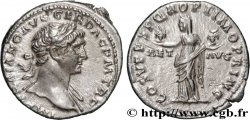
Vorderseite
Titulatur der Vorderseite IMP TRAIANO AVG GER DAC P M TR P COS V P P.
Beschreibung Vorderseite Tête laurée de Trajan à droite, drapée sur l’épaule gauche (O*2).
Übersetzung der Vorderseite “Imperatori Traiano Augusto Germanico Dacico Pontifex Maximus Tribunicia Potestate Consuli quinto, Patri Patriæ”, (À l’empereur Trajan auguste germanique, dacique, grand pontife, revêtu de la puissance tribunitienne, consul pour la cinquième fois, père de la patrie).
Rückseite
Titulatur der Rückseite S P Q R OPTIMO - PRINCIPI.
Beschreibung Rückseite Ceres voilée, debout à gauche, tenant des épside la main droite et une longue torche de la main gauche.
Übersetzung der Rückseite “Senatus Populus Que Romanus Optimo Principi”, (Le sénat et le peuple romain, au meilleur des princes).
Kommentare
Il revient à l’école anglaise et aux travaux de P. V. Hill, The dating and arrangement of the Undated Coins of Rome AD. 98-148, Londres 1970, d’avoir reclassé les différentes émissions de l’atelier de Rome, grâce à la théorie des cycles et d’avoir mis en lumière l’organisation de l’atelier de Rome qui travaille en officines et non pas en fonction du métal comme l’avaient décrit les numismates du XIXe siècle. Rubans de type 3.
It is the English school and the work of PV Hill, The dating and arrangement of the Undated Coins of Rome AD. 98-148, London 1970, which reclassified the various issues of the Rome mint, thanks to the theory of cycles and to have highlighted the organization of the Rome mint which worked in workshops and not according to the metal as the 19th century numismatists had described. Type 3 ribbons
It is the English school and the work of PV Hill, The dating and arrangement of the Undated Coins of Rome AD. 98-148, London 1970, which reclassified the various issues of the Rome mint, thanks to the theory of cycles and to have highlighted the organization of the Rome mint which worked in workshops and not according to the metal as the 19th century numismatists had described. Type 3 ribbons
Historischer Hintergrund
TRAIANUS
(27.10.97-8.08.117)
Augustus
Trajan wurde wie sein Schüler Hadrian am 18. September 53 in Italica, in der Nähe von Sevilla in Spanien, geboren. Er gehört zu einer in Spanien ansässigen Siedlerfamilie. Nach einer glänzenden Militärkarriere unter den Flaviern war er 91 Konsul und Legat von Germania Superior, als er 97 von Nerva als Nachfolger adoptiert wurde. Nach dessen Tod wird er August. Seine Regierungszeit wird von zahlreichen Feldzügen gegen die Deutschen am Rheinlimes geprägt sein, die ihm den Titel Germanicus einbrachten. Anschließend führte er zwei Dakerkriege gegen Decebalus, die mit der Annexion Dakiens endeten. Trajan bereitet einen Feldzug gegen die Parther vor, die unruhigen und mächtigen Nachbarn im Osten. Er verließ Rom in Richtung Osten und richtete sein Hauptquartier in Antiochia ein, bevor er in das parthische Königreich einfiel. Er wird bis nach Ktesiphon (Seleucia am Tigris) gehen. Als er am 8. August 117 starb, befand sich das Reich auf dem Höhepunkt und erlebte seine größte territoriale Expansion..
 Berichten über einen Fehler
 Die Seite drucken
 Teilen meiner Auswahl
 Stellen Sie eine Frage
 Einlieferung/Verkauf
In Verbindung stehende Artikel
 Details


cgbfr.de numismatik


