


E-auction 159-96783 - bpv_154332 - TRAIANUS DECIUS Tétradrachme syro-phénicien
Sie müssen angeschlossen sein und von cgb.fr genehmigt werden, um in einer E-Auktion teilzunehmen.Melden Sie sich an, um zu wetten..Die Kontobestätigungen sind innerhalb von 48 Stunden nach Ihrer Anmeldung gemacht.Warten Sie nicht bis die letzten zwei Tage vor dem Abschluss eines Verkaufs, um Ihre Registrierung abzuschließen. Klickend "BIETEN" verpflichten Sie sich vertraglich, diesen Artikel zu kaufen und Sie nehmen ohne Reserve die allgemeinen Verkaufsbedingungen für den e-auctions zu cgb.fr an.
Der Verkauf wird an der Zeit auf der Übersichtsseite angezeigt geschlossen werden. Angebote, die nach der Schließung Zeit empfangen sind, werden nicht gültig.
Bitte beachten Sie, dass die Fristen für die Einreichung Ihres Angebots auf unsere Server können variieren und es kann zur Ablehnung Ihres Angebots entstehen, wenn es in den letzten Sekunden des Verkaufs gesendet wird. Die Angebote sollen mit ganzer Zahl ausgeführt sein, Sie können Kommas oder des Punktes in Ihrem Angebot nicht erfassen. Bei Fragen klicken Sie hier, um einen Blick auf die FAQ E-Auktionen.
KEINE ANSCHAFFUNGSKOSTEN FÜR DIE KÄUFER.
KEINE ANSCHAFFUNGSKOSTEN FÜR DIE KÄUFER.
| Schätzung : | 140 € |
| Preis : | 31 € |
| Höchstgebot : | 32 € |
| Verkaufsende : | 02 Mai 2016 15:18:30 |
| Bieter : | 6 Bieter |
Type : Tétradrachme syro-phénicien
Datum: 249
Name der Münzstätte / Stadt : Antioche, Syrie, Séleucie et Piérie
Metall : Scheidemünze
Durchmesser : 28 mm
Stempelstellung : 6 h.
Gewicht : 10,40 g.
Seltenheitsgrad : R1
Kommentare zum Erhaltungszustand:
Pas de trace de circulation, il y a même des restes de surface d’origine mais toute la surface est piquée
N° im Nachschlagewerk :
Pedigree :
Cet exemplaire est le 0500_014 de la base TSP
Vorderseite
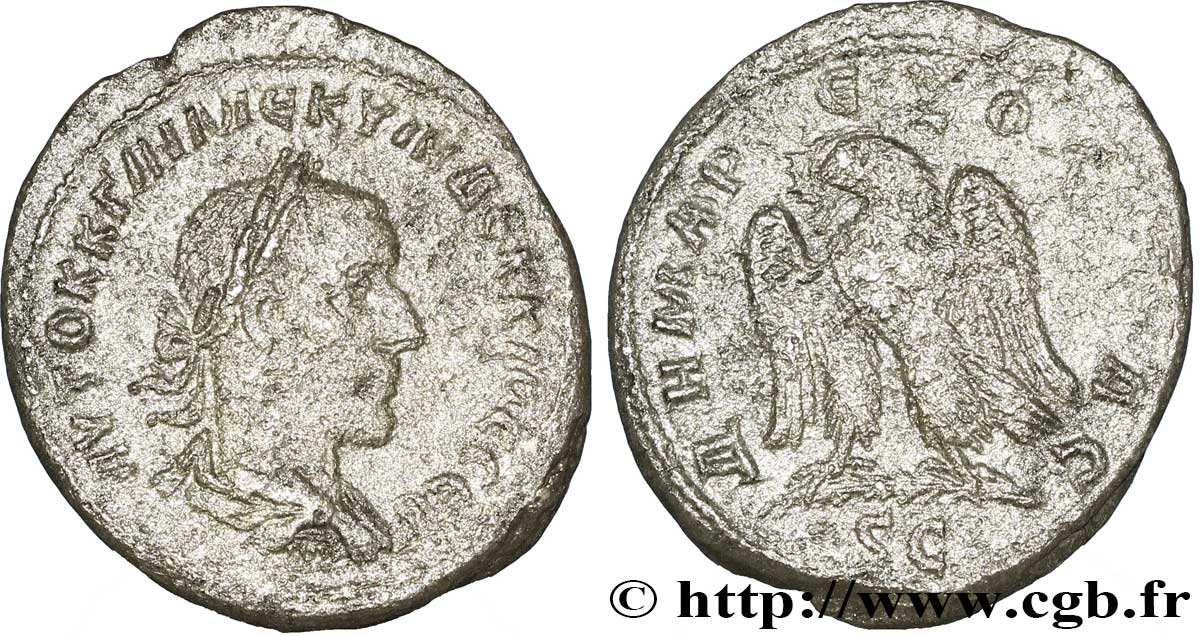
Beschreibung Vorderseite Buste lauré, drapé et cuirassé de Trajan Dèce à droite, vu de trois quarts en arrière (A*2).
Legende des Averses AUTOK K GAI ME KUIN DEKKIOS SEB
Übersetzung der Vorderseite (L’empereur césar Caius Messius Quintus Dèce auguste).
Rückseite
Titulatur der Rückseite S C À L’EXERGUE.
Beschreibung Rückseite Aigle debout à gauche sur une palme, les ailes déployées, tête à gauche et queue à droite, tenant une couronne feuillée dans son bec.
Legende des Reverses : DHMARC EX OUSIAS
Übersetzung der Rückseite (Revêtu de la puissance tribunitienne / avec l’accord du Sénat d’Antioche).
Kommentare
Les premières émissions de Trajan Dèce se définissent par la légende sans le nom de Trajan ; nous savons que prendre ce surnom fut l’un des premiers actes officiels de Dèce, une fois celui-ci arrivé à Rome, et il faut en déduire que tout ce qui fut frappé sans la mention Trajan est antérieur à cette décision.
Compte tenu de l’importance relative des frappes, on peut penser qu’Antioche, en tous cas les autorités provinciales, firent immédiatement allégeance au nouvel empereur dès sa proclamation et le décès des deux Philippe.
On remarque à ce propos la disparition immédiate de l’exergue ANTIOXIA et le retour à la palme, l’usage avant le troisième consulat de Philippe. Faut-il en déduire que le financement des émissions changea et retourna aux autorités provinciales alors qu’elles auraient été assumées par la ville durant les 3e et 4e consulats de Philippe ? Il faut se rappeler que le frère de Philippe, Priscus, installé à Antioche pendant tout le règne avec tous les pouvoirs (y compris le titre de Rector Orientis !) avait peut-être obligé la ville à financer les émissions monétaires ; la source de son pouvoir disparue (on ignore sa fin) on peut imaginer que la ville se débarrassa du fardeau qui revint donc aux nouvelles autorités provinciales, trop heureuses de manifester leur allégeance au nouveau pouvoir par des émissions monétaires à son effigie.
La structure de cette première émission témoigne aussi d’une confusion certaine. La presque totalité des types sont extrêmement rares, on découvre une cinquième officine, qui n’est pas connue sous Philippe, mais on ne connaît aucune pièce pour les 2e et 3e officine, un aigle à gauche avec tête et queue à droite fait son apparition, On trouve même une variante d’orthographe (un seul K à Dekkioc) qui deviendra ensuite la norme.
À propos des officines, il faut noter que la plupart des frappes ne portent pas de point d’officine, ce qui renforce l’hypothèse d’une série pour Philippe sans points d’officine restant à identifier.
Il est certain que le temps fera apparaître de nouveaux types qui viendront compléter cette série particulièrement difficile.
On note que les sigma sont gravés en C.
Dans la base TSP maintenue par Michel Prieur, vingt-neuf exemplaires sont maintenant répertoriés pour ce type, plusieurs en musées : deux à Jérusalem, un à Paris (Fonds Général 828), à Yale (Trouvaille de Doura I, 385), au Hunterian (n° 322), à l’ANS et à Berne (ex collection Righetti).
The first issues of Trajan Decius are defined by the legend without the name of Trajan; we know that taking this nickname was one of the first official acts of Decius, once he arrived in Rome, and we must deduce that everything that was struck without the mention Trajan is prior to this decision.
Given the relative importance of the strikes, we can assume that Antioch, or at least the provincial authorities, immediately pledged allegiance to the new emperor upon his proclamation and the death of the two Philips..
In this regard, we note the immediate disappearance of the exergue ANTIOXIA and the return to the palm, the use before the third consulate of Philip. Should we deduce from this that the financing of the issues changed and returned to the provincial authorities when they would have been assumed by the city during the 3rd and 4th consulates of Philip? It must be remembered that Philip's brother, Priscus, installed in Antioch throughout the reign with all the powers (including the title of Rector Orientis!) had perhaps forced the city to finance the monetary issues; the source of his power having disappeared (we do not know how it ended) we can imagine that the city got rid of the burden which therefore fell to the new provincial authorities, only too happy to show their allegiance to the new power by issuing monetary issues bearing his image.
The structure of this first issue also shows a certain confusion.. Almost all the types are extremely rare, we discover a fifth office, which is not known under Philip, but we do not know any piece for the 2nd and 3rd office, an eagle on the left with head and tail on the right makes its appearance, We even find a spelling variant (a single K in Dekkioc) which will then become the standard.
Regarding the pharmacies, it should be noted that most of the strikes do not bear a pharmacy point, which reinforces the hypothesis of a series for Philippe without pharmacy points remaining to be identified..
It is certain that time will bring out new types that will complete this particularly difficult series..
Note that the sigmas are engraved in C.
In the TSP database maintained by Michel Prieur, twenty-nine examples are now listed for this type, several in museums: two in Jerusalem, one in Paris (Fonds Général 828), at Yale (Trouvaille de Doura I, 385), at the Hunterian (no. 322), at the ANS and in Bern (ex Righetti collection)
Compte tenu de l’importance relative des frappes, on peut penser qu’Antioche, en tous cas les autorités provinciales, firent immédiatement allégeance au nouvel empereur dès sa proclamation et le décès des deux Philippe.
On remarque à ce propos la disparition immédiate de l’exergue ANTIOXIA et le retour à la palme, l’usage avant le troisième consulat de Philippe. Faut-il en déduire que le financement des émissions changea et retourna aux autorités provinciales alors qu’elles auraient été assumées par la ville durant les 3e et 4e consulats de Philippe ? Il faut se rappeler que le frère de Philippe, Priscus, installé à Antioche pendant tout le règne avec tous les pouvoirs (y compris le titre de Rector Orientis !) avait peut-être obligé la ville à financer les émissions monétaires ; la source de son pouvoir disparue (on ignore sa fin) on peut imaginer que la ville se débarrassa du fardeau qui revint donc aux nouvelles autorités provinciales, trop heureuses de manifester leur allégeance au nouveau pouvoir par des émissions monétaires à son effigie.
La structure de cette première émission témoigne aussi d’une confusion certaine. La presque totalité des types sont extrêmement rares, on découvre une cinquième officine, qui n’est pas connue sous Philippe, mais on ne connaît aucune pièce pour les 2e et 3e officine, un aigle à gauche avec tête et queue à droite fait son apparition, On trouve même une variante d’orthographe (un seul K à Dekkioc) qui deviendra ensuite la norme.
À propos des officines, il faut noter que la plupart des frappes ne portent pas de point d’officine, ce qui renforce l’hypothèse d’une série pour Philippe sans points d’officine restant à identifier.
Il est certain que le temps fera apparaître de nouveaux types qui viendront compléter cette série particulièrement difficile.
On note que les sigma sont gravés en C.
Dans la base TSP maintenue par Michel Prieur, vingt-neuf exemplaires sont maintenant répertoriés pour ce type, plusieurs en musées : deux à Jérusalem, un à Paris (Fonds Général 828), à Yale (Trouvaille de Doura I, 385), au Hunterian (n° 322), à l’ANS et à Berne (ex collection Righetti).
The first issues of Trajan Decius are defined by the legend without the name of Trajan; we know that taking this nickname was one of the first official acts of Decius, once he arrived in Rome, and we must deduce that everything that was struck without the mention Trajan is prior to this decision.
Given the relative importance of the strikes, we can assume that Antioch, or at least the provincial authorities, immediately pledged allegiance to the new emperor upon his proclamation and the death of the two Philips..
In this regard, we note the immediate disappearance of the exergue ANTIOXIA and the return to the palm, the use before the third consulate of Philip. Should we deduce from this that the financing of the issues changed and returned to the provincial authorities when they would have been assumed by the city during the 3rd and 4th consulates of Philip? It must be remembered that Philip's brother, Priscus, installed in Antioch throughout the reign with all the powers (including the title of Rector Orientis!) had perhaps forced the city to finance the monetary issues; the source of his power having disappeared (we do not know how it ended) we can imagine that the city got rid of the burden which therefore fell to the new provincial authorities, only too happy to show their allegiance to the new power by issuing monetary issues bearing his image.
The structure of this first issue also shows a certain confusion.. Almost all the types are extremely rare, we discover a fifth office, which is not known under Philip, but we do not know any piece for the 2nd and 3rd office, an eagle on the left with head and tail on the right makes its appearance, We even find a spelling variant (a single K in Dekkioc) which will then become the standard.
Regarding the pharmacies, it should be noted that most of the strikes do not bear a pharmacy point, which reinforces the hypothesis of a series for Philippe without pharmacy points remaining to be identified..
It is certain that time will bring out new types that will complete this particularly difficult series..
Note that the sigmas are engraved in C.
In the TSP database maintained by Michel Prieur, twenty-nine examples are now listed for this type, several in museums: two in Jerusalem, one in Paris (Fonds Général 828), at Yale (Trouvaille de Doura I, 385), at the Hunterian (no. 322), at the ANS and in Bern (ex Righetti collection)
Historischer Hintergrund
TRAIANUS DECIUS
(07/249-06/251)
Decius wurde 201 in Unterpannonien geboren. Nach einer glänzenden Karriere, die ihm die Türen zum Senat öffnete, war er unter der Herrschaft von Alexander Severus Gouverneur von Niedermoesien. Am Ende der Herrschaft Philipps, des Siegers der Barbarenhorden an der Donau, wurde er trotz seiner Weigerung zum Augustus ernannt. Er schreibt es an Philippe, der ihm nicht glaubt und gegen ihn aufmarschiert. Philipp und sein Sohn werden in der Schlacht bei Verona getötet. Decius fügt seinem Namen den prestigeträchtigen Namen Trajan hinzu. Nach einem Aufenthalt in Rom reist Decius an den Donaulimes. Der verlassene Limes ermöglichte es den Goten, durchzudringen und die Donauprovinzen, aus denen der Kaiser stammte, zu verwüsten. Es gelingt ihm nicht, die Invasion einzudämmen. Ab 250 wütet eine neue Seuche im Imperium. Die Pest dezimierte Bevölkerung und Herden und schwächte die Limes weiter. Er begann im Jahr 250 eine Christenverfolgung (Polyeucte, Corneille). Im folgenden Jahr ging er zum Limes, besiegte die Goten, aber sein Sohn wurde getötet. Er selbst findet den Tod, während er ihn rächen will. Er ist der erste Kaiser, der im Kampf gegen die Barbaren fällt.
 Berichten über einen Fehler
 Die Seite drucken
 Teilen meiner Auswahl
 Stellen Sie eine Frage
 Einlieferung/Verkauf
In Verbindung stehende Artikel

 Details


Ihre zuletzt angesehenen Artikel
5 Francs NOUVELLE CALÉDONIE 1940 P.36b fVZ
45.00 €

10 Francs MINERVE FRANKREICH 1916 F.06.01 fVZ
30.00 €
10000 Dobras SAO TOMÉ UND PRINCIPE 1996 P.066a ST
16.00 €
PHÖNIZIEN - ARADOS Tétradrachme stéphanophore SS
320.00 €

SAVOIE - DUCHÉ DE SAVOIE - CHARLES Ier Teston (testone) 1483 Cornavin fVZ
1000.00 €
CHARLES IX Demi-teston, 2e type 1562 La Rochelle fSS/SS
90.00 €
cgbfr.de numismatik


