


E-auction 316-234108 - fme_399998 - TOGO Médaille de l’indépendance
Sie müssen angeschlossen sein und von cgb.fr genehmigt werden, um in einer E-Auktion teilzunehmen.Melden Sie sich an, um zu wetten..Die Kontobestätigungen sind innerhalb von 48 Stunden nach Ihrer Anmeldung gemacht.Warten Sie nicht bis die letzten zwei Tage vor dem Abschluss eines Verkaufs, um Ihre Registrierung abzuschließen. Klickend "BIETEN" verpflichten Sie sich vertraglich, diesen Artikel zu kaufen und Sie nehmen ohne Reserve die allgemeinen Verkaufsbedingungen für den e-auctions zu cgb.fr an.
Der Verkauf wird an der Zeit auf der Übersichtsseite angezeigt geschlossen werden. Angebote, die nach der Schließung Zeit empfangen sind, werden nicht gültig.
Bitte beachten Sie, dass die Fristen für die Einreichung Ihres Angebots auf unsere Server können variieren und es kann zur Ablehnung Ihres Angebots entstehen, wenn es in den letzten Sekunden des Verkaufs gesendet wird. Die Angebote sollen mit ganzer Zahl ausgeführt sein, Sie können Kommas oder des Punktes in Ihrem Angebot nicht erfassen. Bei Fragen klicken Sie hier, um einen Blick auf die FAQ E-Auktionen.
KEINE ANSCHAFFUNGSKOSTEN FÜR DIE KÄUFER.
KEINE ANSCHAFFUNGSKOSTEN FÜR DIE KÄUFER.
| Schätzung : | 150 € |
| Preis : | 57 € |
| Höchstgebot : | 86 € |
| Verkaufsende : | 06 Mai 2019 18:35:00 |
| Bieter : | 4 Bieter |
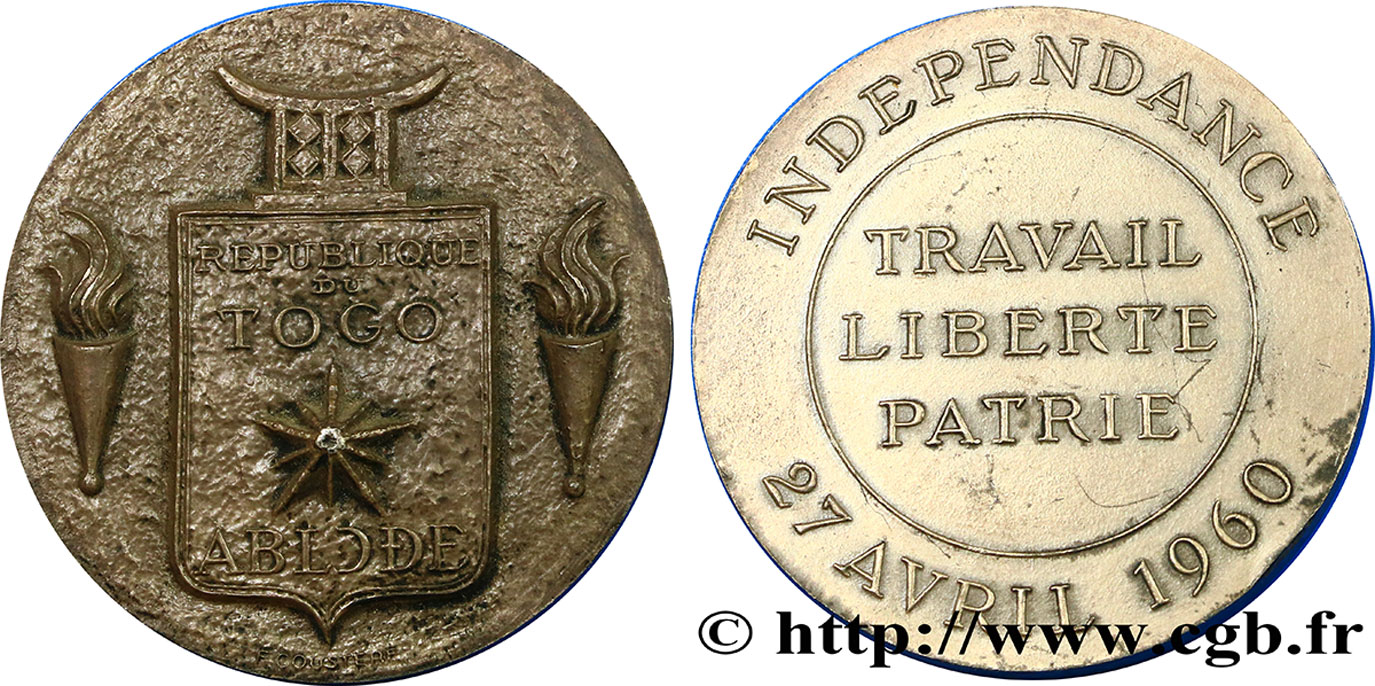
Type : Médaille de l’indépendance
Datum: 1960
Name der Münzstätte / Stadt : Togo
Metall : Silber
Durchmesser : 59 mm
Stempelstellung : 12 h.
Graveur F. COUSTERE
Gewicht : 109 g.
Rand lisse + corne 1 ARGENT
Kommentare zum Erhaltungszustand:
Médaille avec un aspect mat au droit et brillant au revers, dans son écrin d’origine en carton rouge
Vorderseite
Titulatur der Vorderseite RÉPUBLIQUE / DU / TOGO // ABLCDE.
Beschreibung Vorderseite Écu de la République du Togo entre deux torches.
Rückseite
Titulatur der Rückseite INFDEPENDANCE - 27 AVRIL 1960 // TRAVAIL / LIBERTE / PATRIE.
Beschreibung Rückseite Légende en 3 liges horizontale et légende circulaire autour.
Kommentare
Le Togo devient indépendant, le 27 avril 1960 et obtient un siège à l'ONU en septembre de la même année et Sylvanus Olympio est élu président aux dépens de Nicolas Grunitzky, candidat soutenu par la France, lors d'élections supervisées par l'ONU.
C'est logiquement Sylvanus Olympio qui dirige la rédaction de la Constitution de la République du Togo, qui devient une démocratie à régime présidentiel, à la tête de laquelle Olympio engage une politique autoritaire. Cette situation provoqua des impatiences voire des mécontentements dans la région Nord du pays, qui se sent délaissée par un gouvernement dominé par les Ewé de la région de Lomé.
En 1963, l'Afrique des indépendances connut son premier coup d'État. Sylvanus Olympio refuse la réintégration dans l'armée togolaise des soldats qui avaient combattu au sein de l'armée française pendant la Guerre d'Algérie. Ces soldats, majoritairement issus des Kabyê du Nord du Togo, décidèrent alors d'organiser un coup d'État dans la nuit du 12 au 13 janvier 1963, une poignée de militaires dont faisait partie Gnassingbé Eyadema assassinèrent Sylvanus Olympio.
Rapidement, un comité militaire insurrectionnel fait appel à Nicolas Grunitsky, qui fut élu président en 1963, tout en adoptant une nouvelle Constitution. Grunitzky dirigea le pays d'une manière un peu plus libérale, en acceptant l'existence d'une opposition.
Cependant, les difficultés persistent et le 13 janvier 1967, les militaires prennent à nouveau le pouvoir. La Constitution est suspendue et l'Assemblée nationale dissoute. Kléber Dadjo occupe provisoirement le poste de Premier ministre. Le lieutenant-colonel Étienne Gnassingbé Eyadema, appartenant à l'ethnie des Kabyê, prend le pouvoir et met en place un nouveau gouvernement où les personnalités issues du Nord du pays sont majoritaires..
Togo became independent on April 27, 1960, and was granted a seat at the UN in September of the same year, and Sylvanus Olympio was elected president over Nicolas Grunitzky, a candidate supported by France, in elections supervised by the UN..
It was logically Sylvanus Olympio who led the drafting of the Constitution of the Republic of Togo, which became a democracy with a presidential regime, at the head of which Olympio initiated an authoritarian policy.. This situation caused impatience and even discontent in the northern region of the country, which feels abandoned by a government dominated by the Ewe of the Lomé region..
In 1963, post-independence Africa experienced its first coup d'état.. Sylvanus Olympio refuses the reinstatement into the Togolese army of soldiers who had fought in the French army during the Algerian War. These soldiers, mostly from the Kabyê of northern Togo, then decided to organize a coup d'état on the night of January 12 to 13, 1963. A handful of soldiers, including Gnassingbé Eyadema, assassinated Sylvanus Olympio..
Soon, an insurrectionary military committee called upon Nicolas Grunitsky, who was elected president in 1963, while adopting a new Constitution.. Grunitzky ruled the country in a somewhat more liberal manner, accepting the existence of an opposition..
However, difficulties persisted and on January 13, 1967, the military took power again.. The Constitution is suspended and the National Assembly dissolved. Kléber Dadjo temporarily occupies the post of Prime Minister. Lieutenant Colonel Étienne Gnassingbé Eyadema, belonging to the Kabyê ethnic group, took power and established a new government in which figures from the north of the country were in the majority..
C'est logiquement Sylvanus Olympio qui dirige la rédaction de la Constitution de la République du Togo, qui devient une démocratie à régime présidentiel, à la tête de laquelle Olympio engage une politique autoritaire. Cette situation provoqua des impatiences voire des mécontentements dans la région Nord du pays, qui se sent délaissée par un gouvernement dominé par les Ewé de la région de Lomé.
En 1963, l'Afrique des indépendances connut son premier coup d'État. Sylvanus Olympio refuse la réintégration dans l'armée togolaise des soldats qui avaient combattu au sein de l'armée française pendant la Guerre d'Algérie. Ces soldats, majoritairement issus des Kabyê du Nord du Togo, décidèrent alors d'organiser un coup d'État dans la nuit du 12 au 13 janvier 1963, une poignée de militaires dont faisait partie Gnassingbé Eyadema assassinèrent Sylvanus Olympio.
Rapidement, un comité militaire insurrectionnel fait appel à Nicolas Grunitsky, qui fut élu président en 1963, tout en adoptant une nouvelle Constitution. Grunitzky dirigea le pays d'une manière un peu plus libérale, en acceptant l'existence d'une opposition.
Cependant, les difficultés persistent et le 13 janvier 1967, les militaires prennent à nouveau le pouvoir. La Constitution est suspendue et l'Assemblée nationale dissoute. Kléber Dadjo occupe provisoirement le poste de Premier ministre. Le lieutenant-colonel Étienne Gnassingbé Eyadema, appartenant à l'ethnie des Kabyê, prend le pouvoir et met en place un nouveau gouvernement où les personnalités issues du Nord du pays sont majoritaires..
Togo became independent on April 27, 1960, and was granted a seat at the UN in September of the same year, and Sylvanus Olympio was elected president over Nicolas Grunitzky, a candidate supported by France, in elections supervised by the UN..
It was logically Sylvanus Olympio who led the drafting of the Constitution of the Republic of Togo, which became a democracy with a presidential regime, at the head of which Olympio initiated an authoritarian policy.. This situation caused impatience and even discontent in the northern region of the country, which feels abandoned by a government dominated by the Ewe of the Lomé region..
In 1963, post-independence Africa experienced its first coup d'état.. Sylvanus Olympio refuses the reinstatement into the Togolese army of soldiers who had fought in the French army during the Algerian War. These soldiers, mostly from the Kabyê of northern Togo, then decided to organize a coup d'état on the night of January 12 to 13, 1963. A handful of soldiers, including Gnassingbé Eyadema, assassinated Sylvanus Olympio..
Soon, an insurrectionary military committee called upon Nicolas Grunitsky, who was elected president in 1963, while adopting a new Constitution.. Grunitzky ruled the country in a somewhat more liberal manner, accepting the existence of an opposition..
However, difficulties persisted and on January 13, 1967, the military took power again.. The Constitution is suspended and the National Assembly dissolved. Kléber Dadjo temporarily occupies the post of Prime Minister. Lieutenant Colonel Étienne Gnassingbé Eyadema, belonging to the Kabyê ethnic group, took power and established a new government in which figures from the north of the country were in the majority..
Historischer Hintergrund
TOGO
 Berichten über einen Fehler
 Die Seite drucken
 Teilen meiner Auswahl
 Stellen Sie eine Frage
 Einlieferung/Verkauf
 Details
Ihre zuletzt angesehenen Artikel
MAXIMIANUS HERCULIUS Aurelianus fVZ
100.00 €
MONACO 1 Euro PRINCE ALBERT II 2007
5.00 €

TOGO Médaille de l’indépendance VZ
57.00 €
DRITTE FRANZOSISCHE REPUBLIK Plaquette de récompense SS
150.00 €

BELGISCH-KONGO 5 Francs éléphant 1947 SS
18.00 €
FLAVIUS VICTOR Nummus, (PBQ, Æ 4) fVZ
182.00 €
cgbfr.de numismatik


