


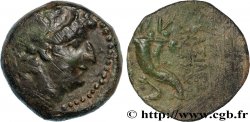
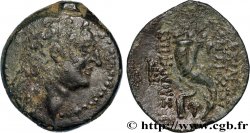
v53_0113 - SYRIEN - SELEUKIDICHES KÖNIGREICH - ANTIOCHOS VIII GRYPOS Tétradrachme

MONNAIES 53 (2012)
Startpreis : 450.00 €
Schätzung : 750.00 €
Erzielter Preis : 450.00 €
Anzahl der Gebote : 1
Höchstgebot : 550.00 €
Startpreis : 450.00 €
Schätzung : 750.00 €
Erzielter Preis : 450.00 €
Anzahl der Gebote : 1
Höchstgebot : 550.00 €
Type : Tétradrachme
Datum: an 193
Name der Münzstätte / Stadt : Phénicie, Sidon
Metall : Silber
Durchmesser : 27,5 mm
Stempelstellung : 12 h.
Gewicht : 16,46 g.
Seltenheitsgrad : R2
Kommentare zum Erhaltungszustand:
Exemplaire sur un petit flan ovale, bien centré des deux côtés. Beau portrait d’Antiochus VIII de haut relief, bien venu à la frappe. Joli revers de style fin, particulier avec un très beau portrait de Zeus. Très belle patine de collection ancienne gris foncé avec des reflets dorés. Conserve une partie de son coupant d’origine
N° im Nachschlagewerk :
Pedigree :
Cet exemplaire provient de la collection Claude Lainé (emblème luni-solaire)
Vorderseite
Titulatur der Vorderseite ANÉPIGRAPHE.
Beschreibung Vorderseite Tête diadémée d’Antiochus VIII à droite, entourée de la stemma.
Rückseite
Beschreibung Rückseite Zeus Uranios nu, debout à gauche, la tête surmontée d'un croissant, à demi-nu, la chlamyde sur l'épaule, tenant une étoile à huit rais (emblème luni-solaire) de la main droite et de la gauche un sceptre long.
Legende des Reverses : BASILEWS// ANTIOCOU// EPI-FANOUS/ SI IER/ /AS/ (AU)/ [GRR]
Übersetzung der Rückseite (du roi Antiochus glorieux).
Kommentare
Sur cet exemplaire, Antiochus n’a pas l’appendice nasal proéminent qui le caractérise (grypus). La stemma, bandelette de laine qui entoure le portrait est peu visible. Le revers présente un symbole luni-solaire. Il y avait un exemplaire dans le trésor de Kessab (IGCH. 1568) découvert en 1952, enfoui vers 110 avant J.-C. qui contenait plus de 388 monnaies d’argent dont 102 tétradrachmes d’Antiochus VIII dont cinq pour l’atelier de Sidon et trois exemplaires avec notre variété.
On this example, Antiochus does not have the prominent nasal appendage that characterizes him (grypus). The stemma, a woolen band that surrounds the portrait, is barely visible. The reverse has a lunisolar symbol. There was a example in the Kessab treasure (IGCH. 1568) discovered in 1952, buried around 110 BC, which contained more than 388 silver coins including 102 tetradrachms of Antiochus VIII, five of which were for the Sidonian mint, and three examples with our variety
On this example, Antiochus does not have the prominent nasal appendage that characterizes him (grypus). The stemma, a woolen band that surrounds the portrait, is barely visible. The reverse has a lunisolar symbol. There was a example in the Kessab treasure (IGCH. 1568) discovered in 1952, buried around 110 BC, which contained more than 388 silver coins including 102 tetradrachms of Antiochus VIII, five of which were for the Sidonian mint, and three examples with our variety
Historischer Hintergrund
SYRIEN - SELEUKIDICHES KÖNIGREICH - ANTIOCHOS VIII GRYPOS
(121-96 v. Chr.)
Die vierte Regierung
Antiochus VIII. mit der langen Nase (Grypos) ist der älteste Sohn von Demetrius II. und Kleopatra Thea. Nach einer Regentschaft zwischen 125 und 121 v. Chr. mit seiner Mutter, die er schließlich vergiftete, bevor er selbst ermordet wurde, musste er zwanzig Jahre lang gegen seinen Halbbruder Antiochos IX. Cyzicene (von Cyzicus) kämpfen. Antiochia musste viermal zurückerobert werden. Antiochos regierte dort von 121 bis 113, dann 112 und 111, von 111 bis 109 und schließlich von 108 bis 96 v. Chr. Antiochos VIII. wurde von seinem Sohn Seleukus VI. ermordet, der auch seinen Onkel Antiochos IX. tötete, bevor er selbst von Antiochos X. eliminiert wurde. Sohn von Antiochus IX. im Jahr 96 v. Chr., eine schöne Familiengeschichte.
 Berichten über einen Fehler
 Die Seite drucken
 Teilen meiner Auswahl
 Stellen Sie eine Frage
 Einlieferung/Verkauf
In Verbindung stehende Artikel

 Details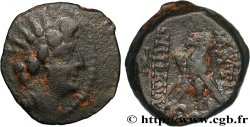


Ihre zuletzt angesehenen Artikel

CHEMIN DE FER DU BOIS DE BOULOGNE 20 Centimes Chemin de fer du Bois de Boulogne
6.00 €
200 Francs MONTESQUIEU FRANKREICH 1981 F.70.01 fST+
70.00 €

1 franc Louis-Philippe, couronne de chêne 1832 Nantes F.210/12 SS
350.00 €

SYRIEN - SELEUKID KINGDOM - ANTIOCHOS VI DIONYSOS Drachme VZ
450.00 €

MAURETANIEN - MAURETANISCHES KÖNIGREICH - JUBA II und KLEOPATRA Denier ST
1800.00 €

LEMOVICES / BITURIGES, UNSPECIFIED Quart de statère à l’androcéphale, à la
300.00 €
cgbfr.de numismatik


