


v13_0610 - PHILIPPUS I. ARABS Tétradrachme syro-phénicien

MONNAIES 13 (2001)
Startpreis : 91.47 €
Schätzung : 182.94 €
Erzielter Preis : 238.74 €
Anzahl der Gebote : 7
Höchstgebot : 487.84 €
Startpreis : 91.47 €
Schätzung : 182.94 €
Erzielter Preis : 238.74 €
Anzahl der Gebote : 7
Höchstgebot : 487.84 €
Type : Tétradrachme syro-phénicien
Datum: 244
Name der Münzstätte / Stadt : Antioche, Syrie, Séleucie et Piérie
Metall : Scheidemünze
Durchmesser : 25 mm
Stempelstellung : 6 h.
Gewicht : 10,61 g.
Kommentare zum Erhaltungszustand:
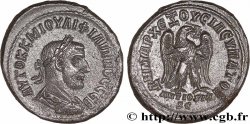
Flan très large avec un très beau portrait. Avec son argenture et des reflets gris argenté. Très joli revers
N° im Nachschlagewerk :
Prieur 304A (60 ex.)
Pedigree :
Cet exemplaire est le 0304A_041 de la base TSP
Vorderseite
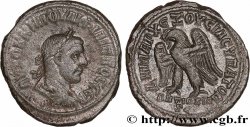
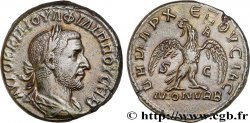
Beschreibung Vorderseite Buste lauré, drapé et cuirassé de Philippe Ier à droite vu de trois quarts en arrière (A*2).
Legende des Averses AUTOK K M IOUL FILIPPOU SEB
Übersetzung der Vorderseite (L’empereur césar Marc Jules Philippe auguste).
Rückseite
Titulatur der Rückseite S|C// MON VRB À L’EXERGUE.
Beschreibung Rückseite Aigle debout de face, tourné à droite, les ailes déployées, la tête tournée à gauche, tenant une couronne dans son bec, sans ligne de sol.
Legende des Reverses : DHMARC - EX OUSIAS
Übersetzung der Rückseite (Revêtu de la puissance tribunitienne).
Kommentare
Suivant les conclusions de H. R. Baldus, Moneta Urbis - Antioxia, Francfort 1969, l’atelier de fabrication de ces premiers tétradrachmes de Philippe Ier l’Arabe semble bien être Rome, plutôt qu’Antioche. D. R. Walker avait analysé 8 tétradrachmes de cette émission dans son étude, The Metrology of the Roman Silver Coinage, part III, from Pertinax to Uranius Antoninus, Oxford 1978. Le titre de fin contenu semblait plus important que pour les autres tétradrachmes, d’au moins 10%.
Following the conclusions of HR Baldus, Moneta Urbis - Antioxia, Frankfurt 1969, the mint of these first tetradrachms of Philip I the Arab seems to be Rome, rather than Antioch. DR Walker had analyzed 8 tetradrachms of this issue in his study, The Metrology of the Roman Silver Coinage, part III, from Pertinax to Uranius Antoninus, Oxford 1978. The fineness of the fineness contained seemed higher than for the other tetradrachms, by at least 10%
Following the conclusions of HR Baldus, Moneta Urbis - Antioxia, Frankfurt 1969, the mint of these first tetradrachms of Philip I the Arab seems to be Rome, rather than Antioch. DR Walker had analyzed 8 tetradrachms of this issue in his study, The Metrology of the Roman Silver Coinage, part III, from Pertinax to Uranius Antoninus, Oxford 1978. The fineness of the fineness contained seemed higher than for the other tetradrachms, by at least 10%
Historischer Hintergrund
PHILIPPUS I. ARABS
(03/244-09/249)
Philippe wurde in Bostra in Trachonitis, einer Provinz Arabiens, geboren, daher der Spitzname des Kaisers. Nach dem Verschwinden von Timésithée, dem Schwiegervater von Gordian III., im Jahr 243 wurde er zum Präfekten des Prätoriums ernannt. Philipp ließ Gordian Anfang 244 ermorden oder ließ ihn ermorden und beeilte sich dann, einen berüchtigten Frieden mit den Sassaniden zu schließen . Er zahlt ihnen einen Tribut von 500.000 Denaren. Er nannte seinen Sohn Philipp Caesar im Jahr 244 und seine Frau Otacilia Sévéra Augusta. Im Jahr 247 erhebt Philipp seinen Sohn im August. Er führte einen brillanten Feldzug gegen die Quades und die Carpes, die in Dacia eingedrungen waren. Das große Ereignis der Herrschaft Philipps ist das Gedenken an das tausendjährige Jubiläum Roms, das am 21. April 247 beginnt. Am Ende der Herrschaft erklären sich mehrere Usurpatoren, darunter Jotapien und Pacatian, zum Augustus. Philippe beauftragt Decius, den Befehlshaber der pannonischen Legionen, die Ordnung an der Donau wiederherzustellen. Gegen seinen Willen proklamieren die Truppen Decius im Juni oder Juli 249 zum August. Philipp stirbt im Kampf gegen die Truppen von Decius im September 249.
 Berichten über einen Fehler
 Die Seite drucken
 Teilen meiner Auswahl
 Stellen Sie eine Frage
 Einlieferung/Verkauf
In Verbindung stehende Artikel
 Details


Ihre zuletzt angesehenen Artikel

CONSTANS II, CONSTANTINE IV, HERACLIUS und TIBERIUS Follis SGE
15.00 €
JUSTINUS II und SOPHIE Follis S
11.00 €

ELAGABALUS Tétradrachme syro-phénicien fSS/SS
16.00 €
cgbfr.de numismatik


