


E-auction 710-785630 - PERCHE - NOBLESSE TRISTAN DE ROSTAING ET FRANCOISE ROBERTEL, PHILIPPE HURAULT CHANCELIER DE FRANCE ET ANNE DE THOU 1595
Sie müssen angeschlossen sein und von cgb.fr genehmigt werden, um in einer E-Auktion teilzunehmen.Melden Sie sich an, um zu wetten..Die Kontobestätigungen sind innerhalb von 48 Stunden nach Ihrer Anmeldung gemacht.Warten Sie nicht bis die letzten zwei Tage vor dem Abschluss eines Verkaufs, um Ihre Registrierung abzuschließen. Klickend "BIETEN" verpflichten Sie sich vertraglich, diesen Artikel zu kaufen und Sie nehmen ohne Reserve die allgemeinen Verkaufsbedingungen für den e-auctions zu cgb.fr an.
Der Verkauf wird an der Zeit auf der Übersichtsseite angezeigt geschlossen werden. Angebote, die nach der Schließung Zeit empfangen sind, werden nicht gültig.
Bitte beachten Sie, dass die Fristen für die Einreichung Ihres Angebots auf unsere Server können variieren und es kann zur Ablehnung Ihres Angebots entstehen, wenn es in den letzten Sekunden des Verkaufs gesendet wird. Die Angebote sollen mit ganzer Zahl ausgeführt sein, Sie können Kommas oder des Punktes in Ihrem Angebot nicht erfassen. Bei Fragen klicken Sie hier, um einen Blick auf die FAQ E-Auktionen.
KEINE ANSCHAFFUNGSKOSTEN FÜR DIE KÄUFER.
KEINE ANSCHAFFUNGSKOSTEN FÜR DIE KÄUFER.
2026/11/23 20:03:00
fjt_1195946
710
Sie müssen sich anmelden, um zu bieten
Klicken Sie hier, um sich anzumelden
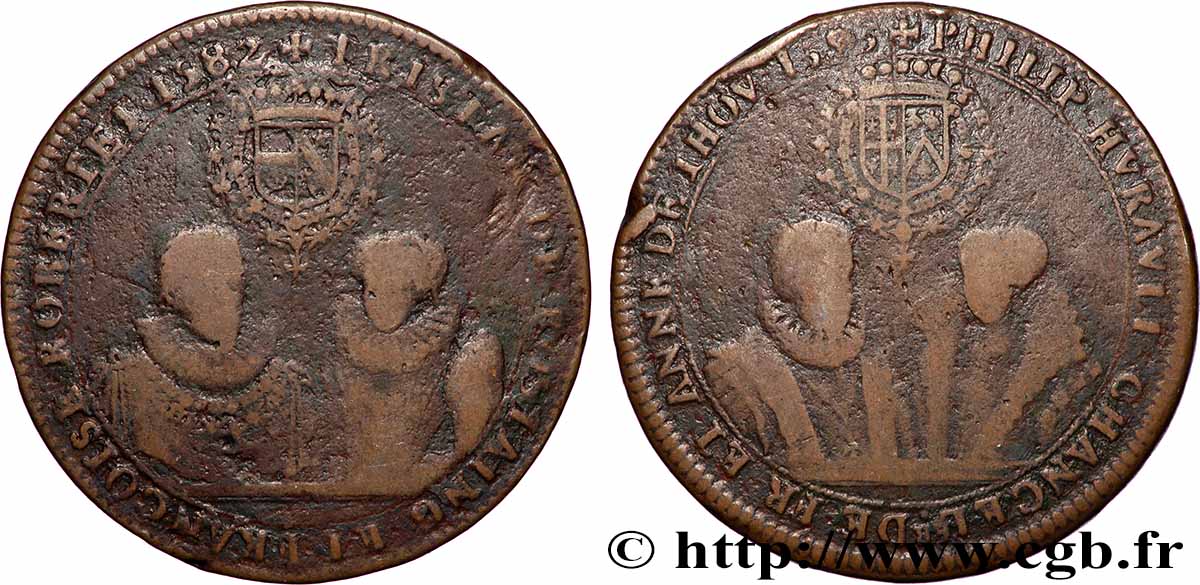
Type : TRISTAN DE ROSTAING ET FRANCOISE ROBERTEL, PHILIPPE HURAULT CHANCELIER DE FRANCE ET ANNE DE THOU
Datum: 1595
Metall : Kupfer
Durchmesser : 31,5 mm
Stempelstellung : 6 h.
Gewicht : 11,98 g.
Rand lisse
Punze : sans poinçon
Seltenheitsgrad : R1
Kommentare zum Erhaltungszustand:
Patine hétérogène avec des traces d’usure, rayures et taches d’oxydation
N° im Nachschlagewerk :
Vorderseite
Titulatur der Vorderseite TRISTAN DE ROSTAING ET FRANCOISE ROBERTEL 1582.
Beschreibung Vorderseite Armes de Tristan de Rostaing et Françoise Robertel, au-dessus de leurs bustes.
Rückseite
Titulatur der Rückseite PHILIP HVRAVLT CHANCELER DE FR ET ANNE DE THOV 1595.
Beschreibung Rückseite Armes de Philippe Hurault et d'Anne de Thou au-dessus de leurs bustes.
Kommentare
Notre personnage semble être Tristan de Rostaing (1513-1591)
Baron de Brou et de La Guerche, Seigneur de Vaux-le-Pénil, de Thieux et de Noisy-le-Sec,Grand Maître des Eaux et Forêts de France, Chevalier du Saint-Esprit (reçu le 31 décembre 1582) selon l’excellent site http://www.brou.net/index.php?option=com_content&view=article&id=302&Itemid=104 mais le style du jeton semble très moderne pour l’époque et la qualité de frappe plus XVIIe que XVIe. Serait-ce un jeton de souvenir ?
Il faut pourtant se souvenir que la famille Rostaing est d’origine allemande et que le style de ce jeton est caractéristique des thalers dynastiques allemands de la période. Par ailleurs le poids de ce jeton est particulièrement lourd et tout à fait contraire aux habitudes françaises de la fin du XVIe. S’agit-il d’une fabrication d’un atelier d’Allemagne ? Peut-être.
Nous recevons un commentaire de notre lecteur Christian Montagne :
“A propos du beau jeton que vous publiez dans la boutique jeton (fjt_015620), son style et sa qualité vous font plus penser, dites-vous, à une frappe du XVIIème siècle qu'à une du XVIème siècle. Je crois, comme vous, qu'il s'agit d'une frappe commémorative que l'on pourrait dater des environs de 1650-1660.
Les quatre personnes représentées sur la pièce, Tristan de Rostaing et Françoise Robertel d'une part et Philippe Hurault et Anne de Thou d'autre part, sont liés. En effet, le 7 janvier 1612, Charles de Rostaing, le fils de Tristan et Françoise, épouse Anne Hurault, la fille de Philippe et Anne.
Sur la fin de sa vie, Charles de Rostaing multiplie les gestes pour honorer sa famille comme l'épitaphe qu'il fit placer en 1655 dans sa ville de Brou où l'on trouve cités côte à côte ses parents et ceux de sa femme ( cf le lien que vous citez http://www.brou.net/index.php?option=com_content&view=article&id=302&Itemid=104 ).
Surtout, Charles de Rostaing disposait de trois chapelles dans trois églises parisiennes; dans l'une d'elle (Église saint Pierre des Célestins), qui lui venait de la famille de sa femme, il y développe en 1659 un véritable programme iconographique qui fait curieusement penser au thème de notre jeton: la chapelle est "surchargée" des écussons Rostaing et Hurault ( plus de détail sur http://www.latribunedelart.com/philippe-de-buyster-1595-1688-catalogue-raisonne-par-ordre-chronologique-4eme-partie#nh20 ). Le décor est aujourd'hui disparu mais quelques documents contemporains (gravures, descriptions, marchés...) peuvent l'évoquer.
On peut donc penser qu'a côté de ces multiples fondations, Charles ait pu également faire frapper ce jeton à la mémoire de sa parenté. Bien sûr, cela n'engage que moi...
.
Our character seems to be Tristan de Rostaing (1513-1591) Baron of Brou and La Guerche, Lord of Vaux-le-Pénil, Thieux and Noisy-le-Sec, Grand Master of Waters and Forests of France, Knight of the Holy Spirit (received on December 31, 1582) according to the excellent site http://www. husk. net/index. php?option=com_content&view=article&id=302&Itemid=104 but the style of the token seems very modern for the time and the quality of the strike more 17th than 16th. Could this be a souvenir token? However, it must be remembered that the Rostaing family is of German origin and that the style of this token is characteristic of German dynastic thalers of the period.. Furthermore, the weight of this token is particularly heavy and completely contrary to French customs at the end of the 16th century.. Is this a German workshop production? Perhaps..
We received a comment from our reader Christian Montagne: “Regarding the beautiful token that you publish in the token shop (fjt_015620), its style and quality make you think more, you say, of a 17th century minting than of one from the 16th century.. I believe, like you, that this is a commemorative strike that could be dated to around 1650-1660..
The four people depicted on the coin, Tristan de Rostaing and Françoise Robertel on the one hand and Philippe Hurault and Anne de Thou on the other, are related. Indeed, on January 7, 1612, Charles de Rostaing, the son of Tristan and Françoise, married Anne Hurault, the daughter of Philippe and Anne.
Towards the end of his life, Charles de Rostaing made numerous gestures to honour his family, such as the epitaph he had placed in 1655 in his town of Brou, where his parents and those of his wife are listed side by side (see the link you cite http://www. husk. net/index. php?option=com_content&view=article&id=302&Itemid=104 ).
Above all, Charles de Rostaing had three chapels in three Parisian churches; in one of them (Church of Saint Pierre des Célestins), which came to him from his wife's family, he developed in 1659 a real iconographic program which curiously brings to mind the theme of our token: the chapel is \\\"overloaded\\\" with the Rostaing and Hurault coats of arms (more details on http://www. thearttribune. com/philippe-de-buyster-1595-1688-catalogue-raisonne-par-ordre-chronologique-4eme-part#nh20 ). The decor has now disappeared but some contemporary documents (engravings, descriptions, markets. . . ) can evoke it.
We can therefore think that alongside these multiple foundations, Charles could also have had this token struck in memory of his relatives.. Of course, this is just my opinion.. . .
Historischer Hintergrund
PERCHE - NOBLESSE
 Berichten über einen Fehler
 Die Seite drucken
 Teilen meiner Auswahl
 Stellen Sie eine Frage
 Einlieferung/Verkauf
In Verbindung stehende Artikel

 Details


Ihre zuletzt angesehenen Artikel

LOUIS XV "THE WELL-BELOVED" Écu aux branches d’olivier, tête ceinte d’un b
70.00 €

LOUIS XV "THE WELL-BELOVED" Écu aux branches d’olivier, tête ceinte d’un b
160.00 €

DEUTSCHLAND 2 Euro 10 ANS DES PIÈCES ET BILLETS EN EUROS - Berlin A 2012
4.00 €

SUISSE Série 8 médailles, Essai Euros fantaisies 2003
20.00 €

LES PREMIÈRES FRAPPES EN HOMMAGE A L'EURO Médaille, Europe, Chypre Polierte Pl
50.00 €

POLEN 2 Zlote Chevau-légers polonais de la garde impériale de Napoléon Ier 20
5.00 €
cgbfr.de numismatik


