


fjt_230887 - NOTAIRES ROYAUX Notaires de Paris, émission de 1756 - Louis XV 1720
Nicht verfügbar.
Artikel auf unserem Online-Shop verkauft (2022)
Preis : 220.00 €
Artikel auf unserem Online-Shop verkauft (2022)
Preis : 220.00 €
Type : Notaires de Paris, émission de 1756 - Louis XV
Datum: 1720
Metall : Silber
Durchmesser : 29,5 mm
Stempelstellung : 6 h.
Gewicht : 8,63 g.
Rand lisse
Seltenheitsgrad : R1
Kommentare zum Erhaltungszustand:
De petites marques de manipulation mais cet exemplaire laisse voir une bonne partie de son brillant d’origine. De petites taches noires ou dorées apparaissent ça et là. Grènetis légèrement hors flan au revers mais complet à l’avers
N° im Nachschlagewerk :
Vorderseite
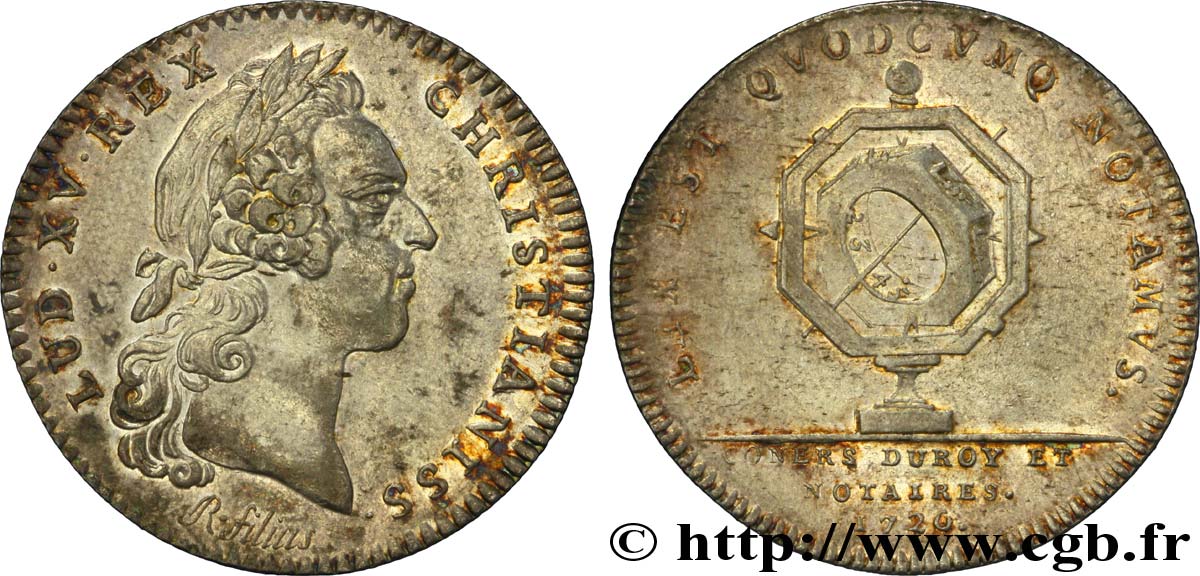
Titulatur der Vorderseite LUD. XV. REX - CHRISTIANISS..
Beschreibung Vorderseite Buste de Louis XV à gauche [Feuardent n° 333], signature R. FILIUS cursive sous le buste, type Guéant Prieur 628F.
Übersetzung der Vorderseite (Louis XV, roi très chrétien).
Rückseite
Titulatur der Rückseite LEX EST QVODCVMQ. NOTAMVS..
Beschreibung Rückseite Un gnomon ; à l’exergue en trois lignes : CONers DV ROY ET / NOTAIRES. / 1720..
Übersetzung der Rückseite (Est loi ce que nous rédigeons).
Kommentare
Gnomon est un terme qui vient du grec gnômôn, indicateur, et qui désigne un instrument servant à marquer les hauteurs du soleil par la direction de l’ombre qu’il porte sur un plan ou une surface courbe. Le gnomon est utilisé dans l’Antiquité gréco-latine où il aurait été découvert par Anaximandre, successeur de Thalès, chez les Chinois, les Égyptiens, les Péruviens, les Musulmans qui ont d’ailleurs laissé plusieurs traités de gnomonique (théorie de la construction des cadrans solaires). Les deux plus célèbres sont ceux de l’église de Bologne construit par Cassini en 1653 et celui de l’église Saint-Sulpice à Paris construit en 1742. Le gnomon a servi d'emblème associé à la devise "Lex est quodcumque notamus" selon la création du père Ménestrier en 1686 pour les secrétaires du roi qui ne s'en sont jamais servi. L'invention fut reprise par les notaires de Paris puis par les notaires de Province.
Gnomon is a term that comes from the Greek gnômôn, indicator, and which designates an instrument used to mark the heights of the sun by the direction of the shadow it casts on a plane or curved surface. The gnomon was used in Greco-Latin Antiquity where it was discovered by Anaximander, successor of Thales, among the Chinese, the Egyptians, the Peruvians, the Muslims who also left several treatises on gnomonics (theory of the construction of sundials). The two most famous are those of the church of Bologna built by Cassini in 1653 and that of the church of Saint-Sulpice in Paris built in 1742. The gnomon served as an emblem associated with the motto \\\"Lex est quodcumque notamus\\\" according to the creation of Father Ménestrier in 1686 for the king's secretaries who never used it. The invention was taken up by the notaries of Paris and then by the notaries of the Provinces
Gnomon is a term that comes from the Greek gnômôn, indicator, and which designates an instrument used to mark the heights of the sun by the direction of the shadow it casts on a plane or curved surface. The gnomon was used in Greco-Latin Antiquity where it was discovered by Anaximander, successor of Thales, among the Chinese, the Egyptians, the Peruvians, the Muslims who also left several treatises on gnomonics (theory of the construction of sundials). The two most famous are those of the church of Bologna built by Cassini in 1653 and that of the church of Saint-Sulpice in Paris built in 1742. The gnomon served as an emblem associated with the motto \\\"Lex est quodcumque notamus\\\" according to the creation of Father Ménestrier in 1686 for the king's secretaries who never used it. The invention was taken up by the notaries of Paris and then by the notaries of the Provinces
Historischer Hintergrund
NOTAIRES ROYAUX
Am Ende des Ancien Régime war der königliche Notar ein öffentlicher Beamter, der für die Ausarbeitung der Urkunden verantwortlich war, denen private Parteien einen Authentizitätscharakter verleihen wollten.. Nur Pariser Notare haben das Privileg, in ganz Frankreich zu praktizieren. Ein provinzieller königlicher Notar ist nur im Zuständigkeitsbereich des Gerichts zuständig, von dem er aufgenommen wurde (mindestens 25 Jahre alt und nach einer Untersuchung seines Lebens und seiner Sitten).. Ein Edikt vom Juli 1682 verpflichtete jeden zur Ausübung des Notariats, katholisch zu sein. Notare sind in Bruderschaften oder Gemeinschaften organisiert und genießen je nach Stadt ein unterschiedliches gesellschaftliches Ansehen.. Das Pariser Notariat ist mächtig und genießt den Schutz des Comptroller General of Finance (und entgeht somit den Formalitäten der Aktenkontrolle).. Einige Offiziere erwerben das adelende Amt des königlichen Sekretärs, um ihren gesellschaftlichen Aufstieg zu vollenden. Landnotare werden hingegen kaum berücksichtigt. In den Beschwerdeheften wird oft von unehrlichen und unfähigen Beamten die Rede! In den meisten Städten ist der Notar jedoch ein angesehener Notar, auch wenn sein Einkommen bescheiden ist.. Schließlich ist überall und ausnahmslos der Notar derjenige, der die Feder in der Hand hält. Er ist somit zugleich Schreiber, Sekretär der Einwohnergemeinden, Verwalter der Adelsfamilien usw.. J. -P. Poisson unterscheidet vier Hauptkategorien notarieller Urkunden unter dem Ancien Regime: 1) Urkunden im Zusammenhang mit dem Kreditrecht (Anleihen, Pachtverträge usw.). ); 2) sonstige wirtschaftliche Angelegenheiten (Verkäufe, Börsen, Arbeitsverträge usw.. ); 3) Familienrecht (Eheverträge, Schenkungen, Testamente, Teilungen usw.). ); 4) Recht des Ancien Regime und Kirchenrecht (Zahlung von Renten, Glauben und Huldigung, religiöse Berufe, Inbesitznahme von Heilmitteln usw.. ). Bibliothek. : AUBENAS R. , „Studie über den provenzalischen Notar im Mittelalter und unter dem Ancien Régime“, Aix-en-Provence, 1931; GASTON J. , „Die Notargemeinschaft von Bordeaux, 1520-1791“, Bordeaux, 1913; STRING M. -F. , „Notare im Châtelet in Paris während der Herrschaft Ludwigs XIV. Institutionelle und soziale Studie“, Toulouse, 1992.
 Berichten über einen Fehler
 Die Seite drucken
 Teilen meiner Auswahl
 Stellen Sie eine Frage
 Einlieferung/Verkauf
In Verbindung stehende Artikel
 Details


cgbfr.de numismatik


