


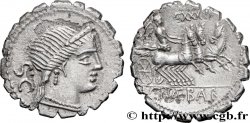
brm_178022 - NAEVIA Denier serratus

Nicht verfügbar.
Artikel auf unserem Online-Shop verkauft
Preis : 45.00 €
Artikel auf unserem Online-Shop verkauft
Preis : 45.00 €
Type : Denier serratus
Datum: 79 AC.
Name der Münzstätte / Stadt : Rome ou Italie
Metall : Silber
Der Feingehalt beträgt : 950 ‰
Durchmesser : 18,5 mm
Stempelstellung : 5 h.
Gewicht : 3,34 g.
Kommentare zum Erhaltungszustand:
Exemplaire à l’usure régulière. A été nettoyé. Droit décentré
N° im Nachschlagewerk :
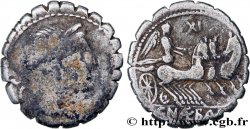
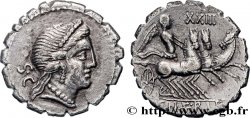
Vorderseite
Titulatur der Vorderseite S. C.
Beschreibung Vorderseite Tête diadémée de Vénus à droite ; marque de contrôle A.
Übersetzung der Vorderseite “Senatus Consulto”, (avec l’accord du Sénat).
Rückseite
Titulatur der Rückseite CNÆ B(AL)B.
Beschreibung Rückseite Victoire dans un trige galopant à droite, tenant les rênes des deux mains à gauche ; au-dessus, marque de contrôle VII, (7).
Übersetzung der Rückseite “Cnæus [Nævius] Balbus”, (Gneius [Nævius] Balbus).
Kommentare
Poids léger. La représentation du trige est aussi rare dans les numismatiques gauloise que romaine. On trouve dans l'ouvrage de LA TOUR (LT. 10074, 10075 et 10085), les dessins de trois deniers copiés ou imités sur ce prototype par les Celtes du Danube. D'autre part, S. Scheers donne comme prototype du bronze véliocasse (LT. 7356), le denier de Jules César (RCV. 1402) avec Énée fuyant Troie. En réalité, la tête de Vénus de notre denier semble assez proche de celle du bronze et pourrait lui avoir servi de modèle.
Light weight. The representation of the trige is as rare in Gallic as in Roman numismatics. In the work of LA TOUR (LT. 10074, 10075 and 10085), we find the drawings of three denarii copied or imitated on this prototype by the Celts of the Danube. On the other hand, S. Scheers gives as prototype of the bronze veliocasses (LT. 7356), the denarius of Julius Caesar (RCV. 1402) with Aeneas fleeing Troy. In reality, the head of Venus of our denarius seems quite close to that of the bronze and could have served as a model for it
Light weight. The representation of the trige is as rare in Gallic as in Roman numismatics. In the work of LA TOUR (LT. 10074, 10075 and 10085), we find the drawings of three denarii copied or imitated on this prototype by the Celts of the Danube. On the other hand, S. Scheers gives as prototype of the bronze veliocasses (LT. 7356), the denarius of Julius Caesar (RCV. 1402) with Aeneas fleeing Troy. In reality, the head of Venus of our denarius seems quite close to that of the bronze and could have served as a model for it
Historischer Hintergrund
NAEVIA
(79 v. Chr.)
Die Naevia gens ist eine Familie plebejischer und patrizischer Herkunft. Caius Naevius Balbus, der Geldgeber, ist ein Unterstützer von Sulla.
 Berichten über einen Fehler
 Die Seite drucken
 Teilen meiner Auswahl
 Stellen Sie eine Frage
 Einlieferung/Verkauf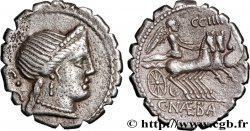
 Details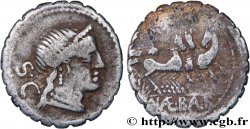

Ihre zuletzt angesehenen Artikel
1 Dollar KANADA 1967 P.084b ST
24.39 €
20 Rupee NEPAL 1995 P.38b ST
3.00 €

CONSTANS Demi-maiorina, (PB, Æ 3) VZ
60.00 €

EUDOCIA Tremissis fVZ/VZ
1500.00 €
cgbfr.de numismatik


