


fme_759933 - MONNAIE DE PARIS Médaille, Monnaie de Paris

Nicht verfügbar.
Artikel auf unserem Online-Shop verkauft (2023)
Preis : 125.00 €
Artikel auf unserem Online-Shop verkauft (2023)
Preis : 125.00 €
Type : Médaille, Monnaie de Paris
Datum: 2002
Name der Münzstätte / Stadt : Monnaie de Paris
Metall : Silber
Der Feingehalt beträgt : 925 ‰
Durchmesser : 64,5 mm
Stempelstellung : 12 h.
Graveur LEONARD Laurent (1758-1774) / DUBOIS Henri (1859-1943)
Gewicht : 152,48 g.
Rand lisse + Corne d’abondance double 925
Punze : corne d’abondance
Kommentare zum Erhaltungszustand:
Patine grise hétérogène. La médaille présente quelques coups. Elle est conservée dans sa boîte bleue façon cuir de la Monnaie de Paris
Vorderseite
Titulatur der Vorderseite AURO ARGENTO AERI FLANDO FERIUNDO // AEDES AEDIFICATAE / MDCCLXX.
Beschreibung Vorderseite Vue de la Monnaie depuis la Seine.
Rückseite
Titulatur der Rückseite M FILIPPI / FRANCK / 2002.
Beschreibung Rückseite Légende en 3 lignes dans un médaillon dans une couronne de chêne et de lauriers. Signé : H. D.
Kommentare
En 1765, Jacques-Denis Antoine fut préféré aux architectes Étienne-Louis Boullée et François Dominique Barreau de Chefdeville pour la construction de ce nouveau bâtiment de style néoclassique. L'abbé Jean Delagrive propose de réaliser le projet sur les quais de la Seine, à l'emplacement de l'ancien hôtel de Conti, qui avait été racheté par la Ville de Paris pour construire un nouvel hôtel de ville. Un arrêt du Conseil retint définitivement ce site auquel Antoine adapta ses plans, un quadrilatère de 1 hectare composé de plusieurs cours. Le site n'était pas encore très bien desservi, mais l'emplacement était historique et les perspectives urbanistiques valorisantes.
La première pierre fut posée par l'abbé Terray le 30 avril 1771. La façade sur le quai, longue de 117 m, fut achevée en 1773 et le gros œuvre, ainsi que l'essentiel du décor, en 1775. Cet édifice, très admiré, valut à Antoine d'entrer en 1776 à l'Académie royale d'architecture. Certains critiquèrent toutefois la façade sur le quai, jugée d'une magnificence peu en accord avec le caractère d'une « manufacture »...
In 1765, Jacques-Denis Antoine was chosen over architects Étienne-Louis Boullée and François Dominique Barreau de Chefdeville for the construction of this new neoclassical-style building. Abbé Jean Delagrive proposed carrying out the project on the banks of the Seine, on the site of the former Hôtel de Conti, which had been purchased by the City of Paris to build a new town hall. A Council decree definitively selected this site, to which Antoine adapted his plans: a 1-hectare quadrilateral composed of several courtyards. The site was not yet very well served, but the location was historic and the urban perspectives were attractive. The first stone was laid by Abbot Terray on April 30, 1771. The 117-meter-long façade on the quayside was completed in 1773, and the main structure, as well as most of the decoration, in 1775. This much-admired building earned Antoine admission to the Royal Academy of Architecture in 1776. However, some criticized the façade on the quayside, which was deemed to be of a magnificence that was hardly in keeping with the character of a \\\"manufactory.\\\"
La première pierre fut posée par l'abbé Terray le 30 avril 1771. La façade sur le quai, longue de 117 m, fut achevée en 1773 et le gros œuvre, ainsi que l'essentiel du décor, en 1775. Cet édifice, très admiré, valut à Antoine d'entrer en 1776 à l'Académie royale d'architecture. Certains critiquèrent toutefois la façade sur le quai, jugée d'une magnificence peu en accord avec le caractère d'une « manufacture »...
In 1765, Jacques-Denis Antoine was chosen over architects Étienne-Louis Boullée and François Dominique Barreau de Chefdeville for the construction of this new neoclassical-style building. Abbé Jean Delagrive proposed carrying out the project on the banks of the Seine, on the site of the former Hôtel de Conti, which had been purchased by the City of Paris to build a new town hall. A Council decree definitively selected this site, to which Antoine adapted his plans: a 1-hectare quadrilateral composed of several courtyards. The site was not yet very well served, but the location was historic and the urban perspectives were attractive. The first stone was laid by Abbot Terray on April 30, 1771. The 117-meter-long façade on the quayside was completed in 1773, and the main structure, as well as most of the decoration, in 1775. This much-admired building earned Antoine admission to the Royal Academy of Architecture in 1776. However, some criticized the façade on the quayside, which was deemed to be of a magnificence that was hardly in keeping with the character of a \\\"manufactory.\\\"
Historischer Hintergrund
MONNAIE DE PARIS
(16.-18. Jahrhundert)
Die Monnaie de Paris befand sich im 17. Jahrhundert an der Stelle der heutigen Samaritaine. Die Emissionsbank entstand aus der Ansammlung kleiner Grundstücke und mittelalterlicher Häuser, die dieser Einrichtung ein heterogenes Erscheinungsbild verliehen. Nicht weit von seinem Standort, hinter der Kirche Saint-Germain-l'Auxerrois, befindet sich noch immer die Rue de l'Arbre Sec, was daran erinnert, dass dort ein Galgen errichtet wurde, um insbesondere einige Fälscher zu bestrafen. Die wenigen Pläne aus dem 18. Jahrhundert zeigen eine Abfolge kleiner Räume unterschiedlicher Größe und auf unterschiedlichen Ebenen, von denen einige aufgrund eines Brandes leer standen. Um 1750 wurden Renovierungsprojekte vorgeschlagen, die jedoch nicht sofort umgesetzt wurden. Nach einem Tauschvertrag mit Grundstücken rund um das ehemalige Hôtel de Conti wird die Monnaie de Paris an ihren jetzigen Standort verlegt. Die alte Währung wird in der zweiten Hälfte des 18. Jahrhunderts abgeschafft.
 Berichten über einen Fehler
 Die Seite drucken
 Teilen meiner Auswahl
 Stellen Sie eine Frage
 Einlieferung/Verkauf
In Verbindung stehende Artikel
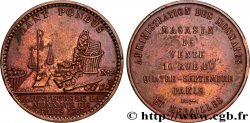
 Details




Ihre zuletzt angesehenen Artikel
05 Francs MONTAIGNE échantillon Échantillon FRANKREICH 1987 EC.1987.01b VZ
175.00 €

750 Francs FRANKREICH 1795 Ass.49a fST
1250.00 €

BUILDINGS AND HISTORY Médaille, Château de Balleroy VZ
80.00 €

FUNFTE FRANZOSISCHE REPUBLIK Médaille, Château de Chantilly VZ
70.00 €

CONQUÊTE DE L'ESPACE - EXPLORATION SPATIALE Médaille, Neil Armstrong pose le p
11.00 €

SCHWEIZ 5 Francs concours de Tir de Berne 1885 VZ
172.00 €
cgbfr.de numismatik


