


v55_0194 - MAXIMINUS I THRAX Denier
MONNAIES 55 (2012)
Startpreis : 550.00 €
Schätzung : 1 500.00 €
unverkauftes Los
Startpreis : 550.00 €
Schätzung : 1 500.00 €
unverkauftes Los
Type : Denier
Datum: (229)
Datum: c. 235-238
Name der Münzstätte / Stadt : Regelwidrig Münzen
Metall : Silber
Durchmesser : 18,00 mm
Stempelstellung : 6 h.
Gewicht : 2,71 g.
Seltenheitsgrad : R3
Kommentare zum Erhaltungszustand:
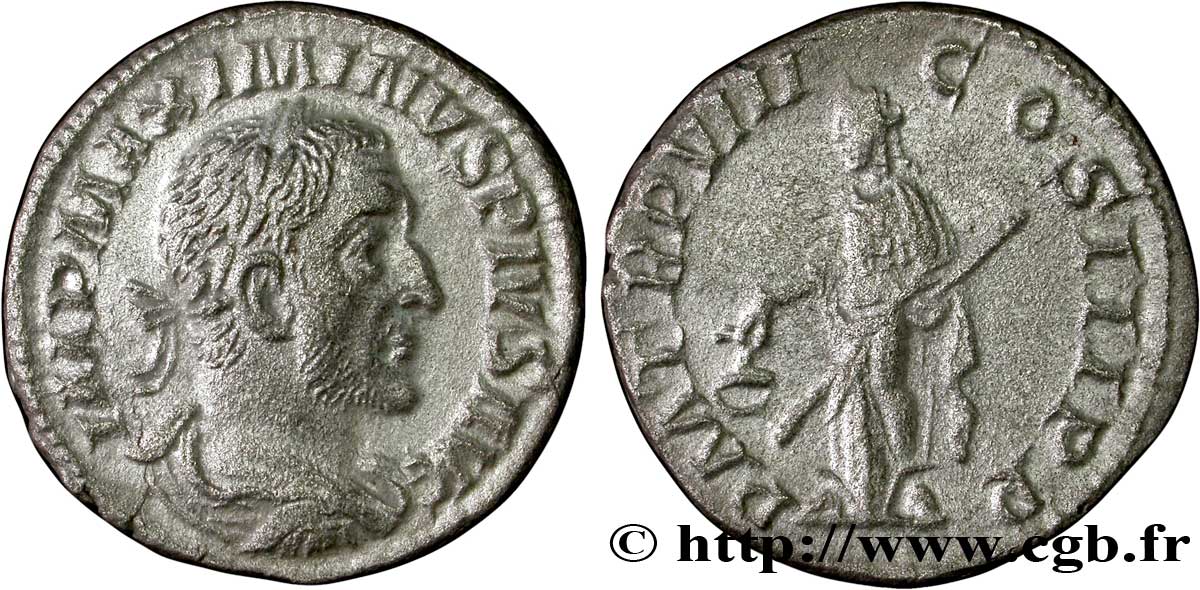
Exemplaire sur un petit flan mince, bien centré des deux côtés. Très beau portrait stylisé. Petite faiblesse de frappe sur la Liberté au revers. Patine grise superficielle, légèrement cristallisée
N° im Nachschlagewerk :
Pedigree :
Cet exemplaire provient de la collection Laurent Schmitt, MONNAIES XXI, n° 2976
Vorderseite
Titulatur der Vorderseite IMP MAXIMINVS PIVS AVG.
Beschreibung Vorderseite Buste lauré, drapé et cuirassé de Maximin Ier à droite, vu de trois quarts en arrière (A*2) ; portrait B.
Übersetzung der Vorderseite “Imperator Maximinus Pius Augustus”, (L'empereur Maximin pieux auguste).
Rückseite
Titulatur der Rückseite P M TR P VIII - COS III P P.
Beschreibung Rückseite Libertas (la Liberté) drapée debout à gauche, tenant un bonnet de la main droite et un sceptre transversal de la main gauche.
Übersetzung der Rückseite “Pontifex Maximus Tribunicia Potestate octavum Consul tertium Pater Patriæ”, (Revêtu de la huitième puissance tribunitienne consul pour la troisième fois père de la patrie).
Kommentare
Imitation, hybride d’Alexandre Sévère. Poids léger. Manque aux plus grands musées. Ne semblait pas avoir été illustré précédemment. C’est le second exemplaire publié, le premier provient du trésor de Rika Devnia (Marcianopolis, p. 137) où il était décrit comme semi-barbare. Quand on examine cet exemplaire, nous nous rendons compte que ce denier hybride ne ressemble pas du tout à une imitation, mais nous nous expliquons mal comment deux coins hybrides, l’un de Maximin Ier Thrace pour le droit, l’autre d’Alexandre Sévère pour le revers, daté de sept ans plus tôt peuvent-ils se retrouver ensemble. Comment des faux-monnayeurs auraient-ils réussi à s’emparer de coins officiels ?.
Imitation, hybrid of Alexander Severus. Light weight. Missing from the largest museums. Did not seem to have been illustrated previously. This is the second example published, the first comes from the treasure of Rika Devnia (Marcianopolis, p. 137) where it was described as semi-barbarian. When we examine this example, we realize that this hybrid denarius does not at all resemble an imitation, but we do not understand how two hybrid dies, one of Maximin I Thrace for the obverse, the other of Alexander Severus for the reverse, dated seven years earlier, could be found together. How could counterfeiters have managed to get hold of official dies?
Imitation, hybrid of Alexander Severus. Light weight. Missing from the largest museums. Did not seem to have been illustrated previously. This is the second example published, the first comes from the treasure of Rika Devnia (Marcianopolis, p. 137) where it was described as semi-barbarian. When we examine this example, we realize that this hybrid denarius does not at all resemble an imitation, but we do not understand how two hybrid dies, one of Maximin I Thrace for the obverse, the other of Alexander Severus for the reverse, dated seven years earlier, could be found together. How could counterfeiters have managed to get hold of official dies?
Historischer Hintergrund
MAXIMINUS I THRAX
(22. März 235 – ca. 15. April 238)
Maximin, ein Soldat, verdankt seine Karriere seiner sehr großen Größe. Er wird von Septimius Severus bemerkt, der ihn zum Prätorianer macht. Nach der Ermordung von Alexander Severus zum Augustus ernannt, wird er in der Geschichte als blutrünstiger Idiot und geschworener Feind des Senats dargestellt. In drei Regierungsjahren wird er Rom nie betreten und bleibt am Rhein-Donau-Limes. Er errang 236 einen großen Sieg über die Deutschen, ließ sich in Sirmium nieder und errang einen Sieg über die Sarmaten. Während er seine ganze Fürsorge den Soldaten widmet, vernachlässigt er Rom und überwältigt die Städte. Er war thrakischer Herkunft und der erste illyrische Kaiser. Im Jahr 238 kam es in Rom und in Afrika zu zahlreichen Aufständen. Die Gordianer werden im Januar oder Februar in Afrika zum Augustus erklärt, während in Rom die beiden Senatoren Balbin und Pupien für die Eliminierung von Maximinus verantwortlich sind, der schließlich zusammen mit seinem Sohn Maximus unter den von ihnen belagerten Mauern von Aquileia ermordet wird.
 Berichten über einen Fehler
 Die Seite drucken
 Teilen meiner Auswahl
 Stellen Sie eine Frage
 Einlieferung/Verkauf
In Verbindung stehende Artikel

 Details
Ihre zuletzt angesehenen Artikel
BOSPHORIEN - KÖENIGREICH DER CIMMERIAN BOSPHORUS - DYNAMIS Unité, (MB, Æ 22)
175.00 €
SIZILIEN - AKRAGAS Quart de shekel VZ
650.00 €
MAXIMINUS I THRAX Denier fST
145.00 €

FLAVIUS VICTOR Silique fSS/SS
325.00 €
MAXIMIANUS HERCULIUS Aurelianus VZ/SS
750.00 €

JOVINVS Silique VZ
1100.00 €
cgbfr.de numismatik


