


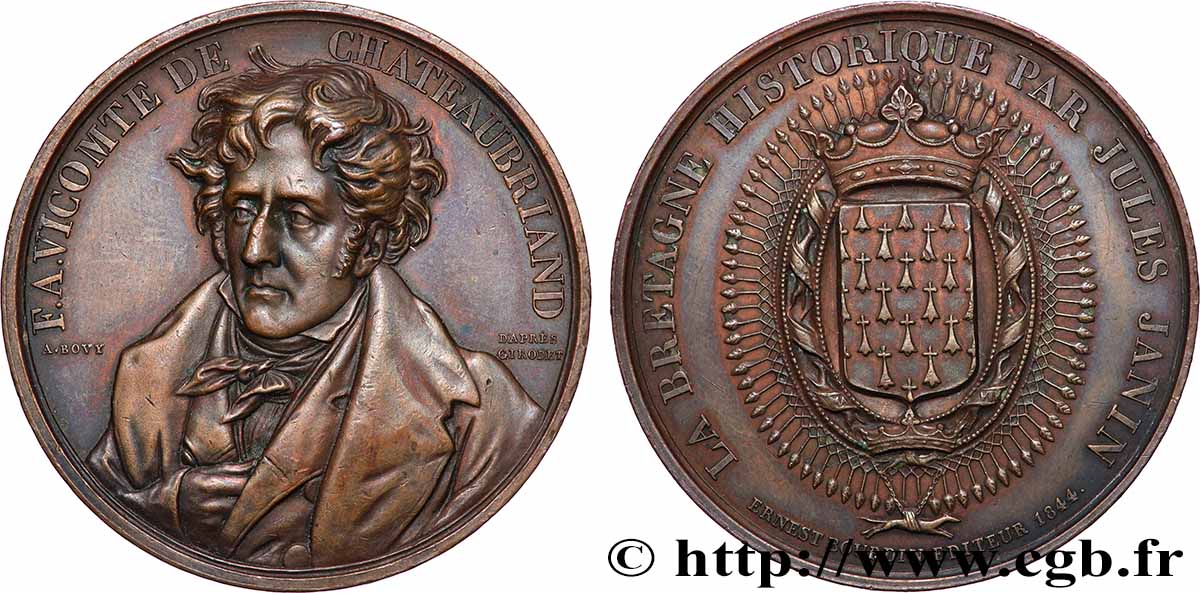
fme_1119170 - LUDWIG PHILIPP I Médaille, Jules Janin, Vicomte de Chateaubriand, refrappe
60.00 €
Menge
In den Warenkorb

Type : Médaille, Jules Janin, Vicomte de Chateaubriand, refrappe
Datum: 1844
Metall : Kupfer
Durchmesser : 41 mm
Stempelstellung : 12 h.
Graveur BOVY Antoine (1795-1877)
Gewicht : 39,72 g.
Rand lisse + proue CUIVRE
Punze : Proue CUIVRE
Kommentare zum Erhaltungszustand:
Patine hétérogène, légèrement irisée, avec des traces d’usure, rayures et taches d’oxydation
N° im Nachschlagewerk :
Vorderseite
Titulatur der Vorderseite F. A. VICOMTE DE - CHATEAUBRIAND.
Beschreibung Vorderseite Buste habillé de trois quarts face de Chateaubriand, signé : A. BOVY - D’APRES GIRODET.
Rückseite
Titulatur der Rückseite LA BRETAGNE HISTORIQUE PAR JULES JANIN.
Beschreibung Rückseite Écu couronné de Bretagne, signé : ERNEST BOURDIN EDITEUR 1844..
Kommentare
Gabriel-Jules Janin, né à Saint-Étienne le 16 février 18041 est mort à Paris le 19 juin 1874, est un écrivain et critique dramatique français.
Fils d’un avocat, Janin reçoit une bonne éducation, d’abord dans sa ville natale puis au lycée Louis-le-Grand à Paris. Après un passage dans l’étude de l’avoué Jean-Baptiste Guillonnet-Merville, où il sera saute-ruisseau en même temps qu’Honoré de Balzac, il devient journaliste et travaille notamment à la Revue de Paris, à la Revue des deux Mondes, au Figaro et à la Quotidienne. Il fut parmi les fondateurs de la Revue de Paris et du Journal des Enfants. Il se fait connaître en 1827 avec le roman L’Âne mort et la femme guillotinée. La Confession en 1830, un peu moins profond, mais au style encore plus remarquable, et Barnave en 1831, où il attaque la famille d’Orléans, finissent d’asseoir sa réputation.
Entre-temps, il entre comme critique au Journal des Débats où il reste quarante ans. Son autorité le fait surnommer « le prince des critiques ».
Gabriel-Jules Janin, born in Saint-Étienne on February 16, 1804, died in Paris on June 19, 1874, was a French writer and drama critic. The son of a lawyer, Janin received a good education, first in his hometown and then at the Lycée Louis-le-Grand in Paris. After a stint in the office of the lawyer Jean-Baptiste Guillonnet-Merville, where he was a leaping brook at the same time as Honoré de Balzac, he became a journalist and worked notably for the Revue de Paris, the Revue des deux Mondes, Le Figaro and La Quotidienne. He was among the founders of the Revue de Paris and the Journal des Enfants. He became known in 1827 with the novel The Dead Donkey and the Guillotined Woman. The Confession in 1830, a little less profound, but with an even more remarkable style, and Barnave in 1831, in which he attacks the Orléans family, finally established his reputation. In the meantime, he joined the Journal des Débats as a critic, where he remained for forty years. His authority earned him the nickname \\\"the prince of critics.\\\"
Historischer Hintergrund
LUDWIG PHILIPP I
(7.08.1830-24.02.1848)
Louis-Philippe wurde 1773 in Paris geboren und ist der älteste Sohn von Louis-Philippe Joseph, Herzog von Orléans (Philippe-Égalité), der 1793 wegen Korruption guillotiniert wurde, nachdem er für den Tod seines Cousins Ludwig XVI. gestimmt hatte. Ab 1793 trägt er nacheinander die Titel eines Herzogs von Valois, Chartres und Orleans. Obwohl er wie sein Vater der Revolution positiv gegenüberstand, musste er dennoch in die Schweiz flüchten, reiste dann nach Skandinavien und in die Vereinigten Staaten und ließ sich schließlich 1801 in England nieder.. Die Restauration ermöglicht es ihm, die riesigen Besitztümer seiner Familie wiederzufinden, doch Ludwig XVIII. betrachtet ihn weiterhin als potenziellen Rivalen, der ihn kalt empfängt. Als Flüchtling in England während der Hundert Tage kehrte er 1817 nach Frankreich zurück. Gierig nach Gewinn unterstützte er die von der liberalen Partei vertretene Opposition und stützte sich dabei auf die besitzende obere Mittelschicht.. Die Tage des Jahres 1830 gaben ihm die Möglichkeit, an die Macht zu kommen, nachdem er der Trikolore treu geblieben und seine Versprechen vervielfacht hatte. Er wurde am 31. Juli 1830 Generalleutnant des Königreichs und am 7. August König der Franzosen. Seine Herrschaft unter einem liberalen Anschein wird die Herrschaft der Bourgeoisie und der Geschäftskreise werden, während die Oppositionen (Legitimisten, Bonapartisten, Republikaner und Sozialisten) illegal aufrechterhalten werden.. Seine Friedenspolitik und seine Autorität verschafften ihm daraufhin großes Ansehen an den europäischen Gerichten.. Der Bankier Laffitte ist Premierminister. La Fayette ist einer der Architekten dieser „bürgerlichen Revolution“. Am 13. März 1831 ersetzte Casimir Périer Laffitte. Frankreich interveniert im August 1831 in Belgien, um den Niederländern entgegenzuwirken. Die Legitimisten versuchen mit der Verschwörung in der Rue des Prouvaires, Heinrich V. als König zu etablieren, während seine Mutter versucht, die Vendée zu erheben. Sie wurde am 3. Dezember 1832 in Nantes verhaftet.. Die Cholera-Epidemie tötet in Paris mehr als zehntausend Menschen, darunter auch Casimir Périer. Die Beerdigung von General Lamarque war Anlass für einen republikanischen Aufstandsversuch, der blutig niedergeschlagen wurde (siehe. Erbärmlich). Am 23. Dezember 1832 besetzen die Franzosen Antwerpen.. Bei Fieschis Angriff auf Louis-Philippe am 28. Juli 1835 kommen achtzehn Menschen ums Leben, darunter auch Marschall Mortier. Die erste Eisenbahnlinie Paris-Orléans und die Julisäule wurden am 24. Oktober 1837 bzw. 28. Juli 1840 eingeweiht.. Das Jahr 1840 markierte einen Wendepunkt im Regime, mit großer Instabilität auf Ministerebene, bevor das Guizot-Ministerium entstand („Werden Sie reich!“).. Prinz Louis-Napoleon Bonaparte wurde nach einem zweiten Putschversuch zu lebenslanger Haft verurteilt und in Fort Ham eingesperrt, aus dem er 1846 floh. Napoleons Asche wird aus St. Helena gebracht und nach Les Invalides überführt. Ab 1841 verpflichtete Louis-Philippe Frankreich auf den Weg der vollständigen Eroberung Algeriens, der bereits unter Karl X. begonnen hatte, während sich im französischen Mutterland ein großer wirtschaftlicher Aufschwung entwickelte.. Ein Gesetz aus dem Jahr 1841 begrenzt die Kinderarbeit auf 12 Stunden. Der erste schwere Eisenbahnunfall ereignete sich am 8. Mai 1842 auf der Strecke Paris-Versailles und forderte 45 Todesopfer. Am 13. Juli starb der Herzog von Orleans, der älteste Sohn des Königs, durch einen Unfall. Am 16. Mai 1843 nahm der Herzog von Aumale die Smala von Abd-el-Kader ein, dem die Flucht gelang. Bugeaud, Gouverneur von Algerien, wird zum Marschall ernannt. 1843 ist auch der Beginn der Entente Cordiale und des Besuchs von Königin Victoria in Frankreich. Die Franzosen besiegten die Marokkaner in Isly. Abd-el-Kader kapituliert am 23. Dezember 1847. Die Ablehnung von Reformen führt zum Sturz des Regimes während der Bankettkampagne und Louis-Philippe, der am 24. Februar 1848 entthront wird, flüchtet nach England, nachdem er zugunsten seines Enkels abgedankt hat..
 Berichten über einen Fehler
 Die Seite drucken
 Teilen meiner Auswahl
 Stellen Sie eine Frage
 Einlieferung/Verkauf
In Verbindung stehende Artikel

 Details


Ihre zuletzt angesehenen Artikel

ABRINCATUI (Area of the Cotentin) Statère de billon à la joue ornée, à la ro
700.00 €

GALLIEN - BELGICA - SUESSIONES (Region die Soissons) Potin au cheval, classe I f
150.00 €

Piéfort Cu-Ni-Al de 10 francs Mathieu 1974 Pessac GEM.186 P1P ST
150.00 €

5 francs Charles X, 2e type 1828 Nantes F.311/25 SS50
160.00 €

SCHWEIZ - KANTON NEUCHATEL Médaille, 50e anniversaire d’émancipation du peu
55.00 €

VEREINIGTEN KÖNIGREICH 5 Pounds (5 Livres) Proof Héritage Viking 2017 ST
100.00 €
cgbfr.de numismatik


