


fme_690871 - THE 100 GREATEST MASTERPIECES Médaille, L’impératrice Théodora et sa suite
Nicht verfügbar.
Artikel auf unserem Online-Shop verkauft (2023)
Preis : 55.00 €
Artikel auf unserem Online-Shop verkauft (2023)
Preis : 55.00 €
Type : Médaille, L’impératrice Théodora et sa suite
Datum: 1981
Metall : Silber
Der Feingehalt beträgt : 800 ‰
Durchmesser : 50,5 mm
Stempelstellung : 12 h.
Graveur LUNGER Jane
Gewicht : 65,19 g.
Rand lisse + ARGENT 1ER TITRE + losange + 81-P + CRABE
Punze : Crabe
Kommentare zum Erhaltungszustand:
Traces de manipulation et d’oxydation irisée et cuivrée sur la tranche et le dessus de la médaille, quelques tâches au revers
Vorderseite
Titulatur der Vorderseite ANÉPIGRAPHE.
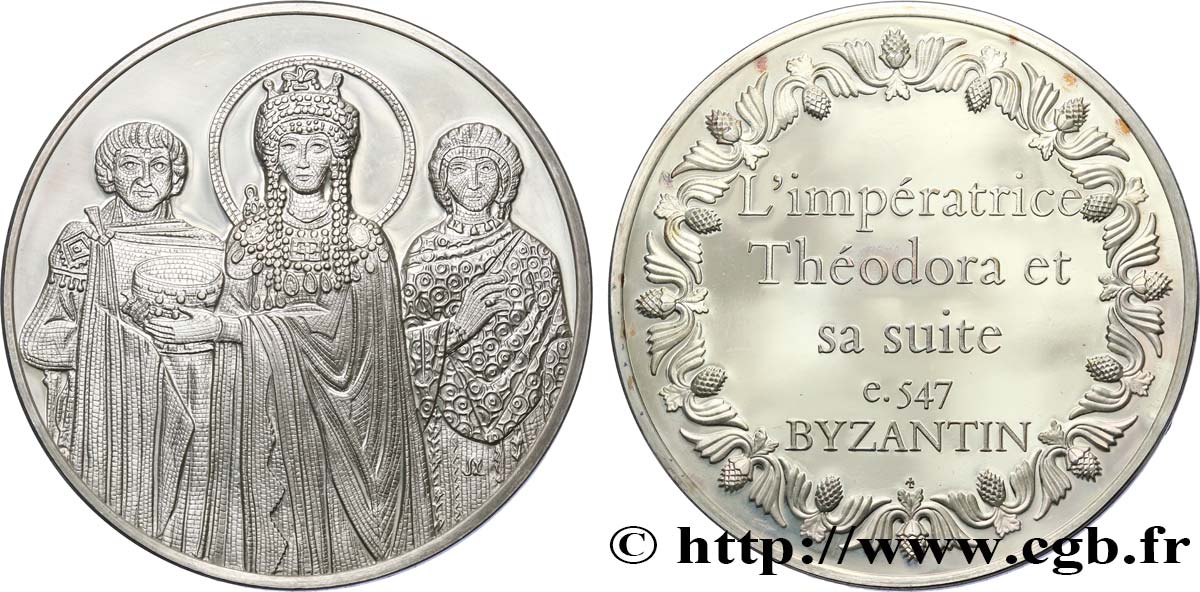
Beschreibung Vorderseite Représentation d’une mosaïque byzantine (e.547).
Monogramme du graveur.
Rückseite
Titulatur der Rückseite L’IMPERATRICE / THEODORA ET / SA SUITE / E.547 / BYZANTIN.
Beschreibung Rückseite Légende en 5 lignes entourée d’une frise végétale.
Kommentare
Exemplaire issu du médaillier Franklin qui met à l’honneur une mosaïque de Théodora et les dignitaires : Théodora a laissé une réputation sulfureuse dans l’histoire et semble avoir eu une influence sur la politique de son époux. Elle est ici représentée frontalement, somptueusement vêtue et parée de perles et de pierres précieuses. Elle tient un calice richement orné et se dirige vers la gauche, donc vers la figure du Christ trônant. Comme les autres visages, celui de l’impératrice n’est pas véritablement un portrait, mais plutôt la représentation idéale de sa fonction. Elle semble néanmoins, contrairement aux autres personnages peu expressifs, un peu songeuse. Théodora est entourée sur sa gauche de sept dames d’honneur et sur sa droite de deux dignitaires. L’un d’entre eux écarte une tenture, dévoilant une fontaine, pour que le cortège puisse passer.
Cette procession trouve un écho dans la broderie d’or qui figure les Rois mages au bas du manteau pourpre de Théodora. Ce thème de la procession se retrouve à la même époque dans d’autres églises de Ravenne, comme à Saint- Apollinaire-le-Neuf, où des martyrs défilent sur les murs de la nef.
Cette mosaïque est conservée dans la basilique Saint-Vital à Ravenne en Italie.
Médaille sculptée par Jane Lunger.
Théoriquement, le poinçon crabe est censé indiquer un titrage à 800 millièmes.
example from the Franklin medal cabinet which features a mosaic of Theodora and the dignitaries: Theodora left a sulphurous reputation in history and seems to have had an influence on her husband's policies.. She is represented here frontally, sumptuously dressed and adorned with pearls and precious stones.. She holds a richly decorated chalice and points to the left, towards the enthroned figure of Christ.. Like the other faces, that of the Empress is not truly a portrait, but rather the ideal representation of her function.. However, unlike the other inexpressive characters, she seems a little pensive.. Theodora is surrounded on her left by seven ladies-in-waiting and on her right by two dignitaries.. One of them pulls back a curtain, revealing a fountain, so that the procession can pass.
This procession finds an echo in the gold embroidery which depicts the Magi at the bottom of Theodora's purple cloak.. This theme of the procession is found at the same time in other churches of Ravenna, such as at Sant'Apollinare Nuovo, where martyrs parade on the walls of the nave..
This mosaic is kept in the Basilica of San Vitale in Ravenna, Italy.
Medal sculpted by Jane Lunger.
Theoretically, the crab hallmark is supposed to indicate a fineness of 800 thousandths.
Cette procession trouve un écho dans la broderie d’or qui figure les Rois mages au bas du manteau pourpre de Théodora. Ce thème de la procession se retrouve à la même époque dans d’autres églises de Ravenne, comme à Saint- Apollinaire-le-Neuf, où des martyrs défilent sur les murs de la nef.
Cette mosaïque est conservée dans la basilique Saint-Vital à Ravenne en Italie.
Médaille sculptée par Jane Lunger.
Théoriquement, le poinçon crabe est censé indiquer un titrage à 800 millièmes.
example from the Franklin medal cabinet which features a mosaic of Theodora and the dignitaries: Theodora left a sulphurous reputation in history and seems to have had an influence on her husband's policies.. She is represented here frontally, sumptuously dressed and adorned with pearls and precious stones.. She holds a richly decorated chalice and points to the left, towards the enthroned figure of Christ.. Like the other faces, that of the Empress is not truly a portrait, but rather the ideal representation of her function.. However, unlike the other inexpressive characters, she seems a little pensive.. Theodora is surrounded on her left by seven ladies-in-waiting and on her right by two dignitaries.. One of them pulls back a curtain, revealing a fountain, so that the procession can pass.
This procession finds an echo in the gold embroidery which depicts the Magi at the bottom of Theodora's purple cloak.. This theme of the procession is found at the same time in other churches of Ravenna, such as at Sant'Apollinare Nuovo, where martyrs parade on the walls of the nave..
This mosaic is kept in the Basilica of San Vitale in Ravenna, Italy.
Medal sculpted by Jane Lunger.
Theoretically, the crab hallmark is supposed to indicate a fineness of 800 thousandths.
Historischer Hintergrund
THE 100 GREATEST MASTERPIECES
(1974-1982)
Vom Medailleur herausgegebene Medaillensammlung in limitierter Auflage. Einmal im Monat wurde eine Medaille zum Preis von 180 Frs verschickt. Diese Sammlung fand zwischen 1974 und 1982 statt. Jede Medaille trägt normalerweise am Rand das staatliche Gütesiegel, das die Silberauflage garantiert, das P-Zeichen für die Proof-Qualität, das Prägejahr und das Gütesiegel „Meister des Medaillons“..
 Berichten über einen Fehler
 Die Seite drucken
 Teilen meiner Auswahl
 Stellen Sie eine Frage
 Einlieferung/Verkauf
cgbfr.de numismatik


