


v52_0408 - IULIUS CAESAR Denier

MONNAIES 52 (2012)
Startpreis : 750.00 €
Schätzung : 1 500.00 €
Erzielter Preis : 830.00 €
Anzahl der Gebote : 4
Höchstgebot : 850.00 €
Startpreis : 750.00 €
Schätzung : 1 500.00 €
Erzielter Preis : 830.00 €
Anzahl der Gebote : 4
Höchstgebot : 850.00 €
Type : Denier
Datum: 49 AC.
Name der Münzstätte / Stadt : Gaule ou Italie
Metall : Silber
Der Feingehalt beträgt : 950 ‰
Durchmesser : 19,5 mm
Stempelstellung : 10 h.
Gewicht : 3,38 g.
Seltenheitsgrad : R1
Kommentare zum Erhaltungszustand:
Exemplaire de qualité exceptionnelle pour ce type sur un flan large, ovale parfaitement centré des deux côtés avec les grènetis complets. Droit magnifique avec un éléphant de haut relief, bien venu à la frappe. Très joli revers de style fin. Patine grise épaisse avec des reflets mordorés. Conserve la plus grande partie de son brillant de frappe et de son coupant d’origine
N° im Nachschlagewerk :
Pedigree :
Cet exemplaire provient de la vente Burgan 23, 1990, n° 218 et de la collection D. J
Vorderseite
Titulatur der Vorderseite CAESAR À L'EXERGUE.
Beschreibung Vorderseite Éléphant passant à droite ; à ses pieds, un serpent (ou carnyx, trompette gauloise).
Übersetzung der Vorderseite “Cæsar”, (César).
Rückseite
Titulatur der Rückseite ANÉPIGRAPHE.
Beschreibung Rückseite Instruments pontificaux : simpulum, aspersoir, hache à sacrifice, chapeau à sacrifice.
Kommentare
Poids léger. Pour ce type, M. Crawford a relevé une estimation de 750 coins de droit et de 833 coins de revers, représentant une production qui pourrait avoisiner les deux à quatre millions de deniers. Les auteurs du CMDRR. ont isolé six variétés différentes pour ce denier. Pendant très longtemps, on pensa que ce denier avait été frappé par César pendant la Guerre des Gaules entre 58 et 52 avant J.-C., en Gaule même. En fait, il fut fabriqué au début des Guerres Civiles. Il a été imité servilement par les Trévires avec le bronze HIRTIVS (LT. 9235), fortement romanisé.
Lightweight. For this type, Mr. Crawford noted an estimate of 750 obverse dies and 833 reverse dies, representing a production that could be around two to four million denarii. The authors of the CMDRR. isolated six different varieties for this denarius. For a very long time, it was thought that this denarius had been struck by Caesar during the Gallic Wars between 58 and 52 BC, in Gaul itself. In fact, it was made at the beginning of the Civil Wars. It was slavishly imitated by the Treveri with the bronze HIRTIVS (LT. 9235), heavily Romanized
Lightweight. For this type, Mr. Crawford noted an estimate of 750 obverse dies and 833 reverse dies, representing a production that could be around two to four million denarii. The authors of the CMDRR. isolated six different varieties for this denarius. For a very long time, it was thought that this denarius had been struck by Caesar during the Gallic Wars between 58 and 52 BC, in Gaul itself. In fact, it was made at the beginning of the Civil Wars. It was slavishly imitated by the Treveri with the bronze HIRTIVS (LT. 9235), heavily Romanized
Historischer Hintergrund
IULIUS CAESAR
(13.07.100-15.03.44 v. Chr.)
Julius Caesar, geboren im Jahr 100 v. Chr., gehört der Partei des Marius an und stellte sich schon in jungen Jahren gegen Sylla. Er war 62 v. Chr. Prätor, bevor er 59 v. Chr., dem Jahr seines Konsulats, mit Pompeius und Crassus das erste Triumvirat bildete. Anschließend erhält er ein prokonsularisches Imperium auf Gallien, das 54 erneuert wird. Er kämpft gegen Vercingétorix in Gergovie und dann in Alesia. Belagert muss der gallische Anführer kapitulieren. Nachdem Crassus 53 v. Chr. bei Carrhae in Mesopotamien getötet worden war, wurde Caesar wütend auf Pompeius und marschierte 49 v. Chr. auf Rom. 48 v. Chr. schlug er bei Pharsalos Pompeius nieder, der nach Ägypten floh, wo er ermordet wurde. Caesar muss sich dann den Söhnen des Pompeius und der pompejanischen Partei stellen. Er besiegte sie 46 v. Chr. bei Thapsus (Afrika, Tod von Cato von Utica) und bei Munda (Spanien, Tod von Cneius Pompeius). Caesar wurde an den Iden des März (15. März 44 v. Chr.) von Cassius und Brutus ermordet. Nach seinem Tod im Jahr 42 v. Chr. wurde er vergöttert..
 Berichten über einen Fehler
 Die Seite drucken
 Teilen meiner Auswahl
 Stellen Sie eine Frage
 Einlieferung/Verkauf
In Verbindung stehende Artikel

 Details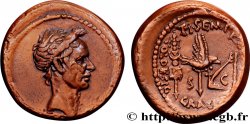


cgbfr.de numismatik


