


fme_412463 - ITALIEN Médaille de Ferdinand II
Nicht verfügbar.
Artikel auf unserem Online-Shop verkauft (2017)
Preis : 900.00 €
Artikel auf unserem Online-Shop verkauft (2017)
Preis : 900.00 €
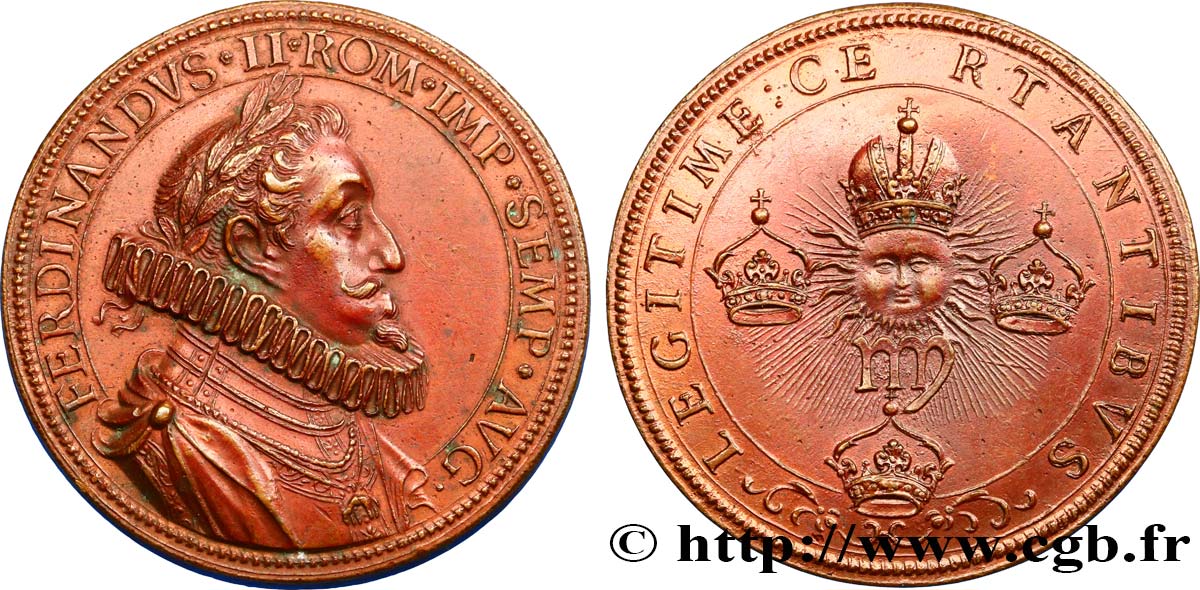
Type : Médaille de Ferdinand II
Datum: 1623
Name der Münzstätte / Stadt : Italie, Florence
Metall : Bronze
Durchmesser : 44 mm
Stempelstellung : 12 h.
Graveur PIETRO DE POMIS Giovanni (1565-1633)
Gewicht : 43 g.
Rand lisse
Kommentare zum Erhaltungszustand:
Magnifique et intéressante médaille, en bronze avec une agréable patine rouge
Vorderseite
Titulatur der Vorderseite FERDINANDVS. II. ROM. IMP. SEMP. AVG..
Beschreibung Vorderseite Buste en armure, avec collerette, à droite de Ferdinand II.
Rückseite
Titulatur der Rückseite LEGITIME : CE RTANTIBVS.
Beschreibung Rückseite Soleil radieux couronnée entre 3 couronnes ; un monogramme au-dessus de la couronne inférieure.
Kommentare
Médaille non datée, non signée mais attribuée à Giovanni Pietro de Pomis (1565 ou 1569/70 - 6 mars 1633) qui était un peintre, un medailleur et un architecte italien. Ses œuvres montrent une influence marquée du maniérisme tardif.
Le dernier exemplaire passé en vente, chez Gerhard Hirsch Nachfolger, Auction 272, Lot 1487, a été vendu 1500€ sur une estimation de 800€.
Ferdinand II de Médicis (1610 à Florence-1670 à Florence) est un grand-duc de Toscane, le fils de Cosme II de Médicis et de Marie-Madeleine d'Autriche.
La chose qui l'intéressait le plus et qui lui donna le plus de satisfaction était la science. Élève de Galilée, puis de ses disciples Torricelli et Viviani, il fonda l'Académie d'Expérimentation des Médicis en 1642, puis protégea l'Accademia del Cimento créée par son frère Léopold (1657), première société scientifique européenne au caractère expérimental (la devise étant « essayer et réessayer »). Dans ce domaine, c'est lui qui perfectionna l'invention du thermomètre et celle de thermoscope, encouragea la chimie dans les jardins Botaniques de Pise. Enfin, passionné de botanique et de météorologie, il chercha une application pratique dans l'agriculture des nouvelles connaissances techniques. Sa faiblesse politique l'empêchera de sauver Galilée du Saint-Office, bien qu'il essayât par tous les moyens de le défendre..
Undated, unsigned medal attributed to Giovanni Pietro de Pomis (1565 or 1569/70 – March 6, 1633) who was an Italian painter, medalist and architect. His works show a marked influence of late Mannerism.
The last example to go on sale, at Gerhard Hirsch Nachfolger, Auction 272, Lot 1487, sold for €1,500 on an estimate of €800..
Ferdinand II de' Medici (1610 in Florence-1670 in Florence) was a Grand Duke of Tuscany, the son of Cosimo II de' Medici and Maria Magdalena of Austria..
The thing that interested him most and gave him the most satisfaction was science.. A pupil of Galileo, then of his disciples Torricelli and Viviani, he founded the Medici Academy of Experimentation in 1642, then protected the Accademia del Cimento created by his brother Leopold (1657), the first European scientific society with an experimental character (the motto being \\\"try and try again\\\").. In this field, he was the one who perfected the invention of the thermometer and the thermoscope, and encouraged chemistry in the Botanical Gardens of Pisa.. Finally, passionate about botany and meteorology, he sought a practical application in agriculture of the new technical knowledge. His political weakness prevented him from saving Galileo from the Holy Office, although he tried by all means to defend him..
Le dernier exemplaire passé en vente, chez Gerhard Hirsch Nachfolger, Auction 272, Lot 1487, a été vendu 1500€ sur une estimation de 800€.
Ferdinand II de Médicis (1610 à Florence-1670 à Florence) est un grand-duc de Toscane, le fils de Cosme II de Médicis et de Marie-Madeleine d'Autriche.
La chose qui l'intéressait le plus et qui lui donna le plus de satisfaction était la science. Élève de Galilée, puis de ses disciples Torricelli et Viviani, il fonda l'Académie d'Expérimentation des Médicis en 1642, puis protégea l'Accademia del Cimento créée par son frère Léopold (1657), première société scientifique européenne au caractère expérimental (la devise étant « essayer et réessayer »). Dans ce domaine, c'est lui qui perfectionna l'invention du thermomètre et celle de thermoscope, encouragea la chimie dans les jardins Botaniques de Pise. Enfin, passionné de botanique et de météorologie, il chercha une application pratique dans l'agriculture des nouvelles connaissances techniques. Sa faiblesse politique l'empêchera de sauver Galilée du Saint-Office, bien qu'il essayât par tous les moyens de le défendre..
Undated, unsigned medal attributed to Giovanni Pietro de Pomis (1565 or 1569/70 – March 6, 1633) who was an Italian painter, medalist and architect. His works show a marked influence of late Mannerism.
The last example to go on sale, at Gerhard Hirsch Nachfolger, Auction 272, Lot 1487, sold for €1,500 on an estimate of €800..
Ferdinand II de' Medici (1610 in Florence-1670 in Florence) was a Grand Duke of Tuscany, the son of Cosimo II de' Medici and Maria Magdalena of Austria..
The thing that interested him most and gave him the most satisfaction was science.. A pupil of Galileo, then of his disciples Torricelli and Viviani, he founded the Medici Academy of Experimentation in 1642, then protected the Accademia del Cimento created by his brother Leopold (1657), the first European scientific society with an experimental character (the motto being \\\"try and try again\\\").. In this field, he was the one who perfected the invention of the thermometer and the thermoscope, and encouraged chemistry in the Botanical Gardens of Pisa.. Finally, passionate about botany and meteorology, he sought a practical application in agriculture of the new technical knowledge. His political weakness prevented him from saving Galileo from the Holy Office, although he tried by all means to defend him..
Historischer Hintergrund
ITALIEN
 Berichten über einen Fehler
 Die Seite drucken
 Teilen meiner Auswahl
 Stellen Sie eine Frage
 Einlieferung/Verkauf
In Verbindung stehende Artikel
 Details

cgbfr.de numismatik


