


fco_384386 - FRANCE UND BOURBON-INSELN 1 Piastre Decaen (10 Livres) 1810 Port-Louis
Nicht verfügbar.
Artikel auf unserem Online-Shop verkauft (2017)
Preis : 950.00 €
Artikel auf unserem Online-Shop verkauft (2017)
Preis : 950.00 €
Type : 1 Piastre Decaen (10 Livres)
Datum: 1810
Name der Münzstätte / Stadt : Port-Louis
Prägemenge : 200000
Metall : Silber
Der Feingehalt beträgt : 840 ‰
Durchmesser : 39 mm
Stempelstellung : 6 h.
Gewicht : 26,21 g.
Rand striée
Seltenheitsgrad : R2
Kommentare zum Erhaltungszustand:
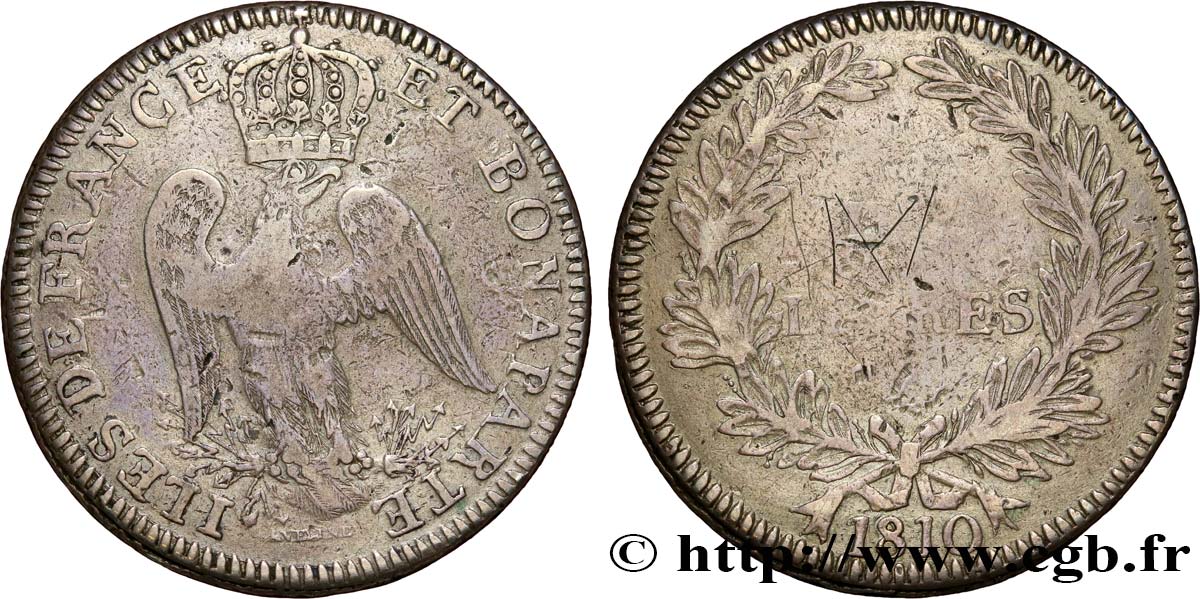
nombreux coups, usure, rayures au revers
Vorderseite
Titulatur der Vorderseite ILES DE FRANCE - ET BONAPARTE.
Beschreibung Vorderseite Aigle debout de face sur un foudre, les ailes déployées, la tête tournée à droite, surmonté d'une couronne ; signé AVELINE à l'exergue.
Rückseite
Titulatur der Rückseite DIX/ LIVRES EN DEUX LIGNES,.
Beschreibung Rückseite dans une couronne formée de deux branches de laurier ; à l'exergue 1810.
Kommentare
Ces pièces furent fabriquées suite aux arrêtés, insérés dans le code des Îles de France et de la Réunion, publiés à l'Île de France (Île Maurice) par le général Decaen, les 6 et 8 mars 1810, comme le fait remarquer Jean Lecompte. Les pièces furent frappées à partir des lingots d'argent récupérés sur l'Ouvidor, navire hollandais qui fut capturé par l'Entreprenant du capitaine Bouvet, un corsaire français. Le nom de la pièce vient du général gouverneur Charles Decaen. La frappe artisanale, réalisée par Aveline fait que de nombreux exemplaires présentent au revers un début d'effacement de la valeur. Victor Guilloteau indiquait en 1942, que le général Decaen avait fait frapper pour 1.128.500 francs soit une production de 112.850 pièces. Il est important de constater sur cette monnaie l'équivalence du mot "livre" et du mot "franc", attitude logique puisque la Révolution choisit la valeur pondérale du franc équivalente à celle de la livre royale de 1726.
These coins were manufactured following the decrees inserted into the code of the Îles de France and Réunion, published in Île de France (Mauritius) by General Decaen on March 6 and 8, 1810, as Jean Lecompte points out. The coins were minted from silver ingots recovered from the Ouvidor, a Dutch ship that was captured by Captain Bouvet's Entreprenant, a French privateer. The name of the coin comes from the Governor General Charles Decaen. The artisanal minting, carried out by Aveline, means that many examples show the beginnings of the value fading on the reverse. Victor Guilloteau indicated in 1942 that General Decaen had minted 1,128,500 francs worth, representing a production of 112,850 coins. It is important to note on this coin the equivalence of the word \\\"livre\\\" and the word \\\"franc\\\", a logical attitude since the Revolution chose the weight value of the franc equivalent to that of the royal pound of 1726.
These coins were manufactured following the decrees inserted into the code of the Îles de France and Réunion, published in Île de France (Mauritius) by General Decaen on March 6 and 8, 1810, as Jean Lecompte points out. The coins were minted from silver ingots recovered from the Ouvidor, a Dutch ship that was captured by Captain Bouvet's Entreprenant, a French privateer. The name of the coin comes from the Governor General Charles Decaen. The artisanal minting, carried out by Aveline, means that many examples show the beginnings of the value fading on the reverse. Victor Guilloteau indicated in 1942 that General Decaen had minted 1,128,500 francs worth, representing a production of 112,850 coins. It is important to note on this coin the equivalence of the word \\\"livre\\\" and the word \\\"franc\\\", a logical attitude since the Revolution chose the weight value of the franc equivalent to that of the royal pound of 1726.
Historischer Hintergrund
FRANCE UND BOURBON-INSELN
 Berichten über einen Fehler
 Die Seite drucken
 Teilen meiner Auswahl
 Stellen Sie eine Frage
 Einlieferung/Verkauf
In Verbindung stehende Artikel

 Details
Ihre zuletzt angesehenen Artikel
GALLIEN - BELGICA - LEUCI (Region die Toul) Potin à la tête d’indien, classe
4.00 €
cgbfr.de numismatik


