


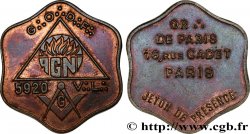
fjt_235528 - FRANC-MAÇONNERIE - PARIS PARFAITE UNION - DOUAI, frappe monnaie 1803
Nicht verfügbar.
Artikel auf unserem Online-Shop verkauft (2014)
Preis : 85.00 €
Artikel auf unserem Online-Shop verkauft (2014)
Preis : 85.00 €
Type : PARFAITE UNION - DOUAI, frappe monnaie
Datum: 1803
Metall : Kupfer
Durchmesser : 27 mm
Stempelstellung : 6 h.
Rand cannelée
Seltenheitsgrad : R1
N° im Nachschlagewerk :
Vorderseite
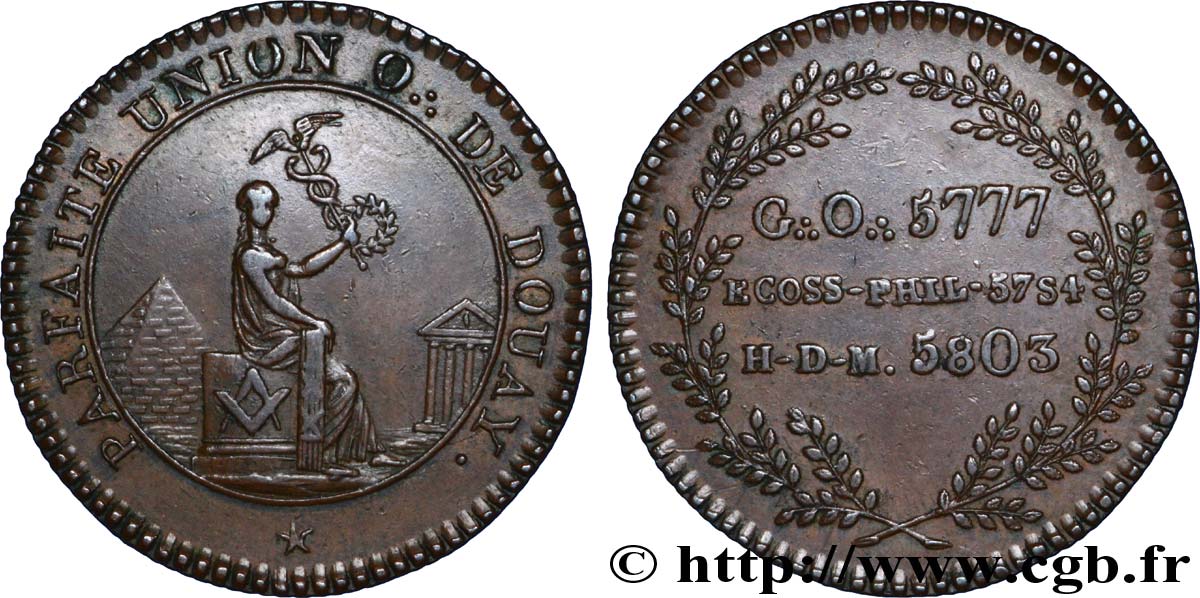
Titulatur der Vorderseite PARFAITE. UNION. O.:. DE. DOUAY..
Beschreibung Vorderseite Femme assise à droite sur une base et tenant un caducée. A ses pieds, compas, équerre, etc..
Übersetzung der Vorderseite Elle aime à unir.
Rückseite
Titulatur der Rückseite G O 5777 / ECOSS - PHIL 5784 / H - D - M 5803.
Beschreibung Rückseite Couronne d’acacia fermée encadrant le texte en grois ligne.
Kommentare
Ce jeton existe tant en frappe médaille qu’en frappe monnaie. Ici l’exemplaire est en frappe monnaie.
La franc-maçonnerie s’implante en France aux alentours du premier quart du XVIIIe s. sous l’influence d’aristocrates anglais. Initiatique, elle est fondée sur le rite hiramique, du nom d’Hiram de Tyr, personnage biblique, architecte du roi Salomon sur le chantier du Temple et qui a résisté à la torture sans livrer ses secrets. Hiram a aussi donné un point de départ du calendrier maçonnique commençant 4000 ans avant le calendrier chrétien. Les symboles servent de signes de reconnaissance entre les initiés, notamment des outils de constructeur de cathédrales (équerre, compas, niveau, maillet, etc.), des formes (triangle, étoile), des nombres (trois, cinq, sept) et des lettres.
This token exists both in medal and coin form. Here the example is in coin form. Freemasonry was established in France around the first quarter of the 18th century under the influence of English aristocrats. Initiatory, it is based on the Hiramic rite, named after Hiram of Tyre, a biblical character, architect of King Solomon on the construction site of the Temple and who resisted torture without revealing his secrets. Hiram also gave a starting point for the Masonic calendar beginning 4000 years before the Christian calendar. Symbols serve as signs of recognition between initiates, including cathedral builder's tools (set square, compass, level, mallet, etc.), shapes (triangle, star), numbers (three, five, seven) and letters
La franc-maçonnerie s’implante en France aux alentours du premier quart du XVIIIe s. sous l’influence d’aristocrates anglais. Initiatique, elle est fondée sur le rite hiramique, du nom d’Hiram de Tyr, personnage biblique, architecte du roi Salomon sur le chantier du Temple et qui a résisté à la torture sans livrer ses secrets. Hiram a aussi donné un point de départ du calendrier maçonnique commençant 4000 ans avant le calendrier chrétien. Les symboles servent de signes de reconnaissance entre les initiés, notamment des outils de constructeur de cathédrales (équerre, compas, niveau, maillet, etc.), des formes (triangle, étoile), des nombres (trois, cinq, sept) et des lettres.
This token exists both in medal and coin form. Here the example is in coin form. Freemasonry was established in France around the first quarter of the 18th century under the influence of English aristocrats. Initiatory, it is based on the Hiramic rite, named after Hiram of Tyre, a biblical character, architect of King Solomon on the construction site of the Temple and who resisted torture without revealing his secrets. Hiram also gave a starting point for the Masonic calendar beginning 4000 years before the Christian calendar. Symbols serve as signs of recognition between initiates, including cathedral builder's tools (set square, compass, level, mallet, etc.), shapes (triangle, star), numbers (three, five, seven) and letters
Historischer Hintergrund
FRANC-MAÇONNERIE - PARIS
Der Kompass und das Quadrat werden sehr oft in einem ambivalenten Symbol des Gleichgewichts verbunden: Festigkeit und Beweglichkeit, passiv und aktiv, Materie und Geist.. Der Kompass ist das Werkzeug des Schöpfers und des großen Architekten des Universums. Der Abstand der Zirkelzweige folgt genauen Regeln und variiert je nach den drei Graden: Lehrling, Gefährte, Meister. Die napoleonische Ära erlebte nach den schrecklichen Jahren der Revolutionszeit in der Tätigkeit der Logen wie auch vieler Gruppen eine Blüte. Die Freimaurertätigkeit, befreit von ihren republikanischen Theorien und streng kontrolliert von einem vom Kaiser ernannten Großmeister, erlebte eine nie dagewesene Kraft der Einheit.. Man geht davon aus, dass jedes Regiment, jede Garnison, jede Stadt ihre Loge hatte. Die Zeugnisse, die uns die kostbaren Zeugnisse dieser Zeit hinterlassen, zeigen, dass diese Logen reich und einflussreich waren.. Die Symbolik ist gesucht, ohne Vergleich mit den späteren Epochen, die zu Beginn des 20. Jahrhunderts viel konventioneller, sogar langweiliger oder mittelloser waren.. Die Freimaurerei hatte mehr als tausend Logen, verteilt auf einhundertdreißig Abteilungen, und mehr als sechzigtausend Brüder.
 Berichten über einen Fehler
 Die Seite drucken
 Teilen meiner Auswahl
 Stellen Sie eine Frage
 Einlieferung/Verkauf
In Verbindung stehende Artikel
 Details


cgbfr.de numismatik


