


bpv_304976 - DOMITIANUS Tétradrachme syro-phénicien

Nicht verfügbar.
Artikel auf unserem Online-Shop verkauft (2015)
Preis : 550.00 €
Artikel auf unserem Online-Shop verkauft (2015)
Preis : 550.00 €
Type : Tétradrachme syro-phénicien
Datum: 88-89
Name der Münzstätte / Stadt : Antioche, Syrie, Séleucie et Piérie
Metall : Silber
Durchmesser : 26,00 mm
Stempelstellung : 12 h.
Gewicht : 14,48 g.
Kommentare zum Erhaltungszustand:
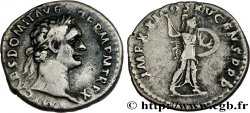
Style magnifique avec un très beau portrait de haut relief et un aigle hiératique. Le décentré du droit met en valeur le portrait
N° im Nachschlagewerk :
Pedigree :
Cet exemplaire est le 0145_004 de la base TSP, il provient de la vente Hess 252, 1982, n° 251 puis de la vente Vecchi N°10, (10 10 1983), n° 321 puis de la collection Richard McAlee dont il illustre le type dans son livre Coins of Roman Antioch
Vorderseite
Beschreibung Vorderseite Tête laurée de Domitien à droite avec l’égide nouvelle sur la poitrine (O*4).
Legende des Averses AUT KAISAR DOMITIANOS SEB GERM (Autokrtor Kaisaros Domitianos Sebastos Germanikos)
Übersetzung der Vorderseite (L'empereur césar Domitien auguste germanique).
Rückseite
Beschreibung Rückseite Aigle debout à droite sur un foudre, les ailes déployées ; une palme dans le champ à droite.
Legende des Reverses : ETOUS - NEOU IEROU - H, (Etous Neou Ierou H)
Übersetzung der Rückseite (année sainte huitième du règne).
Kommentare
L’an 8 marque une vraie renaissance de l’atelier d’Antioche, tant pour les quantités frappées, qui rejoignent les niveaux d’une frappe de circulation, que pour le style et même, pour autant que l’on puisse en juger par l’aspect du métal, pour la pureté de l’aloi utilisé.
Sur le plan stylistique, l’événement est l’arrivée d’un grand graveur, la disparition de l’égide ancienne à la peau de chèvre et au serpent, et l’apparition de l’égide moderne, la tête de Méduse ailée de profil sur la poitrine.
Bien entendu, on peut supposer une lien psychologique dans l’Antiquité entre la beauté et l’aspect de la monnaie et la confiance qui lui était accordée. Sur ce plan, les frappes des an 2 et 7 de Domitien étaient handicapés par l’aspect alexandrin du style et du métal : tout le monde devait savoir que le monnayage égyptien était en bas titre.
Cinquante trois exemplaires sont maintenant répertoriés dans la base TSP, avec, en musées, Paris, Berlin, ANS, British Museum (2), Glasgow Hunterian, Yale (2), Oxford et Jérusalem.
The year 8 marks a true renaissance of the Antioch mint, both for the quantities struck, which reach the levels of a circulation strike, and for the style and even, as far as one can judge by the appearance of the metal, for the purity of the alloy used. Stylistically, the event is the arrival of a great engraver, the disappearance of the ancient aegis with goatskin and snake, and the appearance of the modern aegis, the winged head of Medusa in profile on the chest. Of course, one can suppose a psychological link in Antiquity between the beauty and appearance of the coin and the confidence placed in it. In this respect, the strikes of the years 2 and 7 of Domitian were handicapped by the Alexandrian aspect of the style and the metal: everyone must have known that Egyptian coinage was of low fineness. Fifty-three examples are now listed in the TSP database, with, in museums, Paris, Berlin, ANS, British Museum (2), Glasgow Hunterian, Yale (2), Oxford and Jerusalem
Sur le plan stylistique, l’événement est l’arrivée d’un grand graveur, la disparition de l’égide ancienne à la peau de chèvre et au serpent, et l’apparition de l’égide moderne, la tête de Méduse ailée de profil sur la poitrine.
Bien entendu, on peut supposer une lien psychologique dans l’Antiquité entre la beauté et l’aspect de la monnaie et la confiance qui lui était accordée. Sur ce plan, les frappes des an 2 et 7 de Domitien étaient handicapés par l’aspect alexandrin du style et du métal : tout le monde devait savoir que le monnayage égyptien était en bas titre.
Cinquante trois exemplaires sont maintenant répertoriés dans la base TSP, avec, en musées, Paris, Berlin, ANS, British Museum (2), Glasgow Hunterian, Yale (2), Oxford et Jérusalem.
The year 8 marks a true renaissance of the Antioch mint, both for the quantities struck, which reach the levels of a circulation strike, and for the style and even, as far as one can judge by the appearance of the metal, for the purity of the alloy used. Stylistically, the event is the arrival of a great engraver, the disappearance of the ancient aegis with goatskin and snake, and the appearance of the modern aegis, the winged head of Medusa in profile on the chest. Of course, one can suppose a psychological link in Antiquity between the beauty and appearance of the coin and the confidence placed in it. In this respect, the strikes of the years 2 and 7 of Domitian were handicapped by the Alexandrian aspect of the style and the metal: everyone must have known that Egyptian coinage was of low fineness. Fifty-three examples are now listed in the TSP database, with, in museums, Paris, Berlin, ANS, British Museum (2), Glasgow Hunterian, Yale (2), Oxford and Jerusalem
Historischer Hintergrund
DOMITIANUS
(12/69-18/09/96)
Augustus
Domitian wurde 51 geboren und trat im August 81 die Nachfolge seines Bruders an. Im Jahr 86 wurden erstmals Kapitolinische Spiele veranstaltet. Auf dem Palatin wird der flavische Palast errichtet. Im Jahr 88 wurden die weltlichen Spiele mit Pomp gefeiert. Eine erste Kampagne gegen Dacia wird gestartet, die mit einem Kompromissfrieden endet und Decebalus die Kontrolle über die Situation überlässt. Domitian hat gerade einen brillanten Feldzug gegen die Sarmaten und die Sueben gewonnen (IMP XXII). Agricola starb in Ungnade am 23. August 93. Im Jahr 95 ließ Domitian seinen Cousin Flavius Clemens hinrichten. Im folgenden Jahr wird Domitian auf Betreiben seiner Frau und des Präfekten des Prätoriums ermordet.
 Berichten über einen Fehler
 Die Seite drucken
 Teilen meiner Auswahl
 Stellen Sie eine Frage
 Einlieferung/Verkauf
 Details


cgbfr.de numismatik


