


v27_0171 - DIOCLETIANUS Aurelianus

MONNAIES 27 (2006)
Startpreis : 550.00 €
Schätzung : 850.00 €
unverkauftes Los
Startpreis : 550.00 €
Schätzung : 850.00 €
unverkauftes Los
Type : Aurelianus
Datum: automne 287 - automne 289
Name der Münzstätte / Stadt : Lyon
Metall : Scheidemünze
Der Feingehalt beträgt : 50 ‰
Durchmesser : 24 mm
Stempelstellung : 12 h.
Gewicht : 3,16 g.
Seltenheitsgrad : UNIQUE
Officine: 1e
Emission: 5e
Kommentare zum Erhaltungszustand:
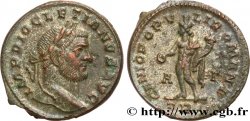
Exemplaire sur un flan exceptionnellement large et ovale, bien centré avec les grènetis visibles. Buste exceptionnel pour cette émission. Portrait de toute beauté et de haut relief. Revers bien venu à la frappe. Magnifique patine avec des reflets métalliques marron glacé. Aurelianus ayant conservé une partie de son brillant de frappe. Infimes petites traces d’oxydation dans le champ du revers
N° im Nachschlagewerk :
Vorderseite
Titulatur der Vorderseite IMP C DIOCLETIANVS AVG.
Beschreibung Vorderseite Buste radié consulaire de Dioclétien à gauche, vu de trois quarts en avant, tenant le scipio placé sur un globe de la main droite (H8).
Übersetzung der Vorderseite “Imperator Cæsar Diocletianus Augustus”, (L'empereur césar Dioclétien auguste).
Rückseite
Titulatur der Rückseite IOVI TVTATORI AVGG/ -|-// P.
Beschreibung Rückseite Jupiter nu debout à gauche, le manteau sur l’épaule, tenant un globe nicéphore de la main droite et un sceptre long de la main gauche ; à ses pieds, un aigle debout à gauche, tournant la tête à droite.
Übersetzung der Rückseite “Iovi Tutatori Augustorum”, (À Jupiter protecteur des augustes).
Kommentare
Avec toute son argenture. Poids léger. Portrait consulaire très particulier car Dioclétien ne semble pas tenir un simple scipio. Le scipio, bâton d’ivoire ou triomphal, est un “sceptre court à tête d’aigle qui était tenu par le général victorieux lors du cortège triomphal”, Le buste monétaire op. cit. p. 289. Sur notre exemplaire, le scipio semble surmonter un globe, ce qui n’a pas été signalé par le Docteur Bastien dans le Buste monétaire II, op. cit., p. 293, “L’association de ces deux insignes impériaux à la trabea est rare”. Il ne se rencontre pas sur les aureliani, mais pour la première fois sous Maximien Hercule, le buste monétaire, pl. 138, n° 8 pour l’atelier de Lyon, mais différenciés. Sur notre exemplaire, le scalptor a dû préparer un buste avec globe (H1) ou avec globe nicéphore (H6), et au dernier moment, a dû placer un scipio, en le rajoutant sur le globe au lieu du scipio seul (H2), créant ainsi un nouveau type de buste complètement inédit et non répertorié. Prendra le numéro 151(alpha) dans le Supplément III du Bastien avec un buste H8.
With all its silver plating. Light weight. Very unusual consular portrait because Diocletian does not seem to be holding a simple scipio. The scipio, an ivory or triumphal staff, is a “short eagle-headed scepter that was held by the victorious general during the triumphal procession,” The Monetary Bust op. cit. p. 289. On our example, the scipio seems to surmount a globe, which was not noted by Doctor Bastien in the Monetary Bust II, op. cit., p. 293, “The association of these two imperial insignia with the trabea is rare.” It is not found on the aureliani, but for the first time under Maximian Hercules, the monetary bust, pl. 138, no. 8 for the Lyon workshop, but differentiated. On our example, the scalper had to prepare a bust with globe (H1) or with Nicephorus globe (H6), and at the last moment, had to place a scipio, adding it on the globe instead of the scipio alone (H2), thus creating a new type of bust completely new and unlisted. Will take the number 151 (alpha) in Supplement III of Bastien with a bust H8
With all its silver plating. Light weight. Very unusual consular portrait because Diocletian does not seem to be holding a simple scipio. The scipio, an ivory or triumphal staff, is a “short eagle-headed scepter that was held by the victorious general during the triumphal procession,” The Monetary Bust op. cit. p. 289. On our example, the scipio seems to surmount a globe, which was not noted by Doctor Bastien in the Monetary Bust II, op. cit., p. 293, “The association of these two imperial insignia with the trabea is rare.” It is not found on the aureliani, but for the first time under Maximian Hercules, the monetary bust, pl. 138, no. 8 for the Lyon workshop, but differentiated. On our example, the scalper had to prepare a bust with globe (H1) or with Nicephorus globe (H6), and at the last moment, had to place a scipio, adding it on the globe instead of the scipio alone (H2), thus creating a new type of bust completely new and unlisted. Will take the number 151 (alpha) in Supplement III of Bastien with a bust H8
Historischer Hintergrund
DIOCLETIANUS
(20.11.284-1.05.305)
Augustus
Diokletian, geboren im Jahr 245 in Dalmatien (Split), ist ein illyrischer Kaiser. Nachdem er Aper, Präfekt des Prätoriums, ebenfalls Schwiegervater und Mörder von Numérien, eliminiert hatte, legte er am 20. November 284 den Purpur an. Er kämpfte zunächst gegen Carin, den letzten Sohn von Carus, und wurde im folgenden Jahr bei Margus geschlagen . Aber Carin wird ermordet und Diokletian allein bleibt im August. Er erhob Maximian, einen Landsmann, im November 285 in den Rang eines Cäsar, dann Augustus am 1. April 286. Diokletian hatte gerade ein neues politisches Regime geschaffen, die Dyarchie. Dort teilten sich zwei Kaiser die militärische und politische Macht, Maximian blieb jedoch Diokletian untergeordnet. Diokletian stellt sich unter den jovianischen Schutz (des Jupiter), während Maximian von herkulischer Essenz (des Herkules) ist. Diokletian kämpfte die ersten zehn Jahre seiner Herrschaft im Osten, während Maximian im Westen blieb. Diokletian ist nach Gibbons Ausdruck der erste Kaiser des Unterreichs und Gründer des Herrschaftsgebiets.
 Berichten über einen Fehler
 Die Seite drucken
 Teilen meiner Auswahl
 Stellen Sie eine Frage
 Einlieferung/Verkauf
In Verbindung stehende Artikel

 Details

cgbfr.de numismatik


