


v27_0419 - CRISPUS Centenionalis ou nummus
MONNAIES 27 (2006)
Startpreis : 500.00 €
Schätzung : 750.00 €
Erzielter Preis : 500.00 €
Startpreis : 500.00 €
Schätzung : 750.00 €
Erzielter Preis : 500.00 €
Type : Centenionalis ou nummus
Datum: 321
Name der Münzstätte / Stadt : Lyon
Metall : Kupfer
Durchmesser : 20 mm
Stempelstellung : 6 h.
Gewicht : 3,22 g.
Seltenheitsgrad : R3
Emission: 7e
Kommentare zum Erhaltungszustand:
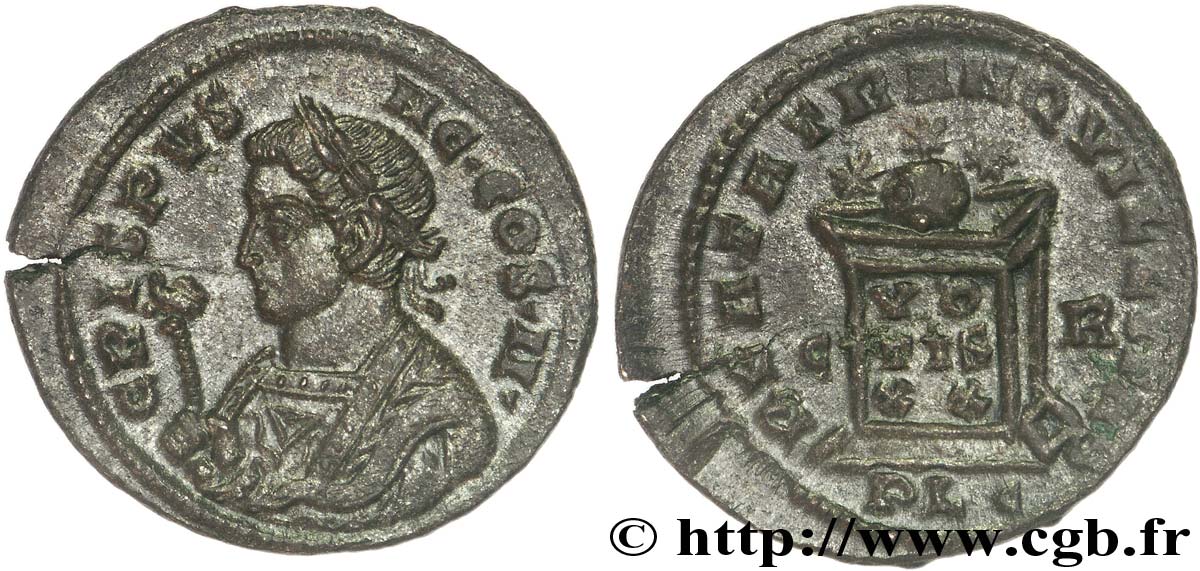
Exemplaire de qualité exceptionnelle pour ce type de monnayage, flan large et complet des deux côtés, légèrement éclaté à 9 heures au droit. Portrait magnifique. Revers de style fin avec une petite faiblesse de frappe sur les légendes. Magnifique patine gris vert avec des reflets métalliques
N° im Nachschlagewerk :
Pedigree :
Cet exemplaire provient de la collection Daniel Compas, MONNAIES XXVII, n° 419
Vorderseite
Titulatur der Vorderseite CRISPVS - N C. COS. II..
Beschreibung Vorderseite Buste lauré consulaire de Cripus à gauche, vu de trois quarts en avant, tenant le scipio (H*2).
Übersetzung der Vorderseite “Crispus Nobilissimus Cæsar Consul iterum”, (Crispus très noble césar consul pour la deuxième fois).
Rückseite
Titulatur der Rückseite BEATA TRANQVILLITAS/ V.O/ TIS/ XX/ C|R// PLG.
Beschreibung Rückseite Autel sur la face antérieure duquel on lit VO/ TIS/ XX en trois lignes ; sur l’autel, un globe divisé en quatre parties ; au-dessus, trois étoiles.
Übersetzung der Rückseite “Beata Tranquillitas/ Votis vicennalibus”, (L’heureuse Tranquillité/ Vœux pour le vingtième année de règne).
Kommentare
Avec des traces d’argenture superficielle (2%). Rubans convergents : rubans descendant verticalement le long de la nuque (type 3). Manteau consulaire, “toga picta” et “toga palmata” richement décorées. Au revers, les lettres dans le champ C|R pourraient être les initiales de “Claritas Reipublicæ” pour l’éclat de la République. Même coin de droit que l’exemplaire du Münzkabinett du Staatliche Museen de Berlin, Bastien n° 88a, pl. VI. C’est le troisième exemplaire publié avec ce type de césure. Prendra le numéro 88d dans le Supplément III du Bastien.
With traces of superficial silvering (2%). Converging ribbons: ribbons descending vertically along the nape of the neck (type 3). Consular mantle, “toga picta” and “toga palmata” richly decorated. On the reverse, the letters in the C|R field could be the initials of “Claritas Reipublicæ” for the brilliance of the Republic. Same obverse die as the example in the Münzkabinett of the Staatliche Museen in Berlin, Bastien no. 88a, pl. VI. This is the third example published with this type of caesura. Will take the number 88d in Supplement III of Bastien
With traces of superficial silvering (2%). Converging ribbons: ribbons descending vertically along the nape of the neck (type 3). Consular mantle, “toga picta” and “toga palmata” richly decorated. On the reverse, the letters in the C|R field could be the initials of “Claritas Reipublicæ” for the brilliance of the Republic. Same obverse die as the example in the Münzkabinett of the Staatliche Museen in Berlin, Bastien no. 88a, pl. VI. This is the third example published with this type of caesura. Will take the number 88d in Supplement III of Bastien
Historischer Hintergrund
CRISPUS
(1.04.317-09.326)
Caesar
Crispus ist der Sohn von Konstantin und Minervin. Er wurde um 300 geboren und 317 zusammen mit Konstantin II. und Licinius II. zum Cäsar ernannt. Zu Recht oder zu Unrecht wird ihm von seiner Stiefmutter vorgeworfen, sie missbrauchen zu wollen. Angesichts dieser Anschuldigungen ließ Konstantin Anfang 326 seinen ältesten Sohn hinrichten.
 Berichten über einen Fehler
 Die Seite drucken
 Teilen meiner Auswahl
 Stellen Sie eine Frage
 Einlieferung/Verkauf
In Verbindung stehende Artikel

 Details


cgbfr.de numismatik


