


brm_1111600 - CONSTANTIUS I Follis ou nummus

120.00 €
Menge
In den Warenkorb

Type : Follis ou nummus
Datum: 295
Name der Münzstätte / Stadt : Boulogne
Metall : Kupfer
Der Feingehalt beträgt : 50 ‰
Durchmesser : 27 mm
Stempelstellung : 12 h.
Gewicht : 8,91 g.
Seltenheitsgrad : R3
Kommentare zum Erhaltungszustand:
Monnaie centrée. Joli portrait de Constance. Usure plus marquée au revers. Avec une partie de son argenture. Patine grise
N° im Nachschlagewerk :
Pedigree :
Cette monnaie provient de la Collection Joulia
Vorderseite
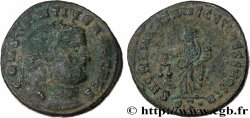
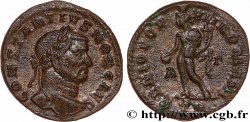
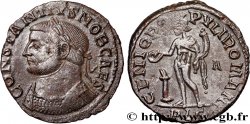
Titulatur der Vorderseite FL VAL CONSTANTIVS NOB C.
Beschreibung Vorderseite Tête laurée de Constance Ier césar à droite (O*).
Übersetzung der Vorderseite “Flavius Valerius Constantius Nobilissimus Cæsar”, (Flavien Valère Constance très noble césar).
Rückseite
Titulatur der Rückseite GENIO POPV-LI ROMANI.
Beschreibung Rückseite Genius (le Génie) debout à gauche, le manteau sur l'épaule gauche, tenant une patère de la main droite et une corne d'abondance de la main gauche.
Übersetzung der Rückseite “Genio Populi Romani”, (Le Génie du Peuple romain).
Kommentare
Exemplaire de la plus grande rareté. La titulature et le portrait sont très proches des folles lyonnais des trois premières émissions (294-295) et seraient donc frappés à Boulogne. Le follis n’est pas de Lyon et n’a pas eu la marque d’exergue arasée ou n’est pas mal frappée, la marque mal venue. Il s’agit d’un scalptor lyonnais comme l’a démontré le Docteur Pierre Bastien qui suit le “comitatus” de Constance Chlore qui s’apprête à passer en Bretagne afin d’affronter Allectus. Un seul exemplaire répertorié dans le corpus du Docteur Bastien en 1976 (B. 4a, pl. LXIX avec la césure POPV-LI contre deux avec la césures POP-VLI). Ces exemplaires d’après V. Drost, RN 2014 pourraient constituer la première émission de l’atelier de Lyon sans marque.
An extremely rare example. The inscription and portrait are very similar to the Lyon folles of the first three issues (294-295) and would therefore have been struck in Boulogne. The follis is not from Lyon and does not have the exergue mark truncated or poorly struck. It is a Lyon scalptor, as demonstrated by Dr. Pierre Bastien, who followed the “comitatus” of Constantius Chlorus as he prepared to cross into Britain to confront Allectus. Only one example is recorded in Dr. Bastien's corpus in 1976 (B. 4a, pl. LXIX with the break POPV-LI, compared to two with the breaks POP-VLI). According to V. Drost, RN 2014, these examples could constitute the first issue from the Lyon mint without a mint mark.
An extremely rare example. The inscription and portrait are very similar to the Lyon folles of the first three issues (294-295) and would therefore have been struck in Boulogne. The follis is not from Lyon and does not have the exergue mark truncated or poorly struck. It is a Lyon scalptor, as demonstrated by Dr. Pierre Bastien, who followed the “comitatus” of Constantius Chlorus as he prepared to cross into Britain to confront Allectus. Only one example is recorded in Dr. Bastien's corpus in 1976 (B. 4a, pl. LXIX with the break POPV-LI, compared to two with the breaks POP-VLI). According to V. Drost, RN 2014, these examples could constitute the first issue from the Lyon mint without a mint mark.
Historischer Hintergrund
CONSTANTIUS I
(01.03.293-25.07.306)
Caesar
Constantius wurde am 1. März 293 gleichzeitig mit Galerius Caesar. Er ist der Caesar, der Maximian untersteht, während sein Kollege Diokletian untersteht. Das ist Tetrarchie. Constance ist mit herkulischer Abstammung verbunden. Er lässt sich von Helen scheiden, um Theodora, Maximians Schwiegertochter, zu heiraten, während Galerius Galéria Valéria, die Tochter von Diokletian, heiratet. 1.03.293-1.05.305.
 Berichten über einen Fehler
 Die Seite drucken
 Teilen meiner Auswahl
 Stellen Sie eine Frage
 Einlieferung/Verkauf
In Verbindung stehende Artikel

 Details

Ihre zuletzt angesehenen Artikel

500 Francs DSCHIBUTI 1979 P.36a ST
55.00 €

TIBERIUS II CONSTANTINUS Follis S/SS
100.00 €

MIKÄEL VII DUKAS Follis SS
145.00 €
SIZILIEN - AKRAGAS Tetras S
72.00 €

CONSTANTIUS I Follis ou nummus SS/fSS
120.00 €

CONSTANS Centenonialis ou Nummus fVZ
60.00 €
cgbfr.de numismatik


