


brm_274777 - CONSTANTINUS I DER GROßE Follis ou nummus
Nicht verfügbar.
Artikel auf unserem Online-Shop verkauft (2012)
Preis : 145.00 €
Artikel auf unserem Online-Shop verkauft (2012)
Preis : 145.00 €
Type : Follis ou nummus
Datum: été
Datum: 307
Name der Münzstätte / Stadt : Lyon
Metall : Kupfer
Durchmesser : 28 mm
Stempelstellung : 6 h.
Gewicht : 6,75 g.
Kommentare zum Erhaltungszustand:
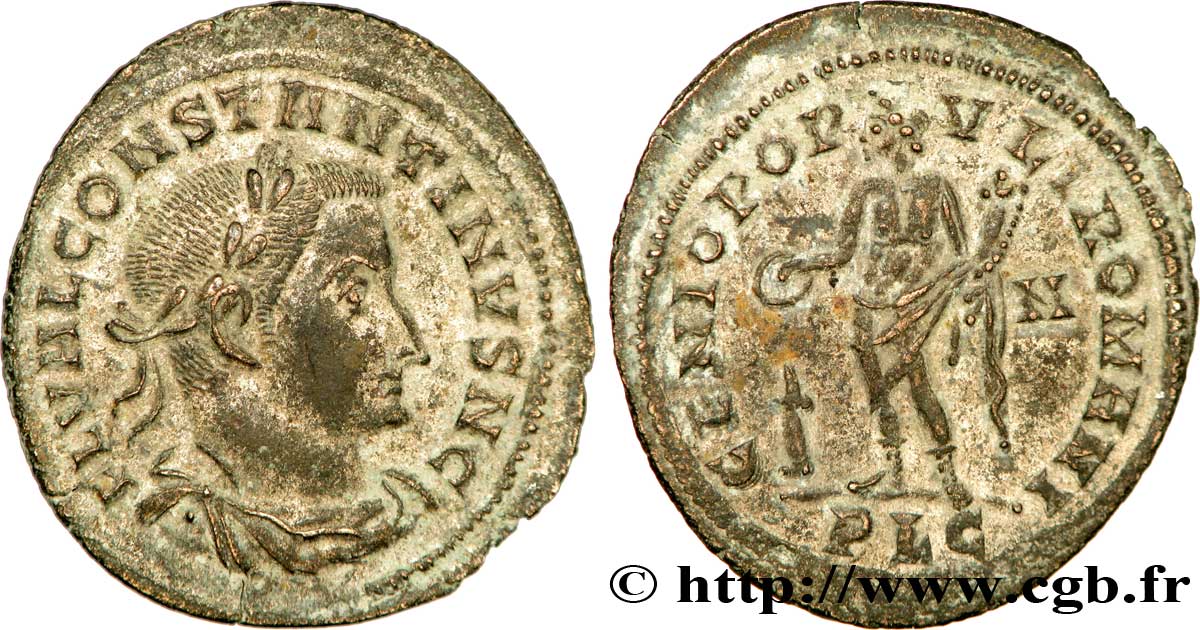
Exemplaire sur un flan mince, très large, ovale, bien centré des deux côtés avec les grènetis visibles. Beau portrait de Constantin Ier. Joli revers de style fin. Patine gris vert avec des reflets métalliques
N° im Nachschlagewerk :
Pedigree :
Cet exemplaire provient du trésor de Marchais (Aisne), (J.-P. Callu, Inventaire des trésors de bronze constantiniens (313-348), p. 29, n° 9 et de la collection du baron L. Chaurand (Lyon)
Vorderseite
Titulatur der Vorderseite FL VAL CONSTANTINVS N C.
Beschreibung Vorderseite Buste lauré, drapé et cuirassé de Constantin Ier césar à droite, vu de trois quarts en avant (A*).
Übersetzung der Vorderseite “Flavius Valerius Constantinus Nobilissimus Cæsar”, (Flavien Valère Constantin très noble césar).
Rückseite
Titulatur der Rückseite GENIO POP-VLI ROMANI/ (AUTEL)|N// PLG.
Beschreibung Rückseite Genius (Génie) debout à gauche, coiffé du modius, le Génie porte l’himation, tenant une patère de la main droite et une corne d'abondance de la main gauche.
Übersetzung der Rückseite “Genio Populi Romani”, (Au Génie du Peuple romain).
Kommentare
Avec son argenture superficielle. Poids léger. Rubans de type 3. Ptéryges invisibles sous le paludamentum. Un changement radical intervient dans la représentation du Génie au revers. Il est maintenant normalement revêtu de l’himation au lieu du manteau tombant sur l’épaule (paludamentum). Une autre innovation est l’apparition d’un N dans le champ à droite. Nous nous sommes interrogés sur la présence et la signification de ce N. Il pourrait tout simplement signifier “Nova”, (nouvelle) pour rappeler techniquement la réduction du follis du 1/32 L. au 1/40 L. Nous n’avons relevé aucune liaison de coin pertinente. Cet exemplaire est cité dans l’ouvrage de Pierre Bastien.
With its superficial silver plating. Light weight. Type 3 ribbons. Invisible pteryges under the paludamentum. A radical change occurs in the representation of the Genius on the reverse. He is now normally dressed in the himation instead of the mantle falling over the shoulder (paludamentum). Another innovation is the appearance of an N in the right field. We wondered about the presence and meaning of this N. It could simply mean “Nova”, (new) to technically recall the reduction of the follis from 1/32 L. to 1/40 L. We did not note any relevant die connection. This example is cited in the work of Pierre Bastien
With its superficial silver plating. Light weight. Type 3 ribbons. Invisible pteryges under the paludamentum. A radical change occurs in the representation of the Genius on the reverse. He is now normally dressed in the himation instead of the mantle falling over the shoulder (paludamentum). Another innovation is the appearance of an N in the right field. We wondered about the presence and meaning of this N. It could simply mean “Nova”, (new) to technically recall the reduction of the follis from 1/32 L. to 1/40 L. We did not note any relevant die connection. This example is cited in the work of Pierre Bastien
Historischer Hintergrund
CONSTANTINUS I DER GROßE
(25.07.306-22.05.337)
Caesar
Konstantin wurde nach dem Tod seines Vaters in York im Jahr 306 zum Augustus ernannt. Um Galerius und Severus nicht zu beleidigen, begnügte er sich mit dem von Galerius anerkannten Titel eines Caesars, der zum „Senior Augustus“ geworden war. Konstantin kontrolliert Gallien und die Bretagne. Am 25. Dezember 307 nahm er den Augustustitel wieder an, nachdem er Fausta, die Tochter von Maximien Hercule, geheiratet hatte.
 Berichten über einen Fehler
 Die Seite drucken
 Teilen meiner Auswahl
 Stellen Sie eine Frage
 Einlieferung/Verkauf
In Verbindung stehende Artikel

 Details



Ihre zuletzt angesehenen Artikel

100 Francs DRAPEAU FRANKREICH 1944 VF.20.01 fVZ
31.00 €
RÖMISCHE REPUBLIK - ANONYM Victoriat SS
125.00 €

CONSTANTINUS I DER GROßE Follis ou nummus fVZ
33.00 €

RÖMISCHE REPUBLIK - ANONYM Victoriat SS
65.00 €

CONSTANTINUS I DER GROßE Follis ou nummus fVZ
91.00 €

HONGKONG 2 Dollars Fleur de bauhinia 2013 fST
3.00 €
cgbfr.de numismatik


