


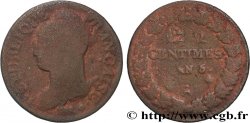
v28_1570 - Cinq centimes Dupré, grand module, CNQ 1799 Paris F.115/46 var.

MONNAIES 28 (2007)
Startpreis : 80.00 €
Schätzung : 200.00 €
Erzielter Preis : 252.00 €
Anzahl der Gebote : 7
Höchstgebot : 264.00 €
Startpreis : 80.00 €
Schätzung : 200.00 €
Erzielter Preis : 252.00 €
Anzahl der Gebote : 7
Höchstgebot : 264.00 €
Type : Cinq centimes Dupré, grand module, CNQ
Datum: An 7/5 (1798-1799)
Name der Münzstätte / Stadt : Paris
Prägemenge : ---
Metall : Kupfer
Durchmesser : 28,17 mm
Stempelstellung : 6 h.
Gewicht : 9,16 g.
Rand chevronnée
Seltenheitsgrad : UNIQUE
Kommentare zum Erhaltungszustand:
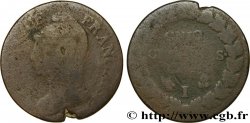
Usure très importante pour cet exemplaire identifiable. Pièce frappée sur un flan déformé. Coups de poinçon au droit
N° im Nachschlagewerk :
Vorderseite
Titulatur der Vorderseite .REPUBLIQUE - FRANÇAISE.*.
Beschreibung Vorderseite Buste drapé de la Liberté à gauche coiffée du bonnet phrygien (Mesdames Tallien ou Récamier) ; signé Dupré cursif au-dessous.
Rückseite
Titulatur der Rückseite CNQ / CENTIMES..
Beschreibung Rückseite En deux lignes dans le champ, au-dessus L’AN 7/5 suivi d'un point et de la lettre d'atelier A encadrés des différents, dans une couronne fermée composée de deux branches de chêne opposées nouées à leur base par un ruban.
Kommentare
La trace du 5 et du point final sont visibles à l’oeil nu, à la droite du 7. Cette variété est tout à fait curieuse. On voit très nettement au droit la trace d’une surfrappe. Les deux Marianne se chevauchent, les légendes également. Par exemple, après le E final de RÉPUBLIQUE, on voit encore la trace d’un autre E, provenant d’un premier RÉPUBLIQUE. Au revers, le C de CNQ n’est ni vertical ni dans l’alignement des deux autres lettres et ceci indépendamment du fait que les poinçons de lettres étaient réalisés à la main et séparément. Le CNQ a donc été obtenu par le C de la première frappe et le NQ de la deuxième. Pour expliquer la déformation, on peut penser que, lors de la première frappe, le flan a été mal placé et a été déformé par la frappe. La deuxième frappe l’aurait redressé.
The trace of the 5 and the full stop are visible to the naked eye, to the obverse of the 7. This variety is quite curious. On the obverse, we can clearly see the trace of an overstrike. The two Mariannes overlap, as do the legends. For example, after the final E of RÉPUBLIQUE, we can still see the trace of another E, coming from a first RÉPUBLIQUE. On the reverse, the C of CNQ is neither vertical nor aligned with the other two letters, regardless of the fact that the letter punches were made by hand and separately. The CNQ was therefore obtained by the C of the first strike and the NQ of the second. To explain the deformation, we can think that, during the first strike, the flan was badly placed and was deformed by the strike. The second strike would have straightened it.
The trace of the 5 and the full stop are visible to the naked eye, to the obverse of the 7. This variety is quite curious. On the obverse, we can clearly see the trace of an overstrike. The two Mariannes overlap, as do the legends. For example, after the final E of RÉPUBLIQUE, we can still see the trace of another E, coming from a first RÉPUBLIQUE. On the reverse, the C of CNQ is neither vertical nor aligned with the other two letters, regardless of the fact that the letter punches were made by hand and separately. The CNQ was therefore obtained by the C of the first strike and the NQ of the second. To explain the deformation, we can think that, during the first strike, the flan was badly placed and was deformed by the strike. The second strike would have straightened it.
Historischer Hintergrund
DIREKTORIUM
(26.10.1795-9-10.11.1799)
Als sich der Konvent am 25. Oktober 1795 trennte, wurde eine neue Exekutivgewalt eingeführt, die in der thermidorischen Verfassung vorgesehen war.. Diese Verfassung sieht vor, die Macht einem Vorstand mit fünf Mitgliedern zu übertragen, die abwechselnd den Vorsitz führen, wobei alle zwei Jahre ein Mitglied ersetzt wird.. Dieses Gremium ernennt Minister und Beamte, leitet die Außenpolitik und setzt Gesetze durch, entwirft diese jedoch nicht und hat keine Kontrolle über öffentliche Gelder.. Die Macht wird mit zwei Kammern geteilt: dem Rat der Fünfhundert und dem Rat der Ältesten, die die gesetzgebende Körperschaft bilden.. Diese Macht ist entschlossen, sich angesichts der Gefahr einer monarchischen Restauration oder einer jakobinischen Reaktion zu behaupten, ist aber vor allem durch die Finanzkrise gelähmt und muss 1796 das Assignat aufgeben.. Die Ersetzung der Assignaten durch die Territorialmandate weckt kein größeres Vertrauen und diese neue Treuhandwährung wird 1797 abgeschafft. Angesichts des Elends und der Destabilisierungsversuche kehrte das Direktorium, dem es vorgeworfen wurde, eine „bürgerliche Republik“ zu sein, zu revolutionären und polizeilichen Maßnahmen zurück. Darüber hinaus dauert der Krieg seit 1792 ununterbrochen und der Einfluss militärischer Führer wächst.. Im Jahr 1799 fanden sich die Anhänger einer starken Macht, darunter Sieyès, im Direktorium wieder und ebneten Bonaparte, der aus Ägypten zurückkam, den Weg zur Macht.. Der Staatsstreich vom 18. und 19. Jahr Brumaire VIII ermöglichte die Errichtung einer Militärdiktatur unter dem Namen Konsulat.
 Berichten über einen Fehler
 Die Seite drucken
 Teilen meiner Auswahl
 Stellen Sie eine Frage
 Einlieferung/Verkauf
In Verbindung stehende Artikel
 Details
cgbfr.de numismatik


