


E-auction 142-82208 - fjt_081426 - CHAMBRES DE COMMERCE Chambre de commerce de Marseille, frappe postérieure 1775
Sie müssen angeschlossen sein und von cgb.fr genehmigt werden, um in einer E-Auktion teilzunehmen.Melden Sie sich an, um zu wetten..Die Kontobestätigungen sind innerhalb von 48 Stunden nach Ihrer Anmeldung gemacht.Warten Sie nicht bis die letzten zwei Tage vor dem Abschluss eines Verkaufs, um Ihre Registrierung abzuschließen. Klickend "BIETEN" verpflichten Sie sich vertraglich, diesen Artikel zu kaufen und Sie nehmen ohne Reserve die allgemeinen Verkaufsbedingungen für den e-auctions zu cgb.fr an.
Der Verkauf wird an der Zeit auf der Übersichtsseite angezeigt geschlossen werden. Angebote, die nach der Schließung Zeit empfangen sind, werden nicht gültig.
Bitte beachten Sie, dass die Fristen für die Einreichung Ihres Angebots auf unsere Server können variieren und es kann zur Ablehnung Ihres Angebots entstehen, wenn es in den letzten Sekunden des Verkaufs gesendet wird. Die Angebote sollen mit ganzer Zahl ausgeführt sein, Sie können Kommas oder des Punktes in Ihrem Angebot nicht erfassen. Bei Fragen klicken Sie hier, um einen Blick auf die FAQ E-Auktionen.
KEINE ANSCHAFFUNGSKOSTEN FÜR DIE KÄUFER.
KEINE ANSCHAFFUNGSKOSTEN FÜR DIE KÄUFER.
| Schätzung : | 42 € |
| Preis : | 22 € |
| Höchstgebot : | 22 € |
| Verkaufsende : | 04 Januar 2016 18:54:30 |
| Bieter : | 3 Bieter |
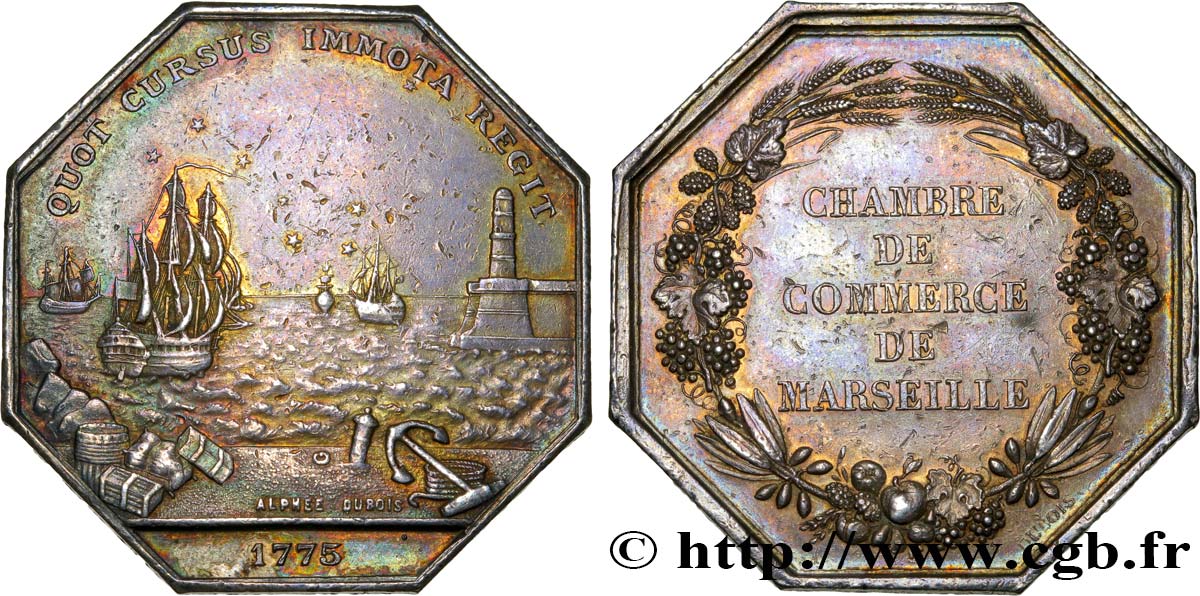
Type : Chambre de commerce de Marseille, frappe postérieure
Datum: 1775
Metall : Silber
Durchmesser : 34,5 mm
Stempelstellung : 12 h.
Rand lisse
Punze : corne ARGENT
Kommentare zum Erhaltungszustand:
Légère usure sur les reliefs. Belle patine
Vorderseite
Titulatur der Vorderseite QUOT CURSUS IMMOTA REGIT.
Beschreibung Vorderseite Bateaux devant le quai du port de Marseille sur lequel sont posés des ballots et une ancre, signature ALPHEE DUBOIS ; à l’exergue : 1775.
Übersetzung der Vorderseite (Elle guide tout en restant immobile).
Rückseite
Titulatur der Rückseite INSCRIPTION AU CENTRE EN CINQ LIGNES : CHAMBRE/ DE/ COMMERCE/ DE/ MARSEILLE.
Beschreibung Rückseite Couronne composite, signature DUBOIS.
Kommentare
La première chambre de commerce fut celle de Marseille créée à la fin du XVIe siècle. Pour Paris, les six corps des marchands et les juges-consuls avaient un rôle similaire à celui d'une chambre de commerce : une association de commerçants réunis pour délibérer sur les intérêts de leur ville ou de leur région et donner leur avis au gouvernement. Colbert les légalise en 1664 en instaurant que chaque place de commerce choisira deux d'entre eux pour les représenter. L'institution ne fut toutefois établie réellement que par l'arrêt du Conseil du 30 août 1701 et de nombreuses chambres de commerce apparaissent au XVIIIe siècle à Lyon, Rouen, Toulouse, Montpellier, Bordeaux, etc.. La plus importante d'entre elles est Marseille qui avait des attributions dans tout le commerce du Levant et était du département des Affaires étrangères, les autres relevaient du Contrôle général des Finances. Supprimées par la Constituante en 1791, les chambres de commerce sont rétablies sous le Consulat. Depuis 1832, leur recrutement se fait par élections, elles sont devenues chambres de commerce et d'industrie depuis 1898, regroupées en 21 chambres régionales.
The first chamber of commerce was that of Marseille, created at the end of the 16th century. For Paris, the six merchant corps and the consul judges had a role similar to that of a chamber of commerce: an association of merchants gathered to deliberate on the interests of their city or region and give their opinion to the government. Colbert legalized them in 1664 by establishing that each trading place would choose two of their number to represent them. However, the institution was not truly established until the Council decree of August 30, 1701, and numerous chambers of commerce appeared in the 18th century in Lyon, Rouen, Toulouse, Montpellier, Bordeaux, etc. The most important of these was Marseille, which had responsibilities in all trade in the Levant and was part of the Department of Foreign Affairs; the others came under the General Control of Finance. Suppressed by the Constituent Assembly in 1791, the chambers of commerce were reestablished under the Consulate. Since 1832, their recruitment has been done by elections, they have become chambers of commerce and industry since 1898, grouped into 21 regional chambers
The first chamber of commerce was that of Marseille, created at the end of the 16th century. For Paris, the six merchant corps and the consul judges had a role similar to that of a chamber of commerce: an association of merchants gathered to deliberate on the interests of their city or region and give their opinion to the government. Colbert legalized them in 1664 by establishing that each trading place would choose two of their number to represent them. However, the institution was not truly established until the Council decree of August 30, 1701, and numerous chambers of commerce appeared in the 18th century in Lyon, Rouen, Toulouse, Montpellier, Bordeaux, etc. The most important of these was Marseille, which had responsibilities in all trade in the Levant and was part of the Department of Foreign Affairs; the others came under the General Control of Finance. Suppressed by the Constituent Assembly in 1791, the chambers of commerce were reestablished under the Consulate. Since 1832, their recruitment has been done by elections, they have become chambers of commerce and industry since 1898, grouped into 21 regional chambers
Historischer Hintergrund
CHAMBRES DE COMMERCE
Die erste Handelskammer war die von Marseille, die Ende des 16. Jahrhunderts gegründet wurde. Für Paris hatten die sechs Kaufmannskorps und die Richterkonsuln eine ähnliche Funktion wie eine Handelskammer: eine Vereinigung von Kaufleuten, die sich versammelten, um über die Interessen ihrer Stadt oder Region zu beraten und der Regierung ihre Meinung mitzuteilen. Colbert legalisierte sie 1664, indem er festlegte, dass jeder Handelsort zwei von ihnen als Vertreter auswählt. Die eigentliche Gründung der Institution erfolgte jedoch erst durch den Beschluss des Konzils vom 30. August 1701, und im 18. Jahrhundert entstanden zahlreiche Handelskammern in Lyon, Rouen, Toulouse, Montpellier, Bordeaux usw. Die wichtigste davon ist Marseille das im gesamten Handel der Levante tätig war und der Abteilung für auswärtige Angelegenheiten angehörte, die anderen betrafen die allgemeine Kontrolle der Finanzen. Die Handelskammern wurden 1791 von der Verfassunggebenden Versammlung abgeschafft und dem Konsulat unterstellt. Seit 1832 erfolgt die Rekrutierung durch Wahlen, seit 1898 sind sie Industrie- und Handelskammern, zusammengefasst in 21 Regionalkammern.
 Berichten über einen Fehler
 Die Seite drucken
 Teilen meiner Auswahl
 Stellen Sie eine Frage
 Einlieferung/Verkauf
In Verbindung stehende Artikel

 Details


Ihre zuletzt angesehenen Artikel

500 Francs PASCAL FRANKREICH 1984 F.71.31 fST+
110.00 €

BRETAGNE - DUCHÉ DE BRETAGNE - FRANÇOIS II Gros à l'écu SS
150.00 €

FUNFTE FRANZOSISCHE REPUBLIK Médaille, Vichnou, Brahma et Civa VZ
150.00 €
IRAN 2000 Dinars Ahmad Shah AH 1331 1912 Téhéran S
25.00 €
RUSSLAND Lot 7 monnaies 1, 5, 10, 20, 50 & 100 Roubles 1997 fST
15.00 €

50 Francs CÉRÈS FRANKREICH 1934 F.17.02 VZ+
738.00 €
cgbfr.de numismatik


