


bpv_173751 - CARACALLA Tétradrachme syro-phénicien
Nicht verfügbar.
Artikel auf unserem Online-Shop verkauft
Preis : 170.00 €
Artikel auf unserem Online-Shop verkauft
Preis : 170.00 €
Type : Tétradrachme syro-phénicien
Datum: 212-213
Name der Münzstätte / Stadt : Laodicée, Syrie, Séleucie et Piérie
Metall : Scheidemünze
Durchmesser : 26 mm
Stempelstellung : 12 h.
Gewicht : 13,18 g.
Kommentare zum Erhaltungszustand:
Très faible usure, bonne frappe, bonnes surfaces, bon centrage
N° im Nachschlagewerk :
Vorderseite
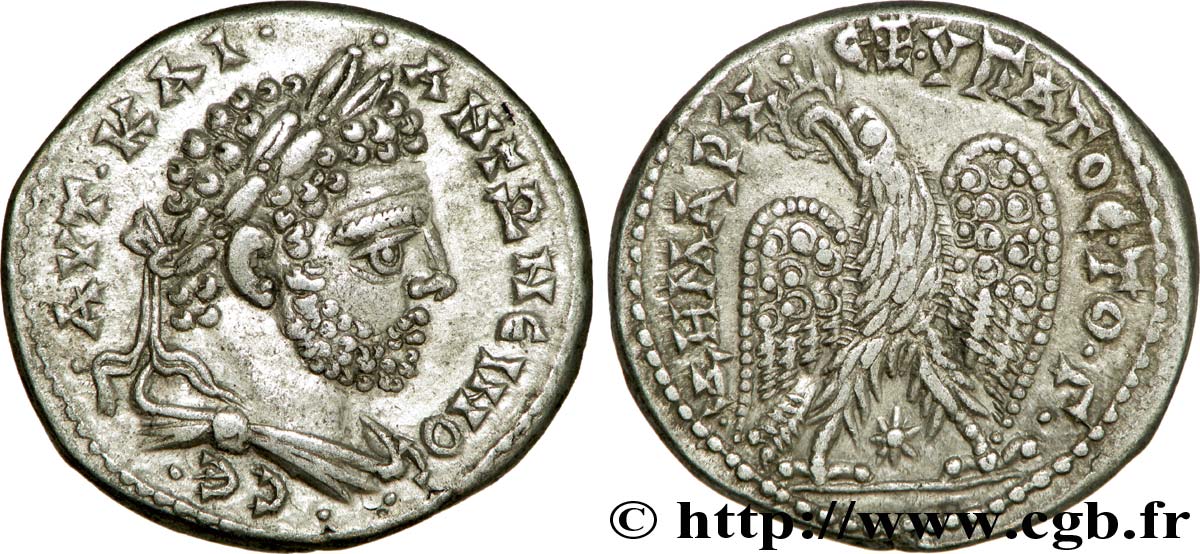
Beschreibung Vorderseite Tête laurée et drapée de Caracalla à droite, l’un des deux rubans de la couronne laurée descendant sur l’épaule (A*01).
Legende des Averses AUT KAI..AN...TWNEINOS .SE. (Autokrator Kaisar Antwneinos Sebastos)
Übersetzung der Vorderseite (L’empereur césar Antonin auguste).
Rückseite
Beschreibung Rückseite Aigle debout à droite, les ailes déployées, la tête et la queue tournées à gauche, couronne feuillée dans le bec ; entre les pattes de l'aigle, sur une ligne de terre, une étoile à huit rais.
Legende des Reverses : DHMARC. EX. UPATOS. TOG. (Dhmarcikhs Exousias Upatos to G)
Übersetzung der Rückseite (Puissance tribunitienne, consul pour la troisième fois).
Kommentare
Le portrait de cet exemplaire est tout à fait caractéristique de la fin du cinquième groupe : c’est alors le début des rides violentes sur le front de l’empereur. Notons à ce propos deux erreurs d’illustrations dans le Prieur, l’image du 1176A est en réalité un 1164 et l’image attribuée au 1176 est en réalité celle d’un 1173A, donc le groupe intermédiaire. Notons également qu’il existe des exemplaires avec un visage ridé au front - donc cinquième groupe - mais avec un aigle assez dissymétrique, donc quatrième.
Avant la catastrophe finale que représente sur le plan stylistique et typologique le sixième groupe de Laodicea, il faut croire que l’atelier ne travaillait déjà plus avec la même régularité que précédemment.
Sinon, les frappes du cinquième groupe en général se différencient avant tout par la taille des portraits qui occupent tout l’espace disponible et par des aigles moins dissymétriques.
L’identification de l’atelier est certaine grâce aux émissions de présentation qui montrent la Tyché de la ville assise sur un mont, un dieu-fleuve tenant le phare de la ville et nageant à ses pieds.
On note que les sigma sont gravés en C.
Dans la base TSP maintenue par Michel Prieur, trente-cinq exemplaires sont maintenant répertoriés. Notre exemplaire est le 1178_001.
The portrait of this specimen is quite characteristic of the end of the fifth group: it is then the beginning of the violent wrinkles on the emperor's forehead. Let us note in this regard two illustration errors in the Prior, the image of 1176A is in reality an 1164 and the image attributed to 1176 is in reality that of an 1173A, therefore the intermediate group. Let us also note that there are examples with a wrinkled face on the forehead - therefore fifth group - but with a rather asymmetrical eagle, therefore fourth.
Before the final catastrophe that the sixth group of Laodicea represents on the stylistic and typological level, it is believed that the workshop was no longer working with the same regularity as previously..
Otherwise, the strikes of the fifth group in general are differentiated above all by the size of the portraits which occupy all the available space and by less asymmetrical eagles..
The identification of the workshop is certain thanks to the presentation emissions which show the city's Tyche seated on a hill, a river god holding the city's lighthouse and swimming at her feet..
Note that the sigmas are engraved in C.
In the TSP database maintained by Michel Prieur, thirty-five examples are now listed. Our example is 1178_001
Avant la catastrophe finale que représente sur le plan stylistique et typologique le sixième groupe de Laodicea, il faut croire que l’atelier ne travaillait déjà plus avec la même régularité que précédemment.
Sinon, les frappes du cinquième groupe en général se différencient avant tout par la taille des portraits qui occupent tout l’espace disponible et par des aigles moins dissymétriques.
L’identification de l’atelier est certaine grâce aux émissions de présentation qui montrent la Tyché de la ville assise sur un mont, un dieu-fleuve tenant le phare de la ville et nageant à ses pieds.
On note que les sigma sont gravés en C.
Dans la base TSP maintenue par Michel Prieur, trente-cinq exemplaires sont maintenant répertoriés. Notre exemplaire est le 1178_001.
The portrait of this specimen is quite characteristic of the end of the fifth group: it is then the beginning of the violent wrinkles on the emperor's forehead. Let us note in this regard two illustration errors in the Prior, the image of 1176A is in reality an 1164 and the image attributed to 1176 is in reality that of an 1173A, therefore the intermediate group. Let us also note that there are examples with a wrinkled face on the forehead - therefore fifth group - but with a rather asymmetrical eagle, therefore fourth.
Before the final catastrophe that the sixth group of Laodicea represents on the stylistic and typological level, it is believed that the workshop was no longer working with the same regularity as previously..
Otherwise, the strikes of the fifth group in general are differentiated above all by the size of the portraits which occupy all the available space and by less asymmetrical eagles..
The identification of the workshop is certain thanks to the presentation emissions which show the city's Tyche seated on a hill, a river god holding the city's lighthouse and swimming at her feet..
Note that the sigmas are engraved in C.
In the TSP database maintained by Michel Prieur, thirty-five examples are now listed. Our example is 1178_001
Historischer Hintergrund
CARACALLA
(27.05.196-08.04.217)
Augustus
Nach Getas Ermordung verfügte Caracalla die „damnatio memoriæ“ seines Bruders. Im Jahr 212 wurde die „Constitution Antoniniana“ verkündet. Alle Bewohner des Reiches wurden römische Bürger. Im folgenden Jahr unternahm er einen Feldzug in Germanien und errang viele Siege über die Deutschen, Iapygen und Goten. Er erhielt den Titel „Germanicus“. Das Ende der Herrschaft wurde im Jahr 215 durch die Währungsreform und die Gründung des Antoninianus markiert. Caracalla beginnt einen letzten Feldzug gegen die Parther. Er wird ermordet, nachdem er seine Vicennalia gefeiert hat.
 Berichten über einen Fehler
 Die Seite drucken
 Teilen meiner Auswahl
 Stellen Sie eine Frage
 Einlieferung/Verkauf
In Verbindung stehende Artikel

 Details



Ihre zuletzt angesehenen Artikel
10 Rupees Remplacement MAURITIUS 1967 P.31cr fVZ
70.00 €
MAGNENTIUS Double maiorina, (GB, Æ 1) fSS
115.00 €
CONSTANTINUS I DER GROßE Centenionalis ou nummus VZ
32.00 €

IULIANUS II Maiorina réduite fSS
21.00 €

RUSSLAND - RUSSISCHE SFSR 10 Kopecks 1923 SS
14.00 €
cgbfr.de numismatik


