


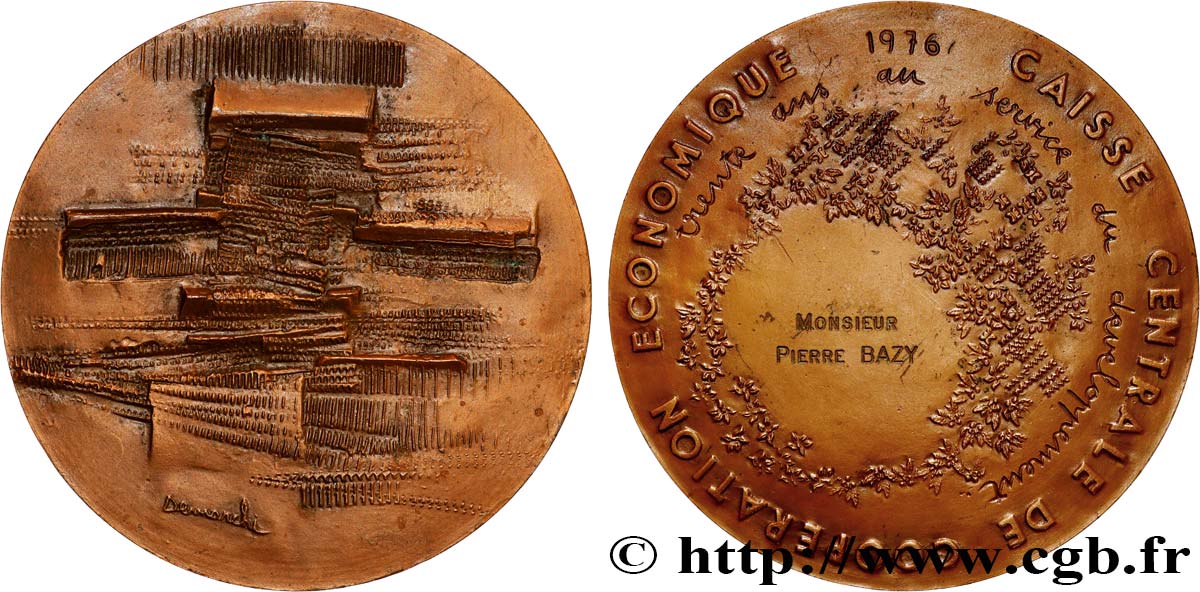
fme_699111 - BANQUES - ÉTABLISSEMENTS DE CRÉDIT Médaille, Caisse Centrale de Coopération Économique
Nicht verfügbar.
Artikel auf unserem Online-Shop verkauft (2022)
Preis : 75.00 €
Artikel auf unserem Online-Shop verkauft (2022)
Preis : 75.00 €
Type : Médaille, Caisse Centrale de Coopération Économique
Datum: 1976
Name der Münzstätte / Stadt : 75 - Paris
Metall : Bronze
Durchmesser : 80,5 mm
Stempelstellung : 12 h.
Graveur DEMARCHI Serge (1934)
Gewicht : 290,83 g.
Rand lisse + 1976 + Corne BRONZE
Punze : corne BRONZE
Kommentare zum Erhaltungszustand:
Patine hétérogène avec quelques taches noires. présence de quelques coups et rayures, notamment sur la tranche
N° im Nachschlagewerk :
Vorderseite
Titulatur der Vorderseite ANÉPIGRAPHE.
Beschreibung Vorderseite Oeuvre contemporaine de Serge Demarchi.
Rückseite
Titulatur der Rückseite CAISSE CENTRALE DE COOPÉRATION ÉCONOMIQUE / TRENTE ANS AU SERVICE DU DÉVELOPPEMENT / MONSIEUR ANDRE DE LATTRE.
Beschreibung Rückseite Légende en 2 lignes circulaires.
Kommentare
Exemplaire décerné à Monsieur Pierre Bazy.
La Caisse centrale de la France libre (CCFL) est créée par l'ordonnance du 2 décembre1941. Ses rôles principaux sont l’émission monétaire, le Trésor public et le contrôle des changes du gouvernement du général de Gaulle en exil à Londres et des territoires ultra-marins ralliés au CFLN.
L’ordonnance du 2 février 1944 change son nom en Caisse centrale de la France d’outre-mer (CCFOM) ; sa compétence est limitée aux territoires d'outre-mer, le trésor central étant assuré par la Trésorerie générale d’Alger. Dans la lignée de la conférence de Brazzaville (6 février 1944), elle s'oriente peu à peu vers la fonction de banque de développement.
Entre 1955 et 1959, la Caisse centrale abandonne ses fonctions d'institut d'émission monétaire.
À la suite du référendum du 28 septembre 1958 qui instaure une communauté française d'États autonomes, les statuts de la CCFOM sont modifiés par l'ordonnance du 30 décembre 1958 et elle devient la Caisse centrale de coopération économique (CCCE), établissement public et institution financière spécialisée, destinée à jouer le rôle de banque de développement pour les États de la fédération. Le Fonds d’aide et de coopération (FAC) remplace le FIDES pour les États autonomes de la Communauté auprès du secrétariat d’État pour les relations avec les États de la Communauté, qui devient ministère de la coopération en 1961..
example awarded to Mr. Pierre Bazy.
The Central Fund of Free France (CCFL) was created by the ordinance of December 2, 1941. Its main roles are the issue of money, the public treasury and the exchange control of the government of General de Gaulle in exile in London and the overseas territories rallied to the CFLN.
The ordinance of February 2, 1944 changed its name to the Central Fund of Overseas France (CCFOM); its jurisdiction was limited to overseas territories, the central treasury being provided by the General Treasury of Algiers.. In line with the Brazzaville conference (February 6, 1944), it gradually moved towards the function of a development bank..
Between 1955 and 1959, the Central Fund abandoned its functions as a monetary issuing institution..
Following the referendum of 28 September 1958 which established a French community of autonomous states, the statutes of the CCFOM were modified by the order of 30 December 1958 and it became the Central Fund for Economic Cooperation (CCCE), a public establishment and specialized financial institution, intended to play the role of development bank for the states of the federation.. The Aid and Cooperation Fund (FAC) replaced FIDES for the autonomous states of the Community within the Secretariat of State for Relations with the States of the Community, which became the Ministry of Cooperation in 1961.
La Caisse centrale de la France libre (CCFL) est créée par l'ordonnance du 2 décembre1941. Ses rôles principaux sont l’émission monétaire, le Trésor public et le contrôle des changes du gouvernement du général de Gaulle en exil à Londres et des territoires ultra-marins ralliés au CFLN.
L’ordonnance du 2 février 1944 change son nom en Caisse centrale de la France d’outre-mer (CCFOM) ; sa compétence est limitée aux territoires d'outre-mer, le trésor central étant assuré par la Trésorerie générale d’Alger. Dans la lignée de la conférence de Brazzaville (6 février 1944), elle s'oriente peu à peu vers la fonction de banque de développement.
Entre 1955 et 1959, la Caisse centrale abandonne ses fonctions d'institut d'émission monétaire.
À la suite du référendum du 28 septembre 1958 qui instaure une communauté française d'États autonomes, les statuts de la CCFOM sont modifiés par l'ordonnance du 30 décembre 1958 et elle devient la Caisse centrale de coopération économique (CCCE), établissement public et institution financière spécialisée, destinée à jouer le rôle de banque de développement pour les États de la fédération. Le Fonds d’aide et de coopération (FAC) remplace le FIDES pour les États autonomes de la Communauté auprès du secrétariat d’État pour les relations avec les États de la Communauté, qui devient ministère de la coopération en 1961..
example awarded to Mr. Pierre Bazy.
The Central Fund of Free France (CCFL) was created by the ordinance of December 2, 1941. Its main roles are the issue of money, the public treasury and the exchange control of the government of General de Gaulle in exile in London and the overseas territories rallied to the CFLN.
The ordinance of February 2, 1944 changed its name to the Central Fund of Overseas France (CCFOM); its jurisdiction was limited to overseas territories, the central treasury being provided by the General Treasury of Algiers.. In line with the Brazzaville conference (February 6, 1944), it gradually moved towards the function of a development bank..
Between 1955 and 1959, the Central Fund abandoned its functions as a monetary issuing institution..
Following the referendum of 28 September 1958 which established a French community of autonomous states, the statutes of the CCFOM were modified by the order of 30 December 1958 and it became the Central Fund for Economic Cooperation (CCCE), a public establishment and specialized financial institution, intended to play the role of development bank for the states of the federation.. The Aid and Cooperation Fund (FAC) replaced FIDES for the autonomous states of the Community within the Secretariat of State for Relations with the States of the Community, which became the Ministry of Cooperation in 1961.
Historischer Hintergrund
BANQUES - ÉTABLISSEMENTS DE CRÉDIT
Bis zur Mitte des 19. Jahrhunderts gab es nur Privatbanken, die auf große Vermögen wie die Rothschilds ausgerichtet waren. Sie nahmen dann den Namen von Investmentbanken wie der Banque de Paris et des Pays-Bas, der Union Générale usw. an. Die Entwicklung der Tätigkeit, die aus der industriellen Revolution hervorging, führte zur Schaffung von Banken neuen Typs für alle , sogenannte Einlagenbanken. Das erste war das 1853 gegründete Comptoir d'escompte. Es folgten weitere Einrichtungen: Crédit Industriel et Commercial, Crédit Lyonnais (1863), Société Générale usw..
 Berichten über einen Fehler
 Die Seite drucken
 Teilen meiner Auswahl
 Stellen Sie eine Frage
 Einlieferung/Verkauf
In Verbindung stehende Artikel

 Details

Ihre zuletzt angesehenen Artikel
MASSALIEN - MARSEILLES Obole MA, tête à gauche, imitation fSS/SS
34.00 €
VIERTE FRANZOSISCHE REPUBLIK Médaille, Fédération nationale des entreprises Ã
55.00 €
AFRICAN STATES (FRENCH) Plaquette, Auguste Terrier, Comité de l’Afrique FranÃ
100.00 €

MÉDAILLES RELIGIEUSES Médaille, Notre Dame du Puy-en-Velay fSS
100.00 €
cgbfr.de numismatik


