


E-auction 256-179539 - fme_412393 - AQUITAINE - DUCHÉ D'AQUITAINE - LOUIS VII Médaille de la reine Aliénor
Sie müssen angeschlossen sein und von cgb.fr genehmigt werden, um in einer E-Auktion teilzunehmen.Melden Sie sich an, um zu wetten..Die Kontobestätigungen sind innerhalb von 48 Stunden nach Ihrer Anmeldung gemacht.Warten Sie nicht bis die letzten zwei Tage vor dem Abschluss eines Verkaufs, um Ihre Registrierung abzuschließen. Klickend "BIETEN" verpflichten Sie sich vertraglich, diesen Artikel zu kaufen und Sie nehmen ohne Reserve die allgemeinen Verkaufsbedingungen für den e-auctions zu cgb.fr an.
Der Verkauf wird an der Zeit auf der Übersichtsseite angezeigt geschlossen werden. Angebote, die nach der Schließung Zeit empfangen sind, werden nicht gültig.
Bitte beachten Sie, dass die Fristen für die Einreichung Ihres Angebots auf unsere Server können variieren und es kann zur Ablehnung Ihres Angebots entstehen, wenn es in den letzten Sekunden des Verkaufs gesendet wird. Die Angebote sollen mit ganzer Zahl ausgeführt sein, Sie können Kommas oder des Punktes in Ihrem Angebot nicht erfassen. Bei Fragen klicken Sie hier, um einen Blick auf die FAQ E-Auktionen.
KEINE ANSCHAFFUNGSKOSTEN FÜR DIE KÄUFER.
KEINE ANSCHAFFUNGSKOSTEN FÜR DIE KÄUFER.
| Schätzung : | 50 € |
| Preis : | 32 € |
| Höchstgebot : | 51 € |
| Verkaufsende : | 12 März 2018 18:56:00 |
| Bieter : | 6 Bieter |
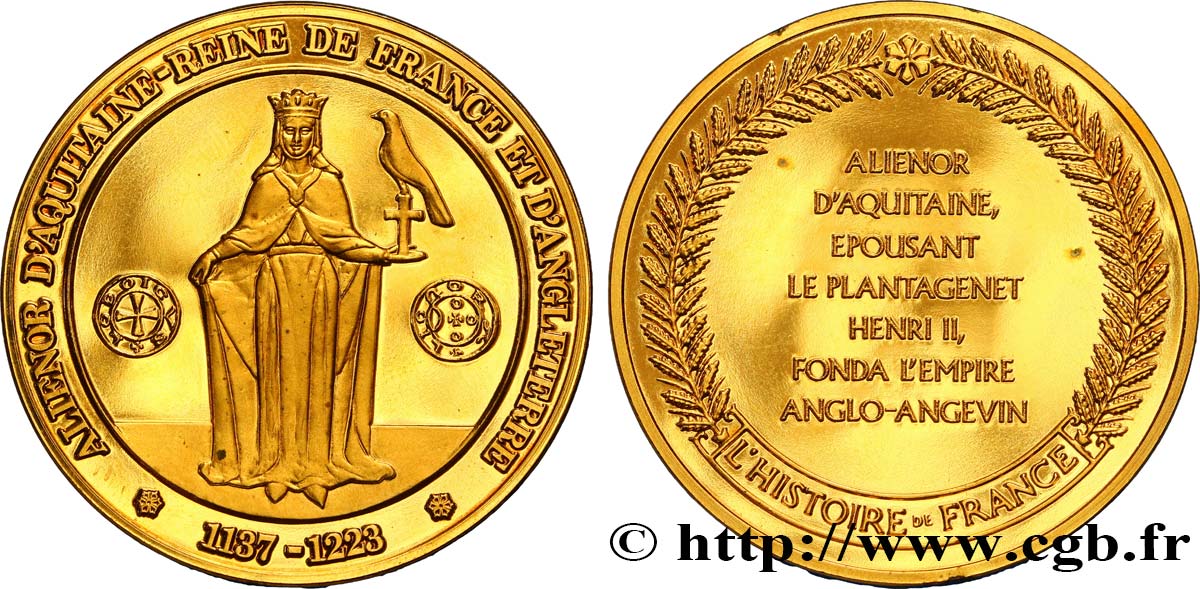
Type : Médaille de la reine Aliénor
Datum: 1137-1223
Name der Münzstätte / Stadt : France
Metall : Silbergold
Durchmesser : 44 mm
Stempelstellung : 12 h.
Gewicht : 39 g.
Rand lisse + losange VERMEIL 78-P
Kommentare zum Erhaltungszustand:
Médaille neuve avec un très bel éclat
Vorderseite
Titulatur der Vorderseite ALIENOR D’AQUITAINE - REINE DE FRANCE ET D’ANGLETERRE // 1137-1223.
Beschreibung Vorderseite La reine Aliénor en pied, tenant un oiseau posé sur une croix de la main gauche ; deux monnaies médiévales de part et d’autre.
Rückseite
Titulatur der Rückseite ALIENOR / D’AQUITAINE / EPOUSANT / LE PLANTAGENET / HENRI II, / FONDA L’EMPIRE / ANGLO-ANGEVIN // L’HISTOIRE DE FRANCE.
Beschreibung Rückseite Légende en 7 lignes horizontales dans une couronne végétale partant d’un cartouche à l’exergue.
Kommentare
Médaille de la série Histoire de France, sans graveur.
Aliénor d’Aquitaine, aussi connue sous le nom de Éléonore d'Aquitaine ou de Guyenne, née vers 1122 ou 1124, et morte le 31 mars ou le 1er avril 1204, à Poitiers et non à l'abbaye de Fontevraud, a été tour à tour reine des Francs, puis reine consort d'Angleterre.
Duchesse d’Aquitaine et comtesse de Poitiers, elle occupe une place centrale dans les relations au XIIe siècle entre les royaumes de France et d’Angleterre : elle épouse successivement le roi de France Louis VII (1137), puis Henri Plantagenêt (1152), futur roi d’Angleterre Henri II, renversant ainsi le rapport des forces en apportant ses terres à l’un puis à l’autre des deux souverains. À la cour fastueuse qu'elle tient en Aquitaine, elle favorise l'expression poétique des troubadours en langue d'oc. À compter de son premier mariage (pendant lequel elle a participé à la deuxième croisade), elle joue un rôle politique important dans l’Europe médiévale..
Medal from the History of France series, without engraver. Eleanor of Aquitaine, also known as Eleanor of Aquitaine or Guyenne, born around 1122 or 1124, and died on March 31 or April 1, 1204, in Poitiers and not at Fontevraud Abbey, was in turn Queen of the Franks, then Queen consort of England. Duchess of Aquitaine and Countess of Poitiers, she occupied a central place in the relations in the 12th century between the kingdoms of France and England: she married successively the King of France Louis VII (1137), then Henry Plantagenet (1152), future King of England Henry II, thus reversing the balance of power by bringing her lands to one then to the other of the two sovereigns. At the lavish court she held in Aquitaine, she encouraged the poetic expression of the troubadours in the langue d'oc. From her first marriage (during which she participated in the Second Crusade), she played an important political role in medieval Europe.
Aliénor d’Aquitaine, aussi connue sous le nom de Éléonore d'Aquitaine ou de Guyenne, née vers 1122 ou 1124, et morte le 31 mars ou le 1er avril 1204, à Poitiers et non à l'abbaye de Fontevraud, a été tour à tour reine des Francs, puis reine consort d'Angleterre.
Duchesse d’Aquitaine et comtesse de Poitiers, elle occupe une place centrale dans les relations au XIIe siècle entre les royaumes de France et d’Angleterre : elle épouse successivement le roi de France Louis VII (1137), puis Henri Plantagenêt (1152), futur roi d’Angleterre Henri II, renversant ainsi le rapport des forces en apportant ses terres à l’un puis à l’autre des deux souverains. À la cour fastueuse qu'elle tient en Aquitaine, elle favorise l'expression poétique des troubadours en langue d'oc. À compter de son premier mariage (pendant lequel elle a participé à la deuxième croisade), elle joue un rôle politique important dans l’Europe médiévale..
Medal from the History of France series, without engraver. Eleanor of Aquitaine, also known as Eleanor of Aquitaine or Guyenne, born around 1122 or 1124, and died on March 31 or April 1, 1204, in Poitiers and not at Fontevraud Abbey, was in turn Queen of the Franks, then Queen consort of England. Duchess of Aquitaine and Countess of Poitiers, she occupied a central place in the relations in the 12th century between the kingdoms of France and England: she married successively the King of France Louis VII (1137), then Henry Plantagenet (1152), future King of England Henry II, thus reversing the balance of power by bringing her lands to one then to the other of the two sovereigns. At the lavish court she held in Aquitaine, she encouraged the poetic expression of the troubadours in the langue d'oc. From her first marriage (during which she participated in the Second Crusade), she played an important political role in medieval Europe.
Historischer Hintergrund
AQUITAINE - DUCHÉ D'AQUITAINE - LOUIS VII
1137
Ludwig VII. (1120–1180) heiratete 1137 Eleonore von Aquitanien (1122–1204), Tochter von Guillaume X., dem letzten Herzog von Aquitanien und Graf von Poitou. Die Ehe war nicht glücklich. Ludwig ließ sich 1152 nach seiner Rückkehr vom zweiten Kreuzzug scheiden. Eleanor heiratete dann Heinrich II. Plantagenet, der 1154 König von England wurde, dem Auslöser des ersten Hundertjährigen Krieges (1154–1259). Die Münzprägung Ludwigs VII. für Aquitanien ist sehr selten.
 Berichten über einen Fehler
 Die Seite drucken
 Teilen meiner Auswahl
 Stellen Sie eine Frage
 Einlieferung/Verkauf
Ihre zuletzt angesehenen Artikel
SYRIEN - SELEUKIDICHES KÖNIGREICH - ANTIOCHOS VIII GRYPOS Tétradrachme VZ
680.00 €
SOCIÉTÉS D'AGRICULTURE, HORTICULTURE, PÈCHE ET CHASSE Société d’agricultu
40.00 €

LYON ET DU LYONNAIS (JETONS ET MÉDAILLES DE...) Médecine, hôpitaux civils de
45.00 €
AQUITAINE - DUCHÉ D'AQUITAINE - LOUIS VII Médaille de la reine Aliénor fST
32.00 €

BELGIEN - PRINZBISTUMS LÜTTICH 1 Liard Évéché de Liège frappe au nom de Jea
12.00 €
cgbfr.de numismatik


