


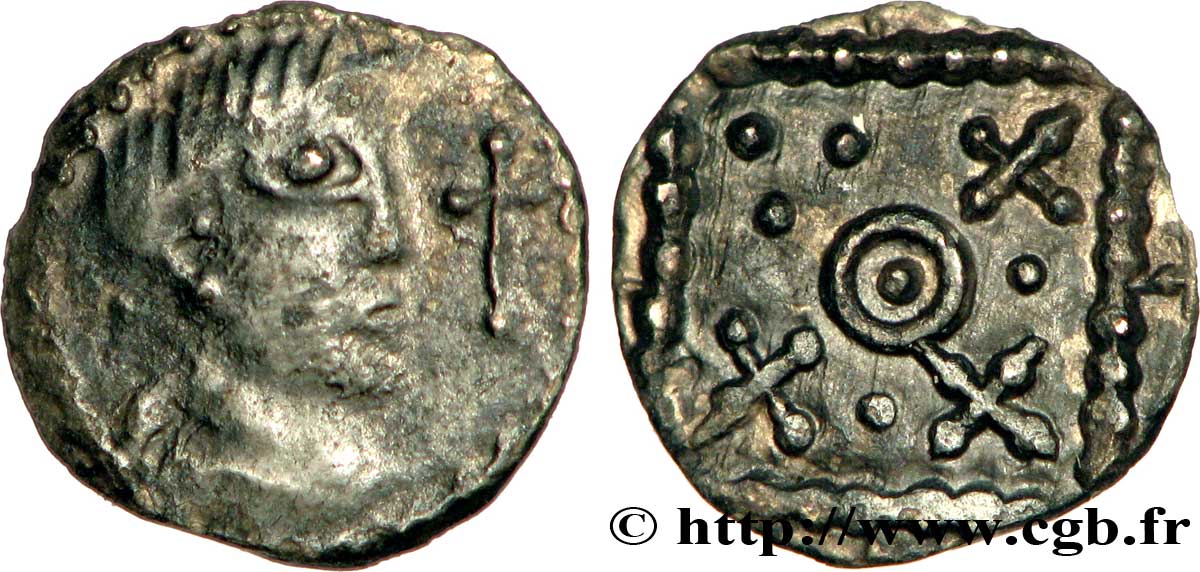
v53_0693 - ENGLAND - ANGELSASSCHE Sceat à la tête et au carré perlé, Série G, type 3a
MONNAIES 53 (2012)
Startpreis : 380.00 €
Schätzung : 500.00 €
Erzielter Preis : 380.00 €
Startpreis : 380.00 €
Schätzung : 500.00 €
Erzielter Preis : 380.00 €
Type : Sceat à la tête et au carré perlé, Série G, type 3a
Datum: c. 710-760
Name der Münzstätte / Stadt : Angleterre (sud-est)
Metall : Silber
Durchmesser : 11,5 mm
Stempelstellung : 12 h.
Gewicht : 0,89 g.
Seltenheitsgrad : R3
Kommentare zum Erhaltungszustand:
Monnaie très intéressante avec des types complets et bien centrés. L’avers est un peu mou, probablement issu d’un coin usé, mais le revers est d’une rare qualité de frappe avec de très beaux reliefs. Fine patine irisée, gris foncé
N° im Nachschlagewerk :
Vorderseite
Titulatur der Vorderseite ANÉPIGRAPHE.
Beschreibung Vorderseite Tête diadémée à droite, une petite croix devant le visage ; grènetis.
Rückseite
Titulatur der Rückseite ANÉPIGRAPHE.
Beschreibung Rückseite Annelet pointé entouré de trois croisette et d’un groupe de trois globules en triangle, posés aux quatre coins ; deux globules dans le champ ; l’ensemble dans un carré perlé.
Kommentare
Ce genre de belle tête classique est assez rare dans le monnayage anglo-saxon ; cet exemplaire est malheureusement issu d’un coin de droit fatigué mais de bon style. Le revers est plus typique avec le carré perlé. Pour ce type particulier, ce revers est néanmoins plus rare, le type traditionnel ayant quatre croisettes au revers et non pas trois comme sur notre exemplaire. Les deux monnaies conservées à Oxford sont dans un triste état ; le n° 269 provient du sud d’Atherstone et le n° 270 a été trouvé sur la plage de Selsey.
This type of fine classical head is quite rare in Anglo-Saxon coinage; this example unfortunately comes from a tired but good style obverse die. The reverse is more typical with the pearled square. For this particular type, this reverse is nevertheless rarer, the traditional type having four crosslets on the reverse and not three as on our example. The two coins preserved at Oxford are in a sad state; No. 269 comes from south of Atherstone and No. 270 was found on Selsey beach
This type of fine classical head is quite rare in Anglo-Saxon coinage; this example unfortunately comes from a tired but good style obverse die. The reverse is more typical with the pearled square. For this particular type, this reverse is nevertheless rarer, the traditional type having four crosslets on the reverse and not three as on our example. The two coins preserved at Oxford are in a sad state; No. 269 comes from south of Atherstone and No. 270 was found on Selsey beach
Historischer Hintergrund
ENGLAND - ANGELSASSCHE
(7. – 8. Jahrhundert)
Wenn die Prägung dieser Münzen zu Beginn des 8. Jahrhunderts in Großbritannien angesiedelt ist, ist es keine Ausnahme, sie in Gallien zu finden. Sie werden oft mit merowingischen Silbermünzen verwechselt (vgl. MONNAIES XIX, Nr. 503, Sceattas um 680-710, klassifiziert im merowingischen Denier von Laon). Im Laufe des 8. Jahrhunderts degenerierte der Stil dieser Stücke immer mehr, sie sind oft geriffelt oder gefüllt. Diese Münzen verschwanden in der zweiten Hälfte des 8. Jahrhunderts aus dem Umlauf.
 Berichten über einen Fehler
 Die Seite drucken
 Teilen meiner Auswahl
 Stellen Sie eine Frage
 Einlieferung/Verkauf
In Verbindung stehende Artikel
 Details


Ihre zuletzt angesehenen Artikel

SAINT-OMER - ÉGLISE ET COUVENT DE SAINT-BERTIN Méreau de 6 deniers SS
100.00 €
GALLIEN - ARMORICA - CORIOSOLITÆ (Region die Corseul, Cotes d'Armor) Statère d
350.00 €
GALLIEN - ARMORICA - BAÏOCASSES (Region die Bayeux) Statère d’argent aux lyr
750.00 €
cgbfr.de numismatik


