


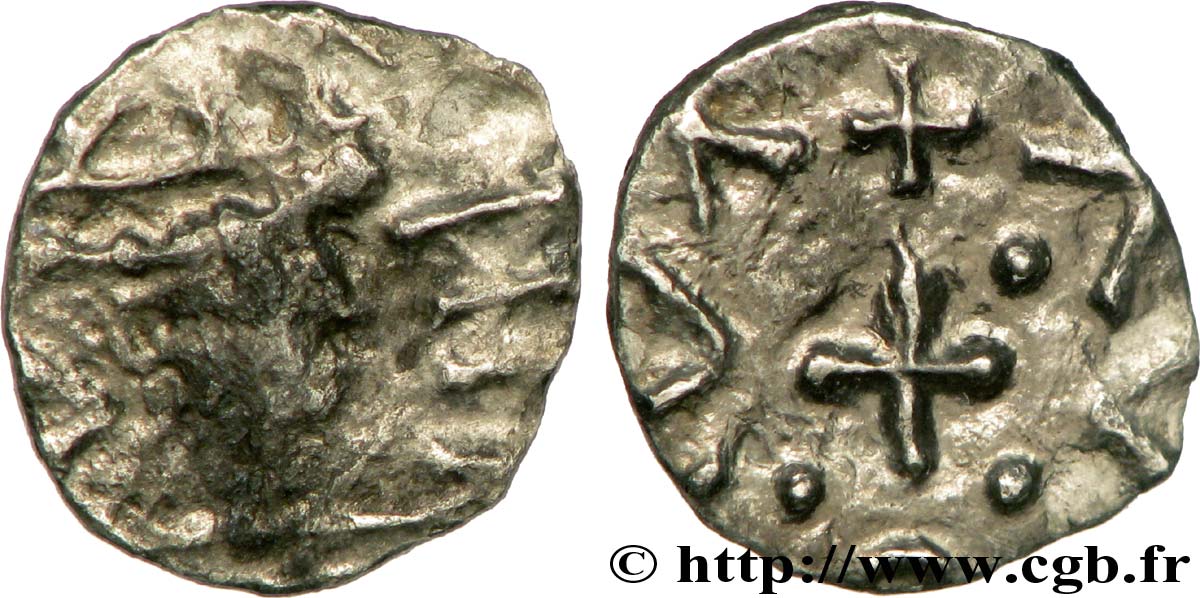
bmv_220140 - ENGLAND - ANGELSASSCHE Sceat à la tête casquée, Série D, type 2c
Nicht verfügbar.
Artikel auf unserem Online-Shop verkauft (2013)
Preis : 150.00 €
Artikel auf unserem Online-Shop verkauft (2013)
Preis : 150.00 €
Type : Sceat à la tête casquée, Série D, type 2c
Datum: c. 695-740
Name der Münzstätte / Stadt : Frise, Domburg (Pays-Bas)
Metall : Silber
Durchmesser : 11 mm
Gewicht : 0,77 g.
Seltenheitsgrad : R2
Kommentare zum Erhaltungszustand:
Monnaie bien identifiable, mais avec une frappe un peu molle en général, sans doute avec des coins usés. Patine grise et brillante au revers, mais avec une zone un peu plus terne au droit
N° im Nachschlagewerk :
Vorderseite
Titulatur der Vorderseite LÉGENDE RUNIQUE DEVANT LE VISAGE.
Beschreibung Vorderseite Tête stylisée à droite, une couronne radiée sur la tête ; les épaules cintrées formées d’un rang de perles entre deux traits parallèles.
Rückseite
Titulatur der Rückseite LÉGENDES GÉOMÉTRIQUES.
Beschreibung Rückseite Croix grecque bouletée, cantonnée de quatre globules ; légende autour.
Kommentare
Ce type 2c de la série D se divise en deux, selon que le poids est lourd ou léger ; avec 0,77 g, cet exemplaire est plutôt léger.
D. M. Metcalf fait remarquer qu'il existe des copie difficile à reconnaître et que certaine monnaies officielles ont pourtant un style très “pauvre”.
Ce denier probablement frappé à Domburg, est repris comme “Continental runic type”.
This type 2c of the D series is divided into two, depending on whether the weight is heavy or light; at 0.77 g, this example is rather light. DM Metcalf points out that there are copies that are difficult to recognize and that some official coins have a very “poor” style. This denarius, probably struck in Domburg, is listed as “Continental runic type”
D. M. Metcalf fait remarquer qu'il existe des copie difficile à reconnaître et que certaine monnaies officielles ont pourtant un style très “pauvre”.
Ce denier probablement frappé à Domburg, est repris comme “Continental runic type”.
This type 2c of the D series is divided into two, depending on whether the weight is heavy or light; at 0.77 g, this example is rather light. DM Metcalf points out that there are copies that are difficult to recognize and that some official coins have a very “poor” style. This denarius, probably struck in Domburg, is listed as “Continental runic type”
Historischer Hintergrund
ENGLAND - ANGELSASSCHE
(7. – 8. Jahrhundert)
Wenn die Prägung dieser Münzen zu Beginn des 8. Jahrhunderts in Großbritannien angesiedelt ist, ist es keine Ausnahme, sie in Gallien zu finden. Sie werden oft mit merowingischen Silbermünzen verwechselt (vgl. MONNAIES XIX, Nr. 503, Sceattas um 680-710, klassifiziert im merowingischen Denier von Laon). Im Laufe des 8. Jahrhunderts degenerierte der Stil dieser Stücke immer mehr, sie sind oft geriffelt oder gefüllt. Diese Münzen verschwanden in der zweiten Hälfte des 8. Jahrhunderts aus dem Umlauf.
 Berichten über einen Fehler
 Die Seite drucken
 Teilen meiner Auswahl
 Stellen Sie eine Frage
 Einlieferung/Verkauf
In Verbindung stehende Artikel
 Details



cgbfr.de numismatik


