


Nicht verfügbar.
Artikel auf unserem Online-Shop verkauft (2018)
Preis : 225.00 €
Artikel auf unserem Online-Shop verkauft (2018)
Preis : 225.00 €
Type : Denier
Datum: 49 AC.
Name der Münzstätte / Stadt : Grèce ou Illyrie
Metall : Silber
Der Feingehalt beträgt : 950 ‰
Durchmesser : 17,5 mm
Stempelstellung : 6 h.
Gewicht : 3,79 g.
Seltenheitsgrad : R1
Slab

NGC :
Kommentare zum Erhaltungszustand:
Exemplaire sur un flan ovale bien centré avec les grènetis visibles. Joli portrait de style fin. Revers de style fin Patine grise superficielle avec des reflets dorés
N° im Nachschlagewerk :
Vorderseite
Titulatur der Vorderseite SALVTIS.
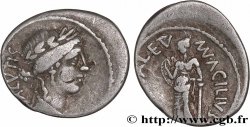
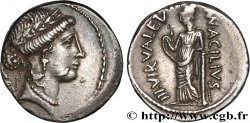
Beschreibung Vorderseite Tête de Salus (la Santé) laurée à droite.
Übersetzung der Vorderseite “Salutis”, (de la Santé).
Rückseite
Titulatur der Rückseite (MN) ACILIVS/ III VIR VALE(TV).
Beschreibung Rückseite Valetudo (la Santé) debout à gauche, appuyée sur une colonne de la main gauche et tenant un serpent de la main droite.
Übersetzung der Rückseite “Manius Acilius Triumviri Valetudinis”, (Manius Acilius triumvir monétaire Valetudo).
Kommentare
Si le poids est correct, la monnaie semble toute de même fourrée avec notamment une boursouflure de métal au revers. Pour ce type, M. Crawford a relevé une estimation de 651 coins de droit et de 723 coins de revers ce qui pourrait correspondre à une fabrication totale comprise entre un million et demi et trois millions de deniers. C’est l’un des types monétaires qui permit de financer le parti sénatorial au début de l’année 49 avant J.-C. quand ce dernier rejoignit Pompée qui avait quitté Rome. Les auteurs du Catàlogo ont différencié trois variétés dont la nôtre qui semble la plus rare avec le mot SALVTIS qui remonte vers le haut derrière la tête.
If the weight is correct, the coin still seems to be filled, notably with a metal bulge on the reverse. For this type, Mr. Crawford noted an estimate of 651 obverse dies and 723 reverse dies, which could correspond to a total production of between one and a half and three million denarii. This is one of the monetary types that allowed the financing of the senatorial party at the beginning of 49 BC when the latter joined Pompey who had left Rome. The authors of the Catàlogo differentiated three varieties, including ours, which seems the rarest, with the word SALVTIS rising upwards behind the head.
If the weight is correct, the coin still seems to be filled, notably with a metal bulge on the reverse. For this type, Mr. Crawford noted an estimate of 651 obverse dies and 723 reverse dies, which could correspond to a total production of between one and a half and three million denarii. This is one of the monetary types that allowed the financing of the senatorial party at the beginning of 49 BC when the latter joined Pompey who had left Rome. The authors of the Catàlogo differentiated three varieties, including ours, which seems the rarest, with the word SALVTIS rising upwards behind the head.
Historischer Hintergrund
ACILIA
(49 v. Chr.)
Die Gens Acilia ist eine plebejische Familie Roms. Manius Acilius ist der Sohn von Manius Acilius Glabrio und Æmilia, der Tochter von Metella und Marcus Æmilius Scaurus. Metella heiratet Sylla in zweiter Ehe. Sie starb 82 v. Chr. Æmilia wurde zur Frau des Pompeius gewählt, obwohl sie bereits mit Glabrio verheiratet war. Sie starb 81 v. Chr.
 Berichten über einen Fehler
 Die Seite drucken
 Teilen meiner Auswahl
 Stellen Sie eine Frage
 Einlieferung/Verkauf
 Details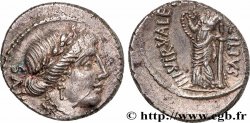


Ihre zuletzt angesehenen Artikel
MYSIEN - KYZIKOS Obole VZ/fST
320.00 €
MAXIMIANUS HERCULIUS Tétradrachme SS
18.00 €

AEMILIA Denier SS
150.00 €

CRISPUS Centenionalis ou nummus ST
100.00 €

MARCIA Denier fVZ/SS
200.00 €

KANADA 1 Cent Victoria 1859 fSS
8.00 €
cgbfr.de numismatik


