


bgr_615974 - LUKANIEN - VELIA Nomos, statère ou didrachme
Nicht verfügbar.
Artikel auf unserem Online-Shop verkauft (2022)
Preis : 220.00 €
Artikel auf unserem Online-Shop verkauft (2022)
Preis : 220.00 €
Type : Nomos, statère ou didrachme
Datum: c. 365-350/340 AC
Name der Münzstätte / Stadt : Vélia, Lucanie
Metall : Silber
Durchmesser : 24,5 mm
Stempelstellung : 3 h.
Gewicht : 6,40 g.
Seltenheitsgrad : R1
Kommentare zum Erhaltungszustand:
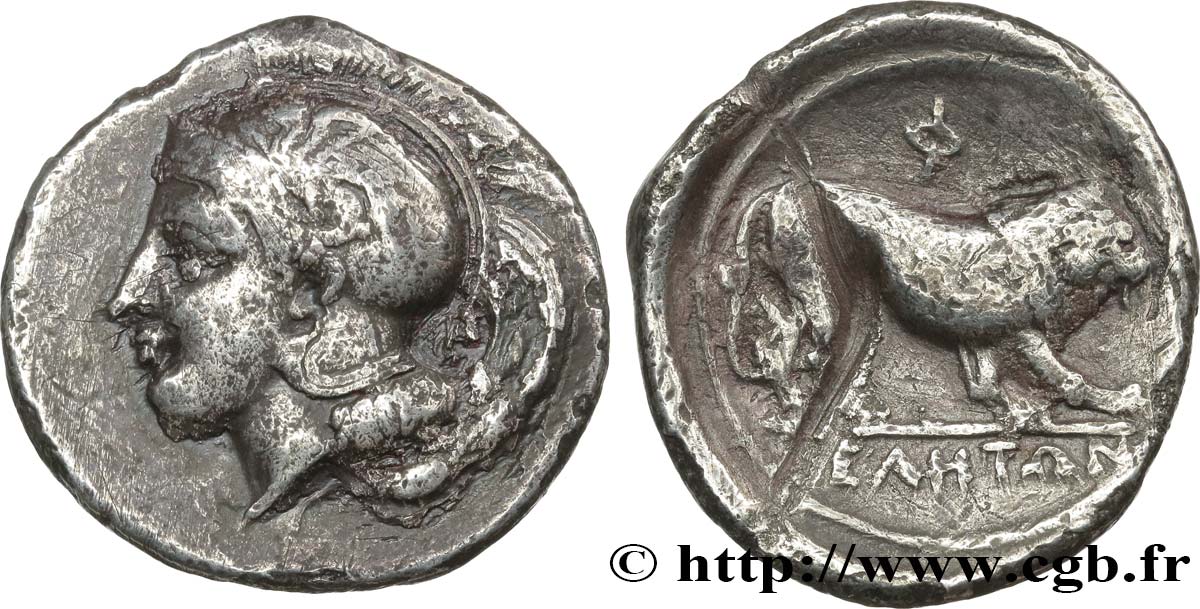
Flan large, centré. Coupure sur la cuisse du lion. Joli portrait. Patine grise
N° im Nachschlagewerk :
Vorderseite
Beschreibung Vorderseite Tête d'Athéna à gauche, coiffée du casque attique à cimier avec triple aigrette, orné d’un griffon.
Legende des Averses R
Rückseite
Beschreibung Rückseite Lion passant à droite .
Legende des Reverses : UELHTWN/ F
Übersetzung der Rückseite (de Vélia).
Kommentare
Poids léger. Fourré ? R. Williams a étudié la dégradation du coin de droit (A/152) et du coin de revers (R/ 203) et a déterminé six phases différentes. Très tôt, le monnayage de Vélia a été décrit comme ayant inspiré la drachme lourde de Marseille (LT. 785-791). Certains l’ont même décrit comme un monnayage symmachique : un lion de Vélia étant l’équivalent de deux lions de Marseille. Aujourd’hui, cette théorie est remise en cause, par G. Depeyrot, non sans arguments, mais avec une certaine acrimonie. Le lion de Vélia a pu servir de modèle à celui de Marseille, mais à quelle date ? La frappe à Vélia commence dans la seconde moitié du Ve siècle avant J.-C. pour se poursuivre jusqu’en 281 avant J.-C. À quel moment les Massaliotes auraient-ils emprunté le lion de Vélia ?.
Lightweight. Stuffed? R. Williams studied the degradation of the obverse die (A/152) and the reverse die (R/203) and identified six different phases. Very early on, the coinage of Velia was described as having inspired the heavy drachma of Marseille (LT. 785-791). Some have even described it as a symmachic coinage: one lion of Velia being the equivalent of two lions of Marseille. Today, this theory is challenged, not without argument, but with some acrimony, by G. Depeyrot. The lion of Velia may have served as a model for that of Marseille, but at what date? Minting at Velia began in the second half of the 5th century BC and continued until 281 BC. At what point might the Massaliotes have borrowed the lion of Velia?
Lightweight. Stuffed? R. Williams studied the degradation of the obverse die (A/152) and the reverse die (R/203) and identified six different phases. Very early on, the coinage of Velia was described as having inspired the heavy drachma of Marseille (LT. 785-791). Some have even described it as a symmachic coinage: one lion of Velia being the equivalent of two lions of Marseille. Today, this theory is challenged, not without argument, but with some acrimony, by G. Depeyrot. The lion of Velia may have served as a model for that of Marseille, but at what date? Minting at Velia began in the second half of the 5th century BC and continued until 281 BC. At what point might the Massaliotes have borrowed the lion of Velia?
Historischer Hintergrund
LUKANIEN - VELIA
(350-281 v. Chr.)
Velia, für die Griechen Elea, wurde um 540 v. Chr. von Phokäern gegründet, die Kleinasien nach dem Fall von Sardes im Jahr 546 v. Chr. verlassen hatten. Velia wurde ab 275 v. Chr. ein Verbündeter der Römer. Der Löwe war das Symbol der Stadt, daher seine Verwendung die Münzprägung von Marseille, da die Metropole Marseille enge Beziehungen zu Velia unterhielt.
 Berichten über einen Fehler
 Die Seite drucken
 Teilen meiner Auswahl
 Stellen Sie eine Frage
 Einlieferung/Verkauf
In Verbindung stehende Artikel
 Details



cgbfr.de numismatik


