


E-auction 453-365841 - fme_423827 - LUDWIG XVIII Médaille, Louis-Antoine d'Artois duc d'Angoulême
Sie müssen angeschlossen sein und von cgb.fr genehmigt werden, um in einer E-Auktion teilzunehmen.Melden Sie sich an, um zu wetten..Die Kontobestätigungen sind innerhalb von 48 Stunden nach Ihrer Anmeldung gemacht.Warten Sie nicht bis die letzten zwei Tage vor dem Abschluss eines Verkaufs, um Ihre Registrierung abzuschließen. Klickend "BIETEN" verpflichten Sie sich vertraglich, diesen Artikel zu kaufen und Sie nehmen ohne Reserve die allgemeinen Verkaufsbedingungen für den e-auctions zu cgb.fr an.
Der Verkauf wird an der Zeit auf der Übersichtsseite angezeigt geschlossen werden. Angebote, die nach der Schließung Zeit empfangen sind, werden nicht gültig.
Bitte beachten Sie, dass die Fristen für die Einreichung Ihres Angebots auf unsere Server können variieren und es kann zur Ablehnung Ihres Angebots entstehen, wenn es in den letzten Sekunden des Verkaufs gesendet wird. Die Angebote sollen mit ganzer Zahl ausgeführt sein, Sie können Kommas oder des Punktes in Ihrem Angebot nicht erfassen. Bei Fragen klicken Sie hier, um einen Blick auf die FAQ E-Auktionen.
KEINE ANSCHAFFUNGSKOSTEN FÜR DIE KÄUFER.
KEINE ANSCHAFFUNGSKOSTEN FÜR DIE KÄUFER.
| Schätzung : | 120 € |
| Preis : | 41 € |
| Höchstgebot : | 211 € |
| Verkaufsende : | 20 December 2021 18:18:30 |
| Bieter : | 4 Bieter |
Type : Médaille, Louis-Antoine d'Artois duc d'Angoulême
Datum: 1823
Metall : Bronze
Durchmesser : 51 mm
Stempelstellung : 12 h.
Graveur CAUNOIS François Augustin (1787-1859)
Gewicht : 66 g.
Rand lisse
Kommentare zum Erhaltungszustand:
Intéressante médaille avec une patine brune, un peu hétérogène
Vorderseite
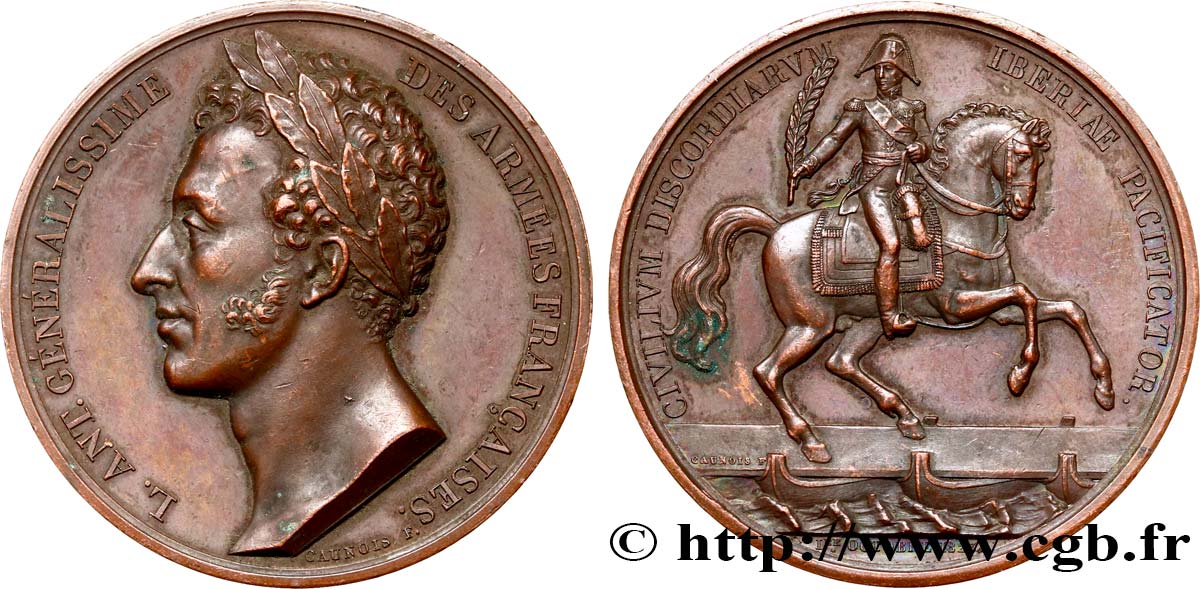
Titulatur der Vorderseite L. ANT. GÉNÉRALISSIME - DES ARMÉES FRANÇAISES.
Beschreibung Vorderseite Tête laurée de Louis-Antoine d'Artois à gauche.
Rückseite
Titulatur der Rückseite CIVILIVM DISCORDIARVM - IBERIAE PACIFICATOR // IER OCTOBRE 1823.
Beschreibung Rückseite Le duc d'Angoulême galopant à droite et tenant une palme de la main droite.
Kommentare
Louis-Antoine d’Artois, né le 6 août 1775 à Versailles, France, et mort à Görz, Autriche — actuellement Nova Gorica (Slovénie) — le 3 juin 1844, petit-fils de France et duc d’Angoulême (1775-1824), puis Louis-Antoine de France, dauphin de France (1824-1830) puis « comte de Marnes » (1830-1844), puis en 1836 Louis de France, est un prince de la maison royale de France, fils de Charles-Philippe de France, ce dernier étant comte d'Artois et le futur roi Charles X, et de Marie-Thérèse de Savoie.
Lors des événements de la révolution de Juillet (1830), moins d'une heure après l’abdication de son père Charles X, il renonce lui-même à ses droits en faveur de son neveu Henri d'Artois. Il s’exile ensuite avec le titre de courtoisie de « comte de Marnes ». À la mort de son père (1836) jusqu'à son propre décès (1844), il devient l’aîné des Capétiens et le «chef de la maison de France», prétendant à la Couronne de France et reconnu comme roi par les légitimistes sous le nom de «Louis XIX».
Parmi les distinctions militaires qui lui ont été données, le duc d’Angoulême était notamment colonel général des cuirassiers et dragons, grand-amiral de France et généralissime de l’armée d'Espagne..
Louis-Antoine d'Artois, born on August 6, 1775 in Versailles, France, and died in Görz, Austria — currently Nova Gorica (Slovenia) — on June 3, 1844, grandson of France and Duke of Angoulême (1775-1824), then Louis-Antoine of France, Dauphin of France (1824-1830) then \\\"Count of Marnes\\\" (1830-1844), then in 1836 Louis of France, is a prince of the royal house of France, son of Charles-Philippe of France, the latter being Count of Artois and the future King Charles X, and of Marie-Thérèse of Savoy.
During the events of the July Revolution (1830), less than an hour after the abdication of his father Charles X, he himself renounced his rights in favor of his nephew Henri d'Artois.. He then went into exile with the courtesy title of \\\"Count of Marnes\\\". From the death of his father (1836) until his own death (1844), he became the eldest of the Capetians and the \\\"head of the house of France\\\", claimant to the Crown of France and recognized as king by the legitimists under the name of \\\"Louis XIX\\\".
Among the military distinctions awarded to him, the Duke of Angoulême was notably Colonel General of the Cuirassiers and Dragoons, Grand Admiral of France and Generalissimo of the Army of Spain..
Lors des événements de la révolution de Juillet (1830), moins d'une heure après l’abdication de son père Charles X, il renonce lui-même à ses droits en faveur de son neveu Henri d'Artois. Il s’exile ensuite avec le titre de courtoisie de « comte de Marnes ». À la mort de son père (1836) jusqu'à son propre décès (1844), il devient l’aîné des Capétiens et le «chef de la maison de France», prétendant à la Couronne de France et reconnu comme roi par les légitimistes sous le nom de «Louis XIX».
Parmi les distinctions militaires qui lui ont été données, le duc d’Angoulême était notamment colonel général des cuirassiers et dragons, grand-amiral de France et généralissime de l’armée d'Espagne..
Louis-Antoine d'Artois, born on August 6, 1775 in Versailles, France, and died in Görz, Austria — currently Nova Gorica (Slovenia) — on June 3, 1844, grandson of France and Duke of Angoulême (1775-1824), then Louis-Antoine of France, Dauphin of France (1824-1830) then \\\"Count of Marnes\\\" (1830-1844), then in 1836 Louis of France, is a prince of the royal house of France, son of Charles-Philippe of France, the latter being Count of Artois and the future King Charles X, and of Marie-Thérèse of Savoy.
During the events of the July Revolution (1830), less than an hour after the abdication of his father Charles X, he himself renounced his rights in favor of his nephew Henri d'Artois.. He then went into exile with the courtesy title of \\\"Count of Marnes\\\". From the death of his father (1836) until his own death (1844), he became the eldest of the Capetians and the \\\"head of the house of France\\\", claimant to the Crown of France and recognized as king by the legitimists under the name of \\\"Louis XIX\\\".
Among the military distinctions awarded to him, the Duke of Angoulême was notably Colonel General of the Cuirassiers and Dragoons, Grand Admiral of France and Generalissimo of the Army of Spain..
Historischer Hintergrund
LUDWIG XVIII
(06.04.1814-16.09.1824)
Louis-Stanislas-Xavier wurde 1755 in Versailles aus der Verbindung von Dauphin Louis (Sohn Ludwigs XV.) und Marie-Josèphe Louise de Savoie geboren. Er erhielt zunächst den Titel eines Grafen der Provence und wurde Monsieur genannt, als sein älterer Bruder Ludwig XVI. 1774 König wurde.. Er war 1771 mit Louise Marie-Joséphine de Savoie verheiratet und hatte keine Kinder. Oft im Widerspruch zum Gericht verurteilte er die Bewegung von 1789 zunächst nicht, aber die Entwicklung der Ereignisse bewog ihn, Paris in Begleitung seiner Frau zu verlassen, genau am Tag der Flucht Ludwigs XVI. nach Varennes, allerdings auf einem anderen Weg. Als Flüchtling in Koblenz mit seinem Bruder, dem Grafen von Artois, nahm er nach der Hinrichtung Ludwigs XVI. den Titel eines Regenten und nach dem Tod seines Neffen Ludwig XVII. den Titel eines Königs an. Er begann trotz der schwachen Unterstützung, die ihm zur Verfügung stand, mit der Restaurierung und musste angesichts der Siege der Revolution und Bonapartes mehrmals seinen Wohnsitz wechseln.. Mit dem Ersten Kaiserreich schien die monarchische Sache hoffnungslos und Ludwig XVIII. ließ sich in einer Zeit des Exils und der finanziellen Verlegenheit in England nieder.. Während der ersten Niederlagen Napoleons I. nahm Ludwig XVIII. seine diplomatische Tätigkeit wieder auf, die ihm auf Initiative Talleyrands und dank englischer Unterstützung im Mai 1814 die Rückkehr nach Frankreich ermöglichte.. Während der Hundert Tage zur Flucht nach Gent gezwungen, versuchte Ludwig XVIII. während der zweiten Restauration, die gleiche Versöhnungspolitik umzusetzen, die er bei seiner ersten Rückkehr nach Frankreich festgelegt hatte.. Nach dem Weißen Terror (Hinrichtung von Marschall Ney) wurde das Regime weicher und schlief ein. Herzog Decazes ersetzt Richelieu ab 1818. Trotz des Drucks der Royalisten unterstützte Ludwig XVIII. in den Anfangsjahren nachdrücklich die gemäßigte Politik von Decazes. Frankreich wird nach dem Kongress von Aix-la-Chapelle wieder in das Konzert der Nationen integriert. Besatzungstruppen verlassen Frankreich. Das Zensurgesetz wird 1819 gelockert. In diesem Jahr präsentierte Géricault das Floß der Medusa. Die Versöhnungspolitik endete nach der Ermordung des Herzogs von Berry am 13. Februar 1820 durch Louvel. Überwältigt von der Reaktion der Ultras nach diesem Attentat trat Decazes am 20. Februar zurück und der Herzog von Richelieu wurde abberufen, was den Triumph der Rechten für das Ende der Herrschaft und für die folgende Herrschaft markierte.. Das Kind des Wunders, Henri, Herzog von Bordeaux, posthumer Sohn von Charles Herzog von Berry und Marie-Caroline de Bourbon, wurde am 29. September 1820 geboren. Napoleon I. starb am 5. Mai 1821 in St. Helena.. Villele ersetzt Richelieu am 14. Dezember 1821. Das Ende der Herrschaft wird durch die vom Herzog von Angoulême kommandierte Expedition nach Spanien markiert, die organisiert wurde, um den von den Liberalen vertriebenen Ferdinand VII. wiederherzustellen. Die Franzosen eroberten Madrid am 23. Mai, Fort Trocadéro am 31. August und Cadiz am 30. September 1823.. Ludwig XVIII., krank und verkrüppelt (Gicht), starb am 16. September 1824. Er wird am 23. September in Saint-Denis beigesetzt.
 Berichten über einen Fehler
 Die Seite drucken
 Teilen meiner Auswahl
 Stellen Sie eine Frage
 Einlieferung/Verkauf
In Verbindung stehende Artikel

 Details


Ihre zuletzt angesehenen Artikel
10 Francs MINERVE modifié FRANKREICH 1939 F.07.08 fVZ
20.00 €
cgbfr.de numismatik


